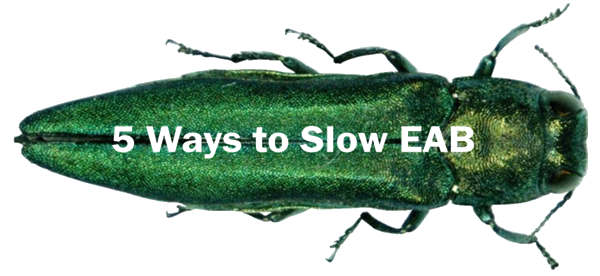
Here are five ways to help slow EAB:
Learn how to identify ash trees
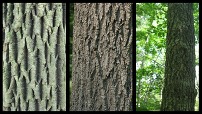
May is a great time to identify ash trees. While all the other hardwood trees are leafing out, Maine's ash trees still look like sticks in the sky. For white and green ash, look for opposite branching and small, ridged bark arranged in a diamond pattern. Brown ash bark (also known as black ash) is characteristically gray to dark gray, with a spongy, corky texture.
|
Learn how to identify signs of emerald ash borer
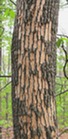
Now that you know what an ash tree looks like, look for signs of emerald ash borer in the trees. You may spot "blonding" on ash trees, the shallow flecking of the bark by woodpeckers going after EAB larvae and pupae. If you think you see "blonding," take some good quality photos, note your location, and report your findings on the EAB Report Form.
|
Create a girdled ash tree to monitor for emerald ash borer
Your tree can be part of the EAB monitoring network. Knowing the whereabouts of EAB helps the DACF and others make good management decisions about ash.
Leave your firewood at home and prevent the spread of invasive pests
Planning a camping trip? Learn about Maine’s firewood laws, and get your firewood at the campground or go to FirewoodScout.org to find other local sources.
For more information about emerald ash borer, identification resources, and reporting tools, visit the Maine Forest Service Emerald Ash Borer page.
Photos Courtesy
Cumberland County Soil and Water Conservation District
Kenneth R. Law (USDA)
Maine Forest Service
|