Browntail Moth Update #1: May 5, 2026
For the past five years, the Maine Forest Service has run a network of ten monitoring sites across Maine to document browntail moth (BTM) caterpillar emergence, growth, and disease outbreaks. Finding sites to monitor this year was difficult, as BTM populations have been steadily decreasing over the past couple of years.
Despite the decrease in BTM winter webs in much of the state, a total of four monitoring sites were established, one in each of the following towns: Bangor, Bridgton, Newport, and Turner. On April 29, BTM caterpillar emergence was documented at our Bangor and Newport sites. Caterpillars had not emerged when these same sites were visited on April 21. This is the latest date of recorded emergence since weekly developmental monitoring began five years ago.
The late emergence this year is likely due to weather patterns, where colder temperatures often signal to overwintering insects that there will likely be no new leaf buds available to feed on and that there is danger due to the risk of frosts. Now that BTM caterpillars have emerged and the weather is getting warmer, BTM caterpillars will begin feeding on the new leaf buds of their host trees.
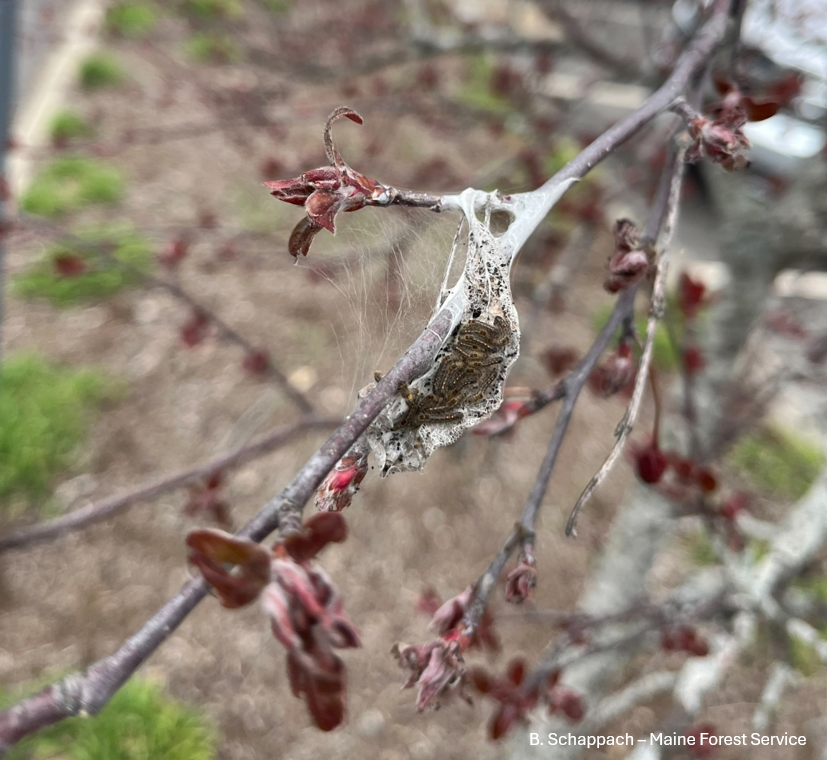
Image: Newly emerged browntail moth caterpillars rest on their winter web in Bangor. Note the presence of gauzy silk strands between the branch and twig, an important early pathway to additional food sources.
Although the caterpillars are currently small, they can be recognized by their hairy appearance with red-orange dots on their backs. Their hairs can break off and cause a rash on exposed skin - take care to inspect trees on your property or in your community to avoid the caterpillars.
In areas with a history of infestation or with an active infestation, please plan ahead to avoid exposure to hairs:
- Avoid areas with BTM caterpillars,
- Cover bare skin when working outside in areas that are currently infested or areas that have had infestations the last couple of years (wear long sleeves, hat, gloves, closed-toed shoes, etc.),
- Plan to do yardwork on wet days to reduce the hairs getting stirred up from mowing or raking leaves,
- Take cool showers and change clothes after outdoor activities.
- May is Lyme Disease Awareness Month; we'd be remiss if we didn't point out that this is good tick-bite prevention practice, too!
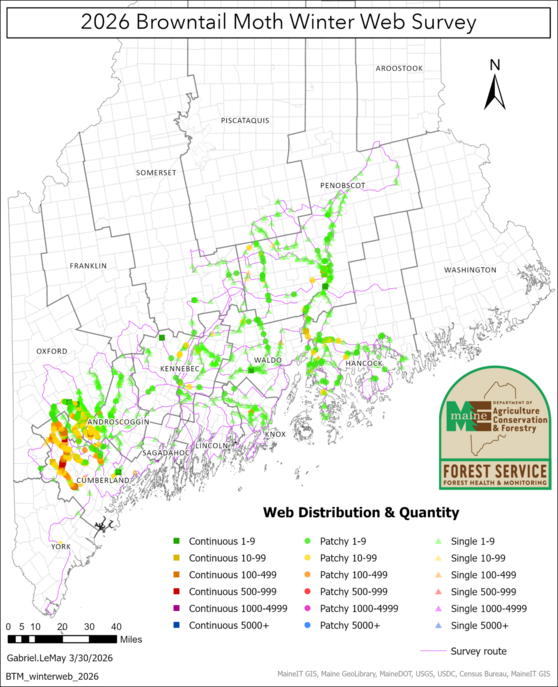
After a long winter of survey efforts, the annual BTM winter web survey wrapped up the week of March 16. The data from this survey is meant to serve as a general guideline for where BTM populations may be elevated throughout Maine and does not provide specific enough information to understand local impacts.
Last year's summer aerial survey results are on the BTM interactive dashboard map, and the winter web survey will be available on the dashboard soon.
|