April 2026
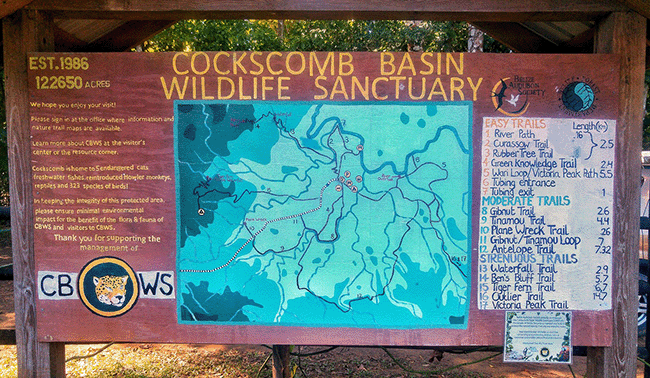
Cockscomb Basin Wildlife Refuge, Belize, hiking trail map.
Wherever I go, I’m drawn to parks, public lands, and other conserved areas – it’s in my DNA. I recently returned from a mud-season getaway to Belize, a country about one-third the size of Maine, with one-third its population, and a dizzying number of birds. (The Merlin app, which identifies birds by sound, is a game-changer for trips like this.) I visited reserves and sanctuaries on coastal islands and in the inland jungle, from reptile-rich mangrove swamps to remote towering waterfalls. Despite the vast differences between Maine and Belize, the protected areas I encountered had a few things in common with ours. They are priceless for their biodiversity, clean water, open space, and for society’s need to explore and absorb nature. People cherish them.
|
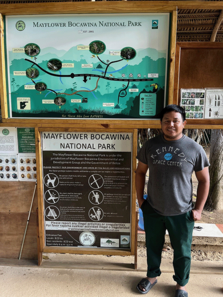
These areas also need our support for long-term sustainability, as the costs of staffing and managing them are ever-increasing and often overlooked. I spoke with Dolores, a ranger who described his daily challenges, and I could have been speaking with one of our park staff. On a positive note, Belize’s National Protected Areas System is a collaborative effort between the government, private donors, and international organizations, and a new agreement signed in 2025 forecasts a brighter future. Knowing that Mainers love our state parks and public lands, I’m hopeful for sunny skies in the years ahead here, too.
~ Andy Cutko, Director, Maine Bureau of Parks and Lands
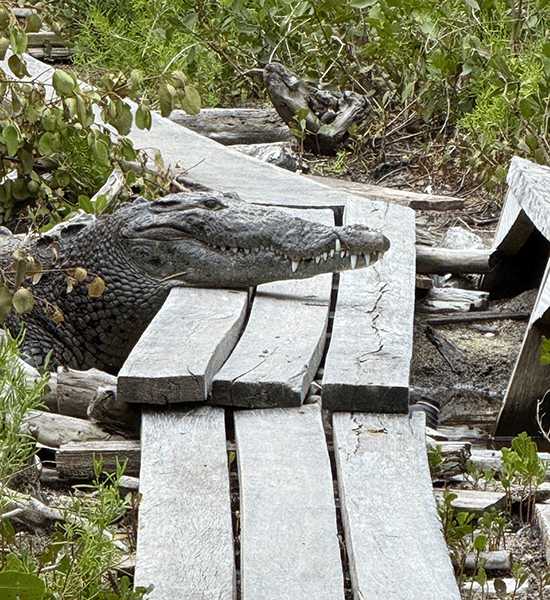
Photos: Kiosk at Cockscomb Basin Wildlife Sanctuary, Belize; Belizean trail hazard - a crocodile; Dolores, Park Ranger, Mayflower Bocawina National Park.
Top of page
|
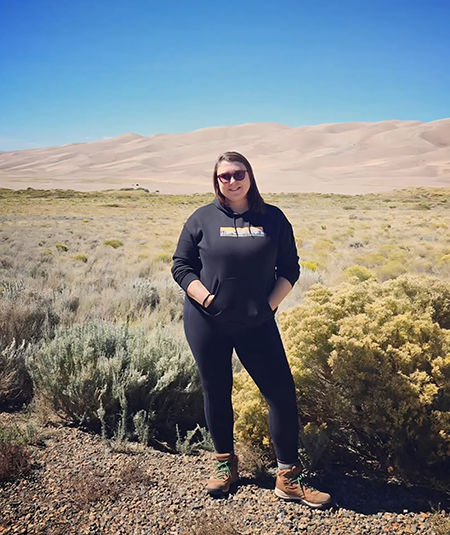
Welcome to Jessica Sayers, the Bureau's new Conservation Easement Monitor. I look forward to working with her as part of the Planning and Acquisition team. She brings many skills from previous work for the State and non-profits.
Jessica spent the last four years working within the Land Bureau at Maine's Department of Environmental Protection (DEP), both in licensing and shoreland zoning. Her roles at the DEP have given her a solid background in State regulations and land use, with a focus on connecting conservation practices with landowners, land trusts, and municipalities. Her work history also includes non-profit, and conservation work focused on water quality and lake health. Jessica went to school both in Maine and New Hampshire, studying environmental sustainability and conservation biology.
In her free time, Jessica enjoys sports, music, and Maine’s beautiful natural resources. You’ll often find her on the water or hiking with her husband and dog
~ Rex Turner, Director of Planning & Acquisition
Top of page
|
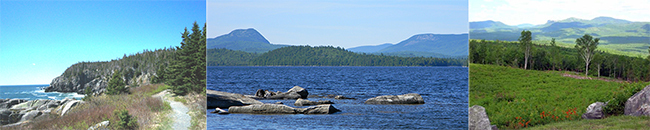 |
Work in a beautiful location while making a lasting impact. You'll be helping visitors enjoy and learn about the outdoors, and stewarding iconic locations so that they will retain robust ecosystems and be healthy places to recreate for future generations.
Employment opportunities are at Maine State Parks and Historic Sites and include Rangers, Lifeguards, and Customer Representative Assistants. View the listings and apply now at BPL's Careers and Seasonal Job webpage. Resources include brochures, videos, and a link to the applications and job descriptions.
Need Experience? Consider applying with the Maine Conservation Corps.
Top of page
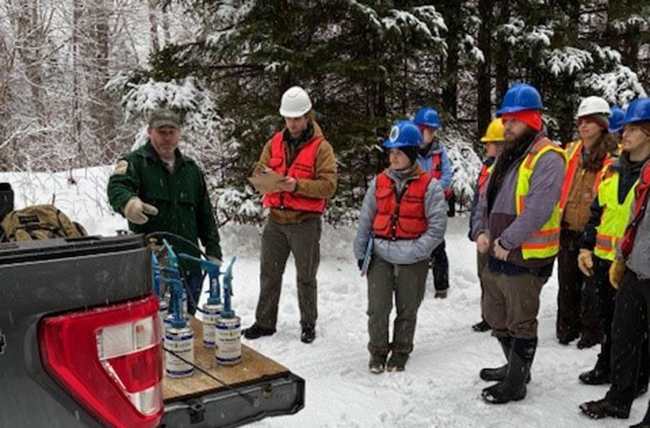
University of Maine students learning about timber marking.
On January 15, 2026, the Maine Bureau of Parks and Lands (BPL) hosted students from the University of Maine Forestry winter camp for an immersive, boots-on-the-ground look at modern forest management. The field tour provided a unique bridge between classroom theory and the rugged reality of Maine’s timber industry.
The day began at an active BPL logging operation, where the air was filled with the scent of fresh balsam and the mechanical hum of productivity. Students weren't just observing from afar; they had the opportunity to engage directly with equipment operators, gaining insights into the precision, safety, and technical skill required to navigate heavy machinery in frozen conditions.
Beyond the harvest, BPL foresters Clint Demusz and Chet Condon led in-depth discussions that highlighted the multifaceted nature of their work. The topics for the day spanned several topics:
- Silviculture: Understanding the growth of trees to ensure long-term forest health.
- Wildlife Habitat: Learning how active management can create diverse environments for wildlife.
- Operational Logistics: Managing the challenges of implementing a harvest.
The highlight of the tour was a hands-on timber marking activity. Under the guidance of seasoned BPL foresters, students stepped into the role of decision-makers. Armed with paint guns, they practiced selecting which trees to harvest and which to leave behind. BPL staff assisted in the complex thought process, explaining how each choice balances economic viability, forest regeneration, and ecological integrity. This direct mentorship allowed students to see that forestry is as much an art as it is a science.
~ Jacob Guimond, Northern Regional Public Lands Manager
Top of page
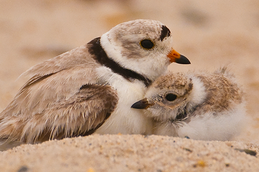
Each year beginning on April 1, all pets (including dogs, and horses), bikes, and kite flying are not allowed on the State Park Beaches in order to protect federally endangered nesting shorebirds. Pets, bikes and kite flying will be welcomed back onto the beach October 1, 2026.
Thank you for helping us protect shorebirds and the dune habitat they rely on.
(Photo of Piping Plover adult and chick by Amanda Reed, courtesy of Maine Audubon.)
~ The Plovers with the help of Jocelyn Hubbell, Interpretive Specialist
Top of page
|
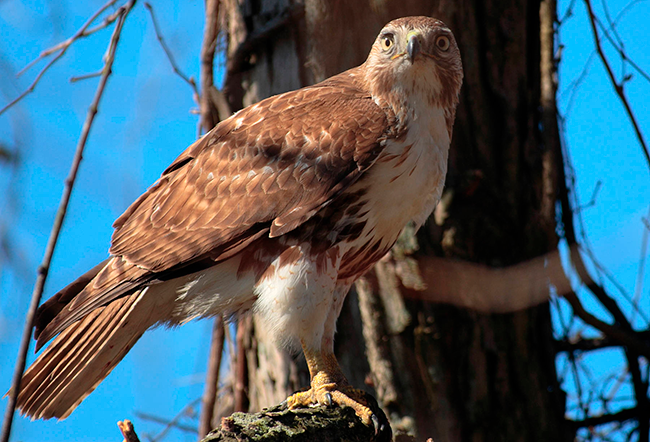
Red-tailed Hawk courtesy of Mark Bohn, USFWS.
Feathers Over Freeport, a birding festival for all ages, will be held on Saturday, May 30, 8:00 a.m. to 4:00 p.m. at Bradbury Mountain State Park, Pownal, and on Sunday, May 31, 10:00 a.m. to 2:00 p.m. at Wolfe's Neck Woods State Park.
The event includes birdwatching for all ages and activities for children.
More details coming soon at the Feathers Over Freeport webpage.
Top of page
|
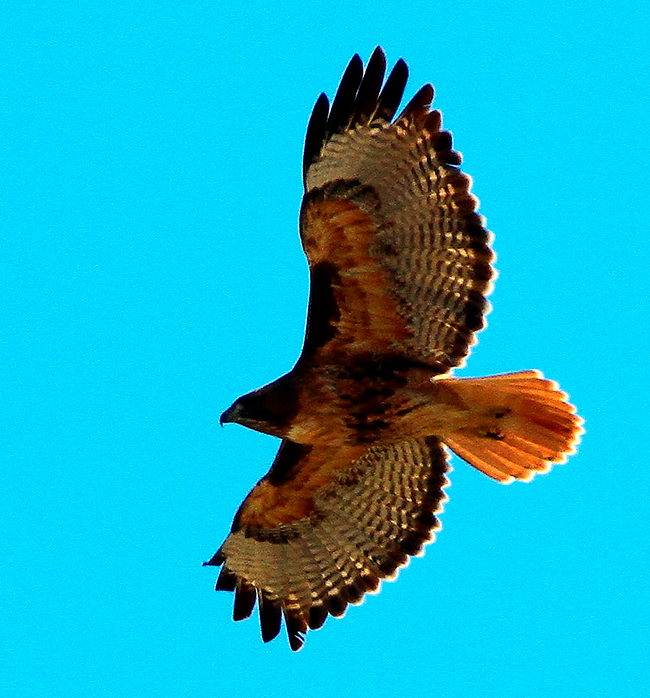 |
Watch the spring migration of hawks from the top of Bradbury Mt. beginning March 15, from 9 AM to 5 PM daily through May 15. Hawk Counters will share the joys of hawk watching as they make their observations and record species information. Hawk Counter Zane Baker is returning for his record 7th season! The Hawkwatch was initiated by Jeannette and Derek Lovitch in 2007 to quantify the extent and duration of the northbound raptor flight over Bradbury Mountain State Park. Daily counts of all raptor and vulture species are posted at the summit, submitted to the Hawk Migration Association of North America, and posted to the BIRDHAWK Listserv. For a quick but steep hike take the Summit Trail. For a 1-mile gentle ascent to the summit take the Northern Loop Trail. View trail map.
~ Chris Silsbee, Manager of Bradbury Mt. State Park
Top of page
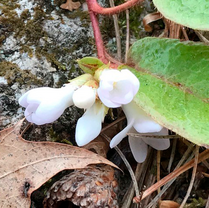
Pre-register to join in on an educational morning of plant inventorying at Camden Hills State Park. Kerry Hardy, a local plant enthusiast, will lead a hike with park staff to document and take GPS coordinates of the park's unique plant species. Included in the inventory will be Brown Ash and other ash species, Spruce, old-growth Hemlock, Maidenhair Fern, Yellow Violets, Mayflowers (also called Trailing Arbutus - see photo) and spring ephemerals.
Limited to 30 people and free to registered participants. Pre-register by emailing charlene.hood@maine.gov and please put "April 22 plant inventory RSVP" in the subject line.
Date: Wednesday, April 22, 2026
Time: 9:00 AM to Noon.
Location: Camden Hills State Park, 280 Belfast Road, Camden, ME 04843
Meet at the main parking lot at 9:00 AM.
Can't make April 22? A second inventory session is being planned for May 27 at 9:00 AM. Email Charlene with "May 27 plant inventory RSVP" in the subject line if you want to attend this session.
~ Charlene (Sunshine) Hood, Manager of Camden Hills State Park
Top of page
|
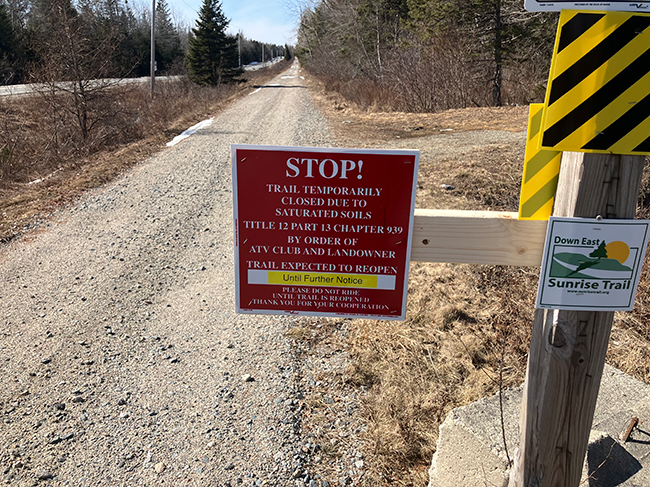 |
Riding on trails before they are open for the season can cause significant damage and can result in landowners permanently closing trails to all users. Do your part to maintain Maine's ATV trails and wait until they are open.
When will the trails open? Conditions around the state are varied and the decision to open trails is managed by the property owner and/or the club or organization who maintains the trail system. ATV trails in Maine typically do not open until May.
Please do your part and respect private landowners and ATV clubs by obeying all mud season closure postings.
Stay in the Know About Trail Conditions:
- Get condition reports from local ATV clubs and tread lightly.
- Sign up for ATV Trail Alerts - Text ATV to 888-514-7527.
Thank you!
~ Matthew Foster, Supervisor Off-Road Recreational Vehicle ATV Program
Top of page
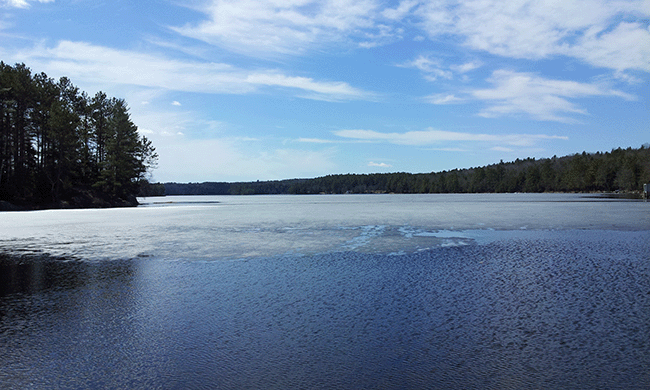
A lake with receding ice. Photo by Tim Thurston.
Did you know you can receive Maine Lakes Ice Out Reports? Text ICE-OUT to 888-514-7527 to get weekday updates through the ice out season. Or, sign up on the Maine Lakes Ice Out webpage to receive them by email. Or, view the Ice Out table online. Past years tables are available online through 2003.
~ Tim Thurston, Navigational Aids Supervisor, Boating Facilities Division
Top of page
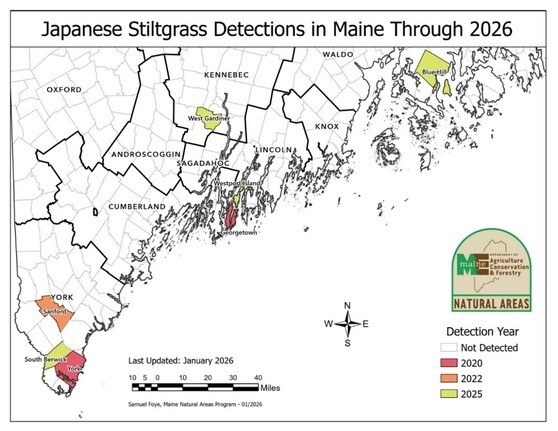
Distribution map of observed invasive stiltgrass locations.
Background
Japanese stiltgrass (Microstegium vimineum) is a severely invasive, annual grass originating from southern Asia. Originally introduced to Tennessee in 1919, stiltgrass has seen unbridled spread across the eastern United States over the past century. In Maine, stiltgrass is classified as an early detection and rapid response invasive species (EDRR). EDRR species are recent invaders, meaning they can still be feasibly eradicated from the state. A prolific seed producer, stiltgrass easily invades natural areas and outcompetes many of our native groundcover species. Stiltgrass is also highly allelopathic, meaning it releases organic compounds into the soil that degrade the health of the soil and inhibit the growth of other plant species. As the growing season ends, stiltgrass stems dry out, leaving a thick layer of dry thatch along the forest floor. This introduces a severe wildfire risk to any invaded areas. Due to the countless negative impacts that stiltgrass poses on Maine’s natural areas, identifying stiltgrass populations and managing its spread is among the highest priorities for invasive species management in the state.
Identification
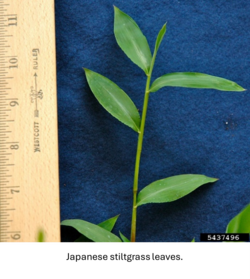
There are several characteristics that can be used to identify stiltgrass and distinguish this species from our native grasses in Maine. The most reliable identifying characteristic for stiltgrass can be found on its pale green, alternate leaves. On the upper surface of stiltgrass leaves is a recognizable silvery midrib (central vein running along the length of the leaf). This silver midrib is unique to stiltgrass and is not found on any of Maine’s native grasses. Additionally, the texture of stiltgrass leaves is extremely smooth or silky. Nearly all of Maine’s native grasses possess a sticky or grippy texture when passing the leaves between your fingers. (View the photo of the stiltgrass stem and leaves beside a ruler.)
Stiltgrass can also be distinguished from native grasses using its growth form. Mature plants produce aerial roots, or “stilt roots” (the namesake for this species), at lower nodes along the stem that help to prop up the plant. This trait is unique to stiltgrass. Additionally, stiltgrass tends to branch out close to the ground, producing several main stems that may appear to have a sprawling growth habit. This trait is extremely uncommon among Maine’s native grass species.
Stiltgrass in Maine
Since 2020, Maine Natural Areas Program (MNAP) staff have actively managed stiltgrass populations in 3 Maine towns: York/Cape Neddick, Sanford, and Georgetown. With consistent annual management, stiltgrass population densities at these sites have significantly declined. In 2025, MNAP increased statewide outreach, detailing the severity of unchecked populations of this invasive species. Mainers from across the state responded in droves, sending in reports of potential stiltgrass populations on their property. With the help of conservation organizations, landowners, and concerned citizens, MNAP confirmed 4 new populations of stiltgrass in South Berwick, Westport Island, West Gardiner, and Blue Hill.
Newly identified populations will all undergo initial management during the 2026 growing season, while control will continue on the older sites. However, the search for stiltgrass is not over. Identifying populations of stiltgrass before they are well established is the key to slowing the spread of this severely invasive species, protecting our natural areas, and ultimately eradicating this species from the state of Maine. If you think you have discovered a stiltgrass population, please email invasives.mnap@maine.gov with pictures of identifying characteristics and specific location details.
~ Courtesy Posting for the Maine Natural Areas Program
|
Send article suggestions or newsletter comments to Jocelyn Hubbell, Interpretive Specialist, webmaster, and newsletter editor for the Maine Bureau of Parks and Lands.
Read back issues of the newsletter.
|