 What Mainers are Asking About Jumping Worms,
and What We Can Tell Them
Following a recent two-day jumping worm workshop hosted by the Maine Department of Agriculture, Conservation and Forestry (DACF), it is clear that jumping worms are a top concern for Maine gardeners and land managers. This event brought together a knowledgeable lineup of leading researchers from across North America to share the latest science and management strategies.
While the first established populations in the state were discovered as recently as 2014, these invasive pests are now considered widespread and have been confirmed in 13 of Maine's 16 counties. With hundreds of questions submitted by workshop registrants, several key themes emerged regarding how to identify, manage, and prevent the spread of these invasive worms.
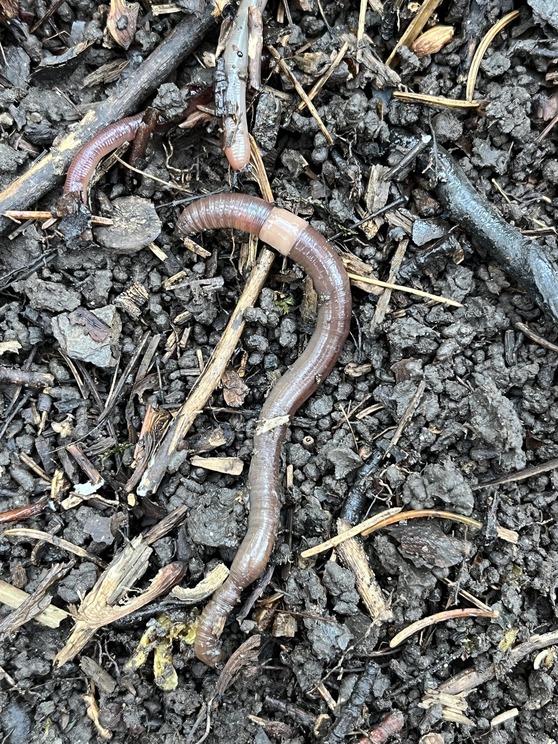 Jumping worm adult on soil. Notice the coffee-ground textured soil and the milky white clitellum (collar like structure). Photo by Maine Forest Service Entomologist Brittany Schappach.
Identification: "Is this a jumping worm?"
Many Mainers are concerned about distinguishing jumping worms from other species of earthworms.
-
Monitor with a Mustard Drench: To see if jumping worms are present at your location, mix 1/3 cup of ground mustard with a gallon of water and pour it directly on the soil (in a forested setting, brush away leaf litter first); this irritates the worms and brings them to the surface for identification.
-
The Timing: Because they are annuals (having a lifespan of only one year), juveniles appear in May and June and are very small and hard to identify. It is best to wait until late July or August to confirm their identity once they develop their distinctive collar.
-
The Look: Look for a milky white or gray collar (clitellum) that is smooth, flat, and completely encircles the body like a ring. In contrast, European earthworms have a raised, saddle-shaped clitellum that only goes partway around.
-
The Behavior: Jumping worms do not crawl like typical earthworms; they thrash vigorously and wriggle like snakes when touched.
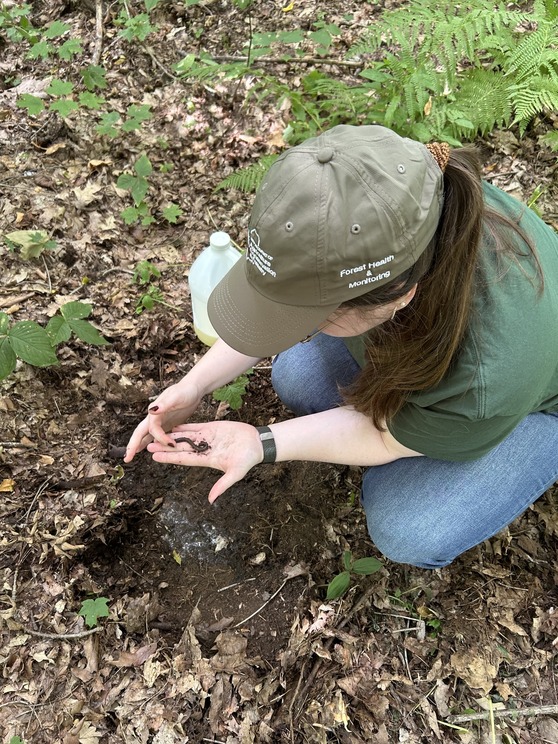 Maine Forest Service Entomologist Brittany Schappach inspects for jumping worms after using a mustard drench in a wooded lot.
Spread & Prevention: "How do I stop them?"
The most common way jumping worms move is through human activity, particularly the movement of soil, compost, mulch, and nursery plants.
-
The "Hidden" Threat: The worms themselves die each winter, but they leave behind tiny, soil-colored cocoons that are nearly impossible to see.
-
Arrive Clean, Leave Clean: Cocoons can hitchhike in the treads of hiking boots and tires. Using boot brushes at trailheads and cleaning tools before moving between garden beds is essential.
-
Plant Sales & Nursery Stock: When possible, choose bare-root plants and rinse the roots into a bucket to ensure no cocoons are hiding in the root ball.
-
Contain and Return: Always dump the wash water and mud back onto the original site where you collected the plants or soil; this ensures you aren't accidentally moving "hitchhiking" cocoons to a new, uninfested area. If you need to dispose of the material, wash your gear over a bucket to capture the sediment, let the soil settle before pouring off the water, and once the remaining mud dries, bag and solarize it (heating it to at least 104°F) before putting it in the trash.
Soil & Garden Impacts: "Will they ruin my vegetables?"
Registrants frequently asked if they could still grow food in infested soil.
-
Soil Texture: Jumping worms eat organic matter so quickly that they turn soil into a dry, loose consistency resembling coffee grounds or "nerds" candy.
-
Nutrient Issues: While their castings are nutrient-dense, the nutrients stay on the soil surface where many plant roots cannot reach them, and the loose soil is prone to erosion.
-
Soil & Garden Impacts: Many Mainers wonder if they can still grow food in infested soil, and while the answer is yes, it requires determining your goals and desired outcomes. Because jumping worms consume organic matter so quickly, gardeners often find they must amend their soil more frequently with compost or mulch to replace what the worms have eaten. However, adding this bulk organic material serves as a continuous food source that can sustain or even increase the jumping worm population in your garden. Ultimately, effective integrated pest management is about weighing the risks and benefits of each approach and making choices that align with what matters most to you in your garden.
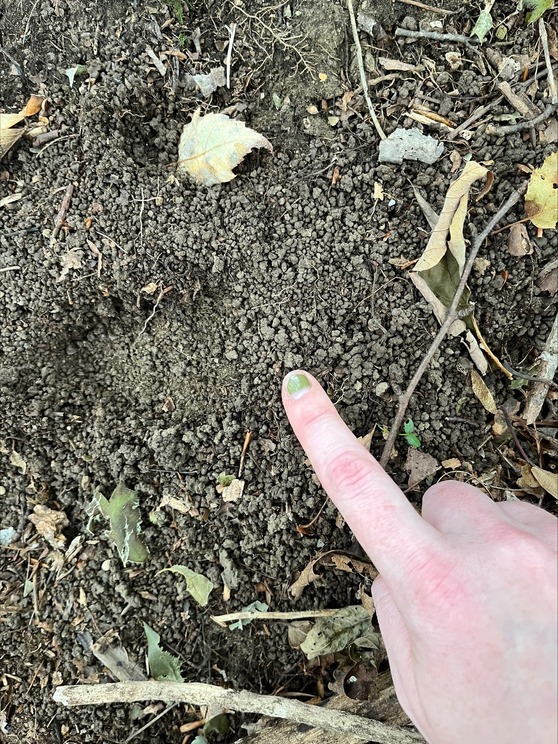 Soil affected by jumping worm feeding resembles coffee grounds. Photo by Maine Forest Service Entomologist Brittany Schappach.
Management: "How do I kill them?"
This remains the most difficult question. Currently, there are no pesticides legally registered for the control of jumping worms in the United States. While it is tempting to try "home remedies" or DIY concoctions, experts strongly advise against this.
-
The Label is the Law: It is a violation of federal law to use any pesticide in a manner inconsistent with its labeling. If a product does not specifically list "jumping worms" on its label, using it to kill them can have unintended consequences for your soil, your plants, and non-target organisms like pollinators. Would you use a medicine that is labeled to treat one disease for another, if it had never been shown to work on that disease and the risks and benefits had never been determined?
-
The "Natural" Misconception: Many gardeners ask about using "natural" products like tea seed meal or soap bark (saponins), which are often sold as fertilizers. However, any product used with the intent to control a pest is legally considered a pesticide. Even though these natural materials are being researched for their efficacy against jumping worms, they are not yet approved for this use, and using them as a vermicide (worm pesticide) remains off-label.
-
Why DIY is Risky: Concocting your own treatments can lead to phytotoxicity (harming your plants' roots or foliage) or damaging the delicate soil food web.
-
Why Chickens Can’t Solve a Jumping Worm Problem: While it is tempting to hope that birds will handle the infestation, the researchers suggested that chickens and other birds are not a reliable or necessarily safe solution for managing jumping worms. Jumping worms are bioaccumulators, meaning they consume and concentrate toxic trace metals (like lead or arsenic) from the soil. Metals like arsenic occur naturally in many Maine soils, and lead may be present from old paint or natural sources. Chickens that eat earthworms could pass those trace metals into their meat and eggs. Even if chickens find the adult worms delicious, they also do not target the small cocoons hidden in the soil. Because these cocoons are the primary way the population survives the winter and "seed banks" for future years, the chickens are only addressing a small fraction of the total population.
Things you can do right now:
-
Solarization: In Maine, this works best in the peak of summer when the sun is strongest. Spread a thin layer of infested soil, about 6–8 inches deep, onto a dark tarp and cover it with a clear drop cloth, sealing the edges to create a “package.” Place a simple soil thermometer in the center to track temperature. Research suggests reaching 104°F for at least two hours can kill the worms and egg-containing cocoons. If you don’t have a soil thermometer, plan to leave the covered soil in full sun for at least three days. On clear, hot summer days, a thin layer will often reach target temperatures within one to two days, but the extra time helps ensure consistent heating throughout the pile and improves your chances of success.
-
Hand Removal: For small populations, you can hand-pick worms and drop them into a bucket of soapy water to kill them.
Reporting: "What should I do if I find them?"
State officials are still tracking the spread of jumping worms across Maine. If you suspect you have them:
-
Check the Map: Visit the Maine DACF Jumping Worms in Maine webpage to see if your town has already been confirmed.
-
Report New Findings: If your area is not yet marked as positive, use the online report form and be sure to include clear photos of the worm's clitellum for confirmation. It is best to put the worm against a solid surface and take multiple photos of the entire worm for submission.
-
"What can the state do?": Currently, jumping worms are illegal to import into Maine, but they are not classified as a "regulated invasive species". This status means the Maine Department of Agriculture, Conservation, and Forestry (DACF) is limited by law to education and outreach rather than enforcement or eradication programs. Because the species often goes under-reported, the state actively seeks reports from the public to better map their presence, particularly if you suspect a specific business or non-profit organization is unintentionally spreading them. While you can reach out to the state horticulturist Gary Fish with these concerns, the DACF cannot guarantee regulatory action or penalties against organizations due to the current lack of a regulated status. Ultimately, your reports serve as vital "citizen science" that helps officials understand the true extent of the spread even when legal regulatory tools are not available.
|