Board of Pesticides Control Update
Stay up to date with the latest from the Board of Pesticides Control. This update covers everything you need to know about upcoming meetings, new rules, and important reminders to keep you and your community safe. We’re here to keep you informed, and we’d like to hear your thoughts—drop us an email anytime at pesticides@maine.gov.
The next Board Meeting is February 27, 2026 it will be hybrid at the Deering Building in Rm 101 in Augusta, ME 04330, and on Microsoft Teams. The meeting starts at 9:00 AM. For more information, visit the Board Meetings Page.
The following program has been approved for pesticide recertification credits. More recertification opportunities may be found on the BPC Credit Calendar.
February 3, 2026 – Turf & Outdoor Ornamental Pest Management
February 7, 2026 – UMaine Wild Blueberry Spring Conference
March 18, 2026 – Preseason Tree Fruit Meeting
The BPC maintains a list of registered products on the front page of its website. For a list of the current Maine registrations.
Online Training for Annual Use Summary Reports and Annual Sales Summary Reports
Annual Summary Use and Sales Reports are due for the 2025 season. These are typically due by January 31, 2026 for the 2025 season and **MUST** be submitted through the MEPERLS portal. This year, BPC is offering an additional live training on February 19, 2026 at 9:00 AM on Microsoft Teams for anyone that is still having issues with submitting reports. BPC staff will be available to answer questions, run through a live demonstration of the portal, and help with login access. Commercial applicators and dealers will be given additional time to submit their reports if they have trouble meeting the January 31st deadline. You can sign up for the training on February 19, 2026 at 9:00 AM and submit any questions you have ahead of time. This training will also be worth one recertification credit and recorded for those unable to attend.
SIGN UP FOR THE MEPERLS TRAINING
Please visit our website or use the guides below to submit your annual reports:
If you have issues logging into your account, please reach out to the BPC at pesticides@maine.gov or 207-287-2731. BPC is currently experiencing a high number of requests for login assistance, with only a limited number of staff available to help. Your patience is greatly appreciated as we work to process your request.
New rules requiring reports to be submitted electronically were implemented in 2024, see CMR01-026 Chapter 50: Record Keeping and Reporting Requirements.
License Renewals Update
BPC is currently experiencing a high volume of license applications and has a backlog of licenses to approve. If you want to know the status of your license or how many credits you have, you can check them through your portal. If you are having issues with the portal, please reach out so that we can help you access your account at pesticides@maine.gov or 207-287-2731.
This month’s Tox Talk explores the possible toxicological consequences when multiple pesticides interact with each other. From both a health and environmental perspective, this has relevance when assessing risk in rare cases when the concentrations of multiple pesticides exceed a safety threshold, such as the no-observed adverse effect level (NOAEL). [As discussed in previous “Tox Talks,” the EPA uses the NOAEL when setting a reference dose (RfD), which is health protective.] However, predicting the toxicity of multiple pesticides is challenging because toxicological experiments are almost always performed on an individual pesticide rather than a combination of pesticides.
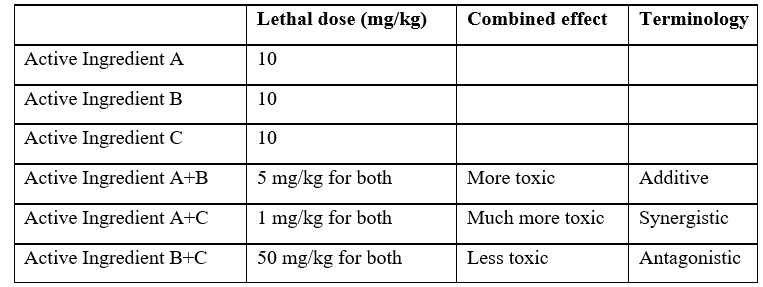
For example, the table below considers three different hypothetical active ingredients named A, B, and C. All three active ingredients have a lethal dose of 10 mg/kg when tested individually by the EPA. Imagine if A and B are added together. If the lethal dose of each active is 5 (sum of 10), this effect would be termed “additive.” This is a typical scenario if the active ingredients have the same mode of action (or same IRAC/HRAC code). If the toxicity of two interacting pesticides greatly exacerbates the toxicity by increasing lethal dose, this effect is synergistic. This occurs in the table below when active ingredients A and C interact to yield a lethal dose that is more toxic than the additive effect. Lastly, if the combination of active ingredients neutralizes each other, this effect would be described as antagonistic. In this scenario, the interaction of the active ingredients makes them less toxic and increases the lethal dose.
 Next month’s ToxTalk will build on the topic of toxicological interactions between pesticides, and discuss a timely example of potential exposure to multiple pesticides in cannabis products.
The enforcement team thought it would be a good time to remind everyone about the type of information that must be recorded for pesticide records, as outlined in CMR 01-026 Board of Pesticides Control Rules, Chapter 50. Below is a summary, please see the chapter for full details.
- Commercial agricultural producers and commercial applicators must maintain pesticide application records for a period of two years from the date of application, and must include:
- Site information
- Application information
- Rate information
- Weather conditions (for outdoor applications. See Ch. 50 for exceptions)
- TBT anti-foulant paint applications to marine vessels recordkeeping requirements, see Ch. 50
- Licensed pesticide dealers must maintain a variety of records, such as records of each sale of a restricted/limited use pesticide, including the customer's name and license number. See Ch. 50 for full details.
- Spray Incident Reports:
- Commercial agricultural producers, commercial applicators, spray contracting firms, and licensed pesticide dealers must contact BPC if there is a reportable spray incident.
- A reportable spray incident is any significant misapplication or accidental discharge of a pesticide. See Ch.50 for a full list of examples of reportable incident.
Maine CDC Poster Contest Announcement: Tick-Free Zone!
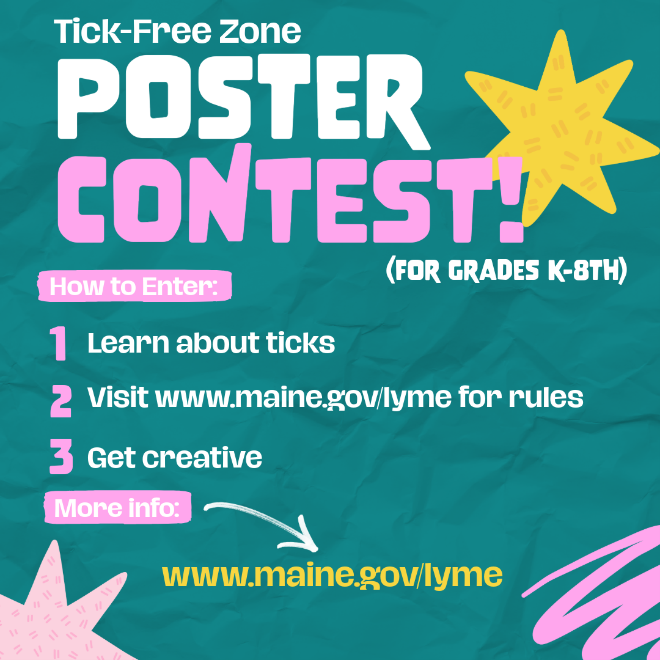
Calling all young Maine artists in kindergarten through 8th grade! We need your help to spread the word about how to prevent tick bites!
Maine CDC is excited to announce our Tick-Free Zone Poster Contest. We invite any kid in Maine, kindergarten through 8th grade, to create a poster to share ways to prevent tick bites at home, at school, and outdoors. These include:
- Use caution in tick-infested areas
- Use an EPA-approved repellent
- Wear protective clothing
- Perform daily tick checks by both sight and by touch
We encourage parents, teachers, and youth leaders to get involved by guiding students through this fun, educational activity that combines art, science, and wellness.
For contest rules, deadlines, and submission guidelines, visit www.maine.gov/lyme.
Released December 31, 2025
Today, U.S. Environmental Protection Agency (EPA) is releasing final guidance on how the agency will conduct endangered species assessments for new active ingredients, new use, and registration review actions for antimicrobial pesticides. This guidance fulfills requirements outlined in the Pesticide Registration Improvement Act of 2022 (PRIA 5) and puts additional processes and environmental protections in place to ensure pesticide exposures are not posing risks to federally listed species or their critical habitats. Although this document does not create new requirements for pesticide registrants, the recommendations in the guidance will guide companies as they fully consider and address potential effects of antimicrobial pesticides to listed species.
PRIA 5 mandates that EPA develop and issue guidance to registrants regarding analyses necessary to support the evaluation of potential adverse effects from new outdoor uses of pesticide products on listed species and their designated critical habitats. While PRIA 5 focuses on outdoor uses, this guidance addresses all antimicrobial pesticide uses—including indoor uses—with the potential for exposures to listed species and critical habitats (e.g., antimicrobial pesticides used to treat water in industrial settings that are released directly into surface water). EPA took public comment on the draft guidance, and considered the comments, which covered topics from the scope and applicability of the guidance to concerns about new data requirements and updated the guidance where appropriate.
The finalized guidance focuses on information applicants may consider to inform label changes that reduce or eliminate the potential for effects to listed species and their critical habitats and identifies opportunities within the existing regulatory processes where applicants can discuss with EPA potential for effects and ways to reduce or eliminate potential exposure. EPA’s review of effects to endangered species is part of a robust human health and environmental assessment the agency does for every registered pesticide.
The guidance is available in docket EPA-HQ-OPP-2023-0281 at www.regulations.gov.
|