|
In this issue:
As 2025 ends here’s a look back at some of the things that kept the Horticulture Program busy this year and a look forward to what we anticipate working on in 2026.
Thrips parvispinus
In April we were notified that a handful of Maine businesses had received plant material from an out-of-state supplier that were potentially infested with Thrips parvispinus. Subsequent follow-up inspections confirmed populations of these thrips in at least a couple of greenhouses. Affected growers chose to either discard the affected plants or treated the plants with insecticide. While discouraging, these introductions were not entirely unexpected. Greenhouses in the southern US have been dealing with T. parvispinus for several years and it has been repeatedly shipped on plant material to other states. Fortunately, T. parvispinus is tropical and is not expected to survive year-round in Maine. However, it could survive in greenhouses, especially those with plants year-round and repeated introductions during the growing season could still cause significant plant damage. All thrips can be difficult to control, and T. parvispinus is no exception. The insects are tiny and like to hide in protected parts of the plants like buds, under leaves, leaf axils and flowers. Tapping plants on a white sheet of paper can help with detection and use of a good hand lens or other magnification is also helpful. Plant symptoms to look for include silvery scars on leaves, distorted or deformed leaves and flowers, and scarring on fruits.
Factsheet from PennState Extension
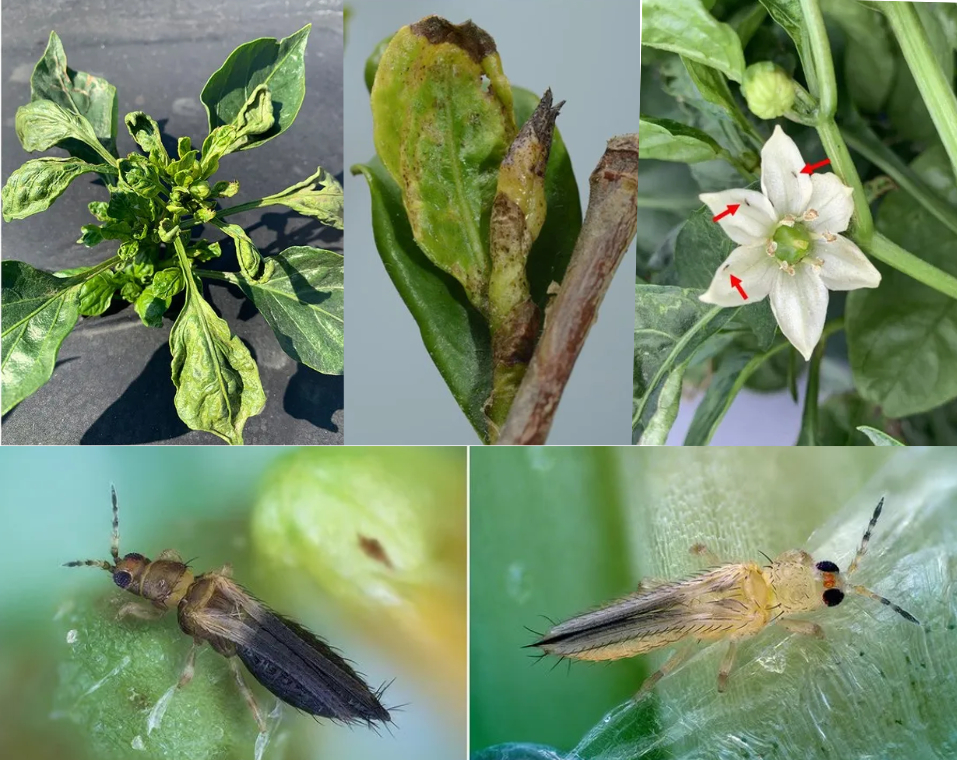 Top L to R: Damage on Pepper. Damage on gardenia. Adults on a pepper flower. Photo Credits: Ana Meszaros, UF-IFAS. Bottom: Close up of adult female left and male, right. Photo Credit: www.thrips-id.com
Post Rosa rugosa signs
The invasive plant rule (Ch 277) requires signs be posted with Rosa rugosa plants offered for sale that indicate the plants may be invasive in some habitats. Inspectors continue to encounter Rosa rugosa without the proper signage. After two growing seasons of outreach and working with growers to obtain compliance, unfortunately, it is time to take a firmer stance. In 2026 inspectors will be issuing formal notices for non-compliance that will include a follow-up to ensure that signs are posted. Repeat offenders may face fines. The good news is that complying with signage requirements is easy (and free).
Request rugosa rose signs and other outreach materials
Also, please check your inventory before the sales season starts to ensure that you are not selling any varieties, cultivars or hybrids of the species on the Do Not Sell List.
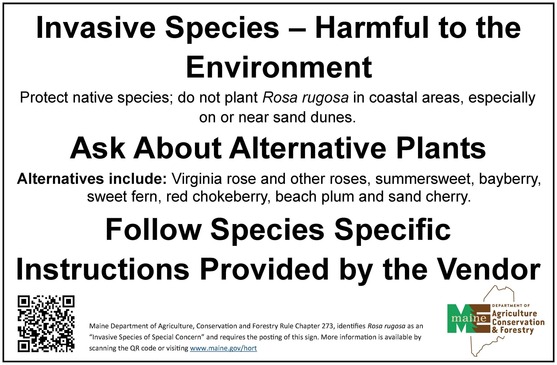 An example Rosa rugosa sign. These signs are available for free and must be posted near Rosa rugosa plants that are for sale.
Box Tree Moth Continues Territory Expansion
Box tree moth continued to spread and was found this year in St. Andrew’s, New Brunswick, just over the Canadian border from Washington County. Box tree moth caterpillars quickly defoliate boxwood leading to rapid decline and death of the plants. Box tree moth can easily move undetected in nursery stock and early detection is difficult as the eggs are small, caterpillars and overwintering structures easily blend in with foliage and adult moths are most active at night. We have not yet found box tree moth in Maine and we encourage all nurseries to become familiar with this pest and report any suspected box tree moth damage by sending a picture to horticulture@maine.gov.
More information from USDA
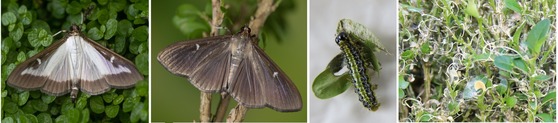 Photo 1 (Ian Redding): Box tree moth adult – light morph; Photo 2 (Juergen Kottmann): adult – dark morph; Photo 3 (Mujezinovic Osman, Faculty of Forestry, bugwood.org): mature caterpillar and your caterpillar feeding damage (“peeling”); Photo 4 (Ferenc Lakatos, University of Sopron, bugwood.org): heavy defoliation showing midribs of leaves left behind.
Spotted Lanternfly
To the best of our knowledge, there are no established populations of SLF in Maine yet. This summer, we received a series of pictures of adult spotted lanternflies in towns along I-95 from Gray to Lewiston. No active infestations were found during follow-up surveys. We believe these reports are the result of insects riding along on vehicles arriving from infested areas in other states. Outside of Maine, SLF has continued to expand its range and can now be found from Virginia to Massachusetts, west to Ohio and sporadically throughout the Midwest and southern states. Given this pest’s abundance to our south and status as a master hitchhiker, there are likely multiple introductions of SLF in Maine every year. Under the right circumstances any introduction could lead to an established population. Help slow the spread of SLF by looking for and reporting any suspicious insects. SLF overwinters as egg masses that can be laid on any item and closely resemble clumps of mud. Check any incoming plants, outdoor goods and vehicles carefully. Report SLF by sending a picture to the horticulture@maine.gov. Please be sure to include the date and location where the photo was taken.
More information about SLF
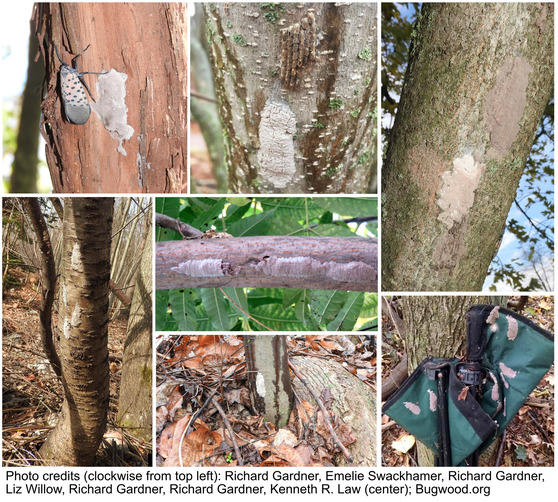 Spotted lanternfly egg masses
Look for Invasive Stiltgrass
Stiltgrass, an invasive annual weed, is not widespread in Maine, but new infestations are found every year. Stiltgrass moves easily to new locations on boots, tires, mowing equipment and in the rootballs of nursery stock. Stiltgrass crowds out native plants in the forest understory, reducing species diversity and produces a thick thatch layer that increases fire risk. Look for a grass with alternate leaves that are 2 to 4 inches long and ½ inch wide with a stripe of silvery reflective hairs along the midrib. Unlike many native look-a-likes, stiltgrass leaf edges feel smooth to the touch. Report suspect infested nursery stock by emailing a picture and location information to horticulture@maine.gov.
More information about stiltgrass
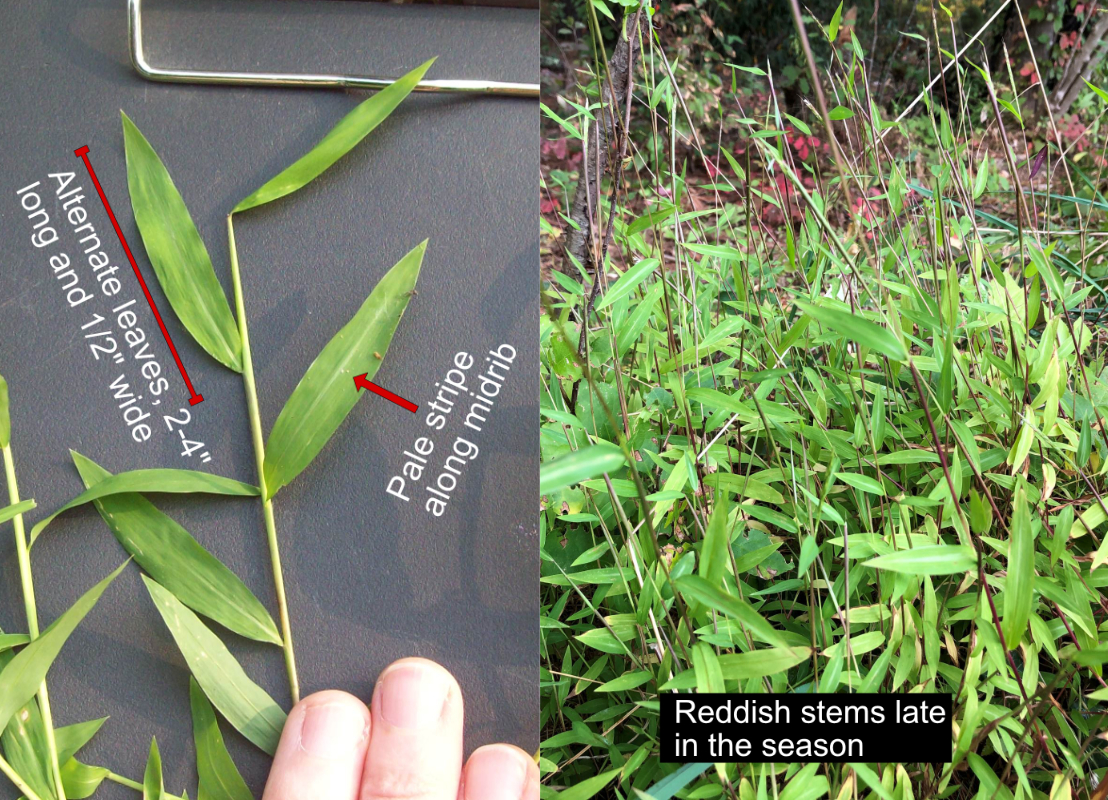 Invasive stiltgrass
-
January 13 - 15, 2026: Maine Agricultural Trades Show, hosted by the Maine Department of Agriculture, Conservation and Forestry (DACF) at the Augusta Civic Center
-
January 21, 2026: Grow Maine Green Expo, hosted by the Maine Landscape and Nursery Association (MELNA) at the Augusta Civic Center
-
January 22, 2026 to March 5, 2026, Thursdays 6:00 - 7:30 pm: Greenhouse Scout School hosted by Cornell University, University of Vermont and University of Maine.
On Demand/Previously Recorded:
|