MELeaf: A Newsletter From the Horticulture Program, August 2025
In this issue:
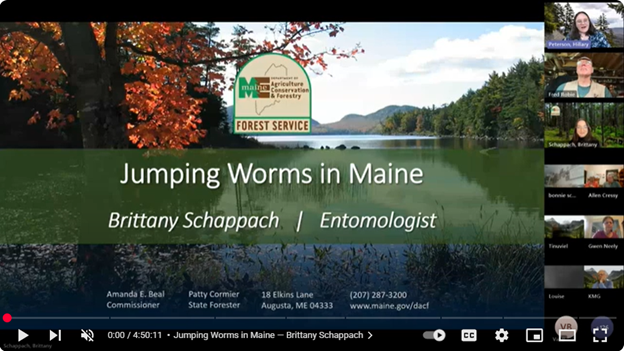
Jumping worms are an emerging threat to forests, gardens, and soil health across the U.S., and our understanding of them is evolving fast. In June the Maine Department of Agriculture, Conservation and Forestry hosted a two-day virtual event that brought together researchers, land managers, and outreach professionals from across North America to share the latest science, management approaches, and outreach strategies. The event was recorded and is now available online.
Each talk is followed by a Q&A session with the presenter. This event was open to all levels of experience, from concerned homeowners to seasoned scientists. Speakers and topics covered are:
-
Jumping Worms in Maine, Brittany Schappach, Maine Forest Service
-
Heat, Organisms & Chemicals, Dr. Josef Gorres, University of Vermont
-
Plant Sales & Pesticide Trials, Erin Buccholz, University of Minnesota
-
Citizen Science and Emotions, Angela Gupta, University of Minnesota Extension
-
Jumping Worms & Soil Nutrients, Dr. Justin Richardson, University of Virginia
-
Impacts on a Small Scale, Dr. Erin Cameron, Saint Mary’s University
-
Spread & Prevention in Forests, Tricia Bethke, Morton Arboretum/USDA-APHIS
-
Control: Where We’re Going, Dr. Vera Krischik, University of Minnesota
The legislative session that wrapped up earlier this summer included two bills concerning pesticide use that could potentially affect nursery growers.
Several Maine towns have passed local ordinances that govern the use of certain pesticides within the town, other Maine towns and cities may be considering implementing one. Now is a good time to review any local ordinances that could affect how you or your customers use pesticides. Contact your local officials or code enforcement office to get the most recent information.
The 2025 Greenhouse Best Management Practices workshop will be held October 2 at Estabrook’s new facility in Pownal, ME from 9:00 AM to 4:15 PM. This state-of-the-art greenhouse will provide an inspiring backdrop for a full day of training covering weed management, common greenhouse arthropod pests and biocontrol, pesticide product selection and updates on regulations, and a panel discussion on updating and building greenhouse facilities. Attendees will hear from experienced growers and specialists, with plenty of time for questions and discussion.
Approved for 4 pesticide recertification credits, the program is designed to give greenhouse and nursery professionals practical tools to improve operations and stay current with best practices. The $25 registration fee includes morning coffee and refreshments; please bring your own lunch. Pre-register to be the first to hear when online registration opens!
Basil Downy Mildew
Basil production is still threatened by downy mildew because current methods of prevention and resistance are wavering. It appears that the pathogen is evolving rapidly, and we need your help to understand this phenomenon. Researchers at Rutgers (who are part of an international team addressing this) are asking anyone who observes basil downy mildew on their plants in the USA and Canada to send infected leaf samples and to report occurrence to the Ag Pest Monitor: Basil. These samples will be used to better understand the existing pathogen populations and help drive solutions towards the downy mildew problem.
Shipping Instructions: Please collect as many infected leaves showing sporulation (or classic yellow leaf banding of this disease) as possible and wrap in a dry paper towel before placing inside a quart-sized ziplock bag. Seal the bag partially (leaving about a quarter open) before placing in an envelope. Include a piece of paper with sample source address, basil variety, if known, and contact information (email, phone number) in case there are questions about the sample.
Mail Samples to :(regular mail is fine as just the pathogen’s DNA is needed; not the live pathogen):
B.A.S.I.L.
Foran Hall, Rm 392
59 Dudley Rd
Rutgers University
New Brunswick, NJ 08901
Please address any questions or concerns you may have to Rob Mattera (robert.mattera@rutgers.edu)
Native Plant Propagation and Production Survey
The Ohio State University researchers are seeking voluntary input from individuals or businesses that propagate and grow native plants. This 5-minute industry survey aims to identify research and extension priorities focused on native plant propagation and production.
Except for your time, there are no risks or conflicts of interest associated with participation in this study and participation is voluntary. All responses will remain confidential. Your anonymous input for the survey will help identify research and Extension priorities in the United States.
If you or your business are currently growing or are interested in propagating and growing native plants, please fill out this short survey.
The survey will close on Sept. 26, 2025, so please provide your input today!
Questions or additional feedback contact Dr. W. Garrett Owen at owen.367@osu.edu.
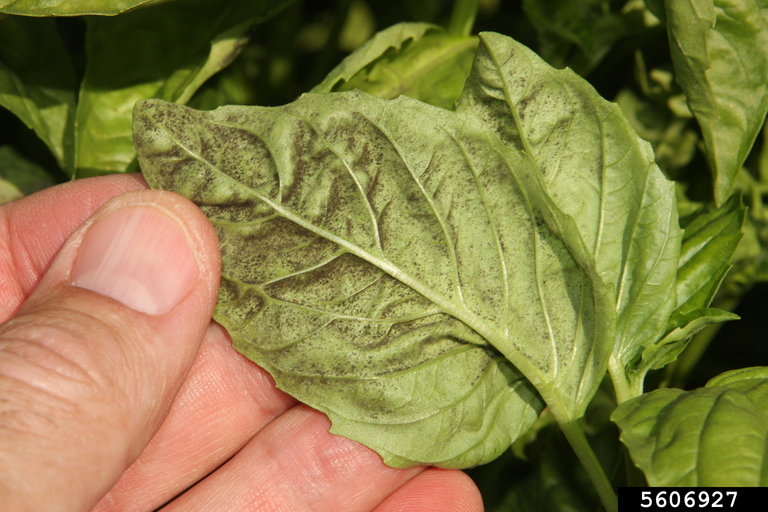 The underside of a basil leaf infected with downy mildew. Photo credit: Gerard Holmes, Strawberry Center, Cal Poly San Luis Obispo, www.bugwood.org
General Observations: Overall insect pest pressure seems to be low in nurseries this summer, although we are occasionally seeing some plant damage from common pests like Japanese beetle, and recently the hot dry weather has been good for the rapid increase in two-spotted spider mite populations. The weather is dry now, but the wet spring is still evident on some plants and we’ve observed leaf spots on maple and birch and obvious cedar apple rust galls on the foliage of apple and crabapple.
Papaver Downy Mildew: This spring, papaver downy mildew (Peronospora arborescens) was found on poppy plants at a Maine nursery. While this disease is known to occur worldwide, its distribution in the US is unknown, and this was the first time it had been observed by inspectors in the state. Downy mildews prefer periods of prolonged wetness which were abundant in the early growing season this year. During these conditions, rain, wind and handling of infected plants can easily spread spores to nearby poppy plants, but this disease is also seed-borne. Scout for symptoms of yellowing upper leaf surfaces with black or red angular necrotic spots, and corresponding fuzzy white to purple fungal growth on the underside of leaves. Management of poppy downy mildew includes cultural practices that reduce humidity and wetness on leaves, good sanitation practices, and the use of appropriate fungicides.
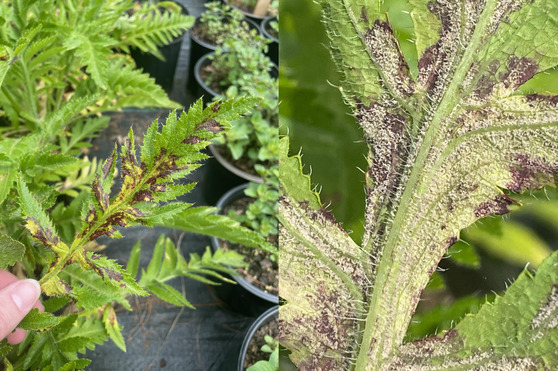 Left: angualr leaf spots of poppy downy mildew as seen on the upper surface of a poppy leaf. Right: Spores of poppy down mildew on the underside of an infected leaf.
Spotted Lanternfly (SLF): To the best of our knowledge, there are still no established populations of SLF yet in Maine. SLF has continued to expand its range and can now be found in states from Virginia to Massachusetts and west to Ohio with populations found sporadically throughout the Midwest and southern states. Given this pest’s abundance to our south and status as a master hitchhiker, there are likely multiple introductions of SLF in Maine every year. Under the right circumstances any introduction could lead to an established population. Help slow the spread of SLF by looking for and reporting any suspicious insects. Adult SLF are present now and will soon be laying eggs. Check any incoming plants, outdoor goods and vehicles carefully. Egg masses can be laid on any item stored outdoors and may be difficult to spot as they closely resemble clumps of mud. Report SLF by sending a picture to the Horticulture Program. Please be sure to include the date and location where the photo was taken. More information about SLF
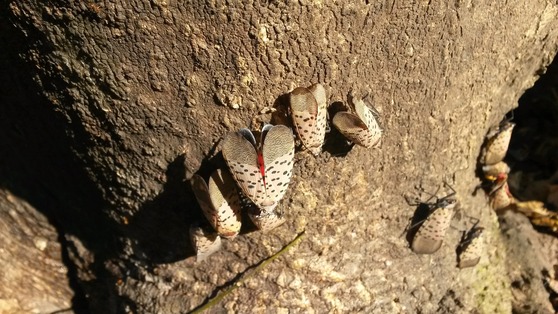 Spotted lanternfly adults on a tree trunk.
Box Tree Moth: Box tree moth is another pest that continues to expand its infested territory with recent detections in Maryland, North Carolina Virginia, and West Virginia. Previously reported infested areas include Delaware, Massachusetts, Michigan, New York, Pennsylvania and Ohio as well as parts of Canada including New Brunswick and Quebec. Box tree moth has not yet been found in Maine. The good news is that box tree moth only feeds on boxwood (Buxus spp.) plants, the bad news is that it can quickly defoliate the plants leading to rapid decline and death of the plants. Early detection of box tree moth is difficult as the eggs are small, caterpillars and overwintering structures easily blend in with foliage and adult moths are most active at night. Box tree moth can easily move undetected in nursery stock. If boxwood plants are important to your business, scout your crop by carefully looking for caterpillars, webbing and defoliation where the leaf midrib is left behind. Box tree moth may have several overlapping generations between May and October; any life stage may be present on plants during the summer. Report suspect box tree moth by sending a picture to the Horticulture Program. Please be sure to include the date and location where the photo was taken.
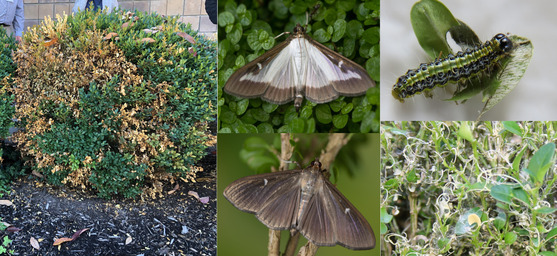 Left and bottom right: box tree moth damage on boxwood. Center: Box tree moth adults can be two different colors. Top right: a box tree moth caterpillar.
Invasive Plants: We’ve encountered several businesses this summer that were selling Rosa rugosa without displaying the proper signage. If you sell rugosa rose, please remember that all R. rugosa plants (regardless of variety) for sale in Maine must have a sign or label indicating the plants can be invasive in some habitats. The Horticulture Program has a supply of free signs printed on weather resistant paper that are available to order using the outreach materials request form. If you prefer to create your own signs, or would rather tag individual plants, you can find the specifications for signs and labels on the invasive plant webpage.
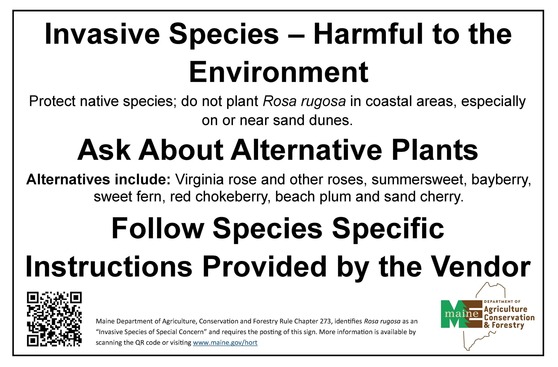 An example of a sign that must be posted with rugosa roses that are for sale. Copies of these free signs can be requested by emailing horticulture@maine.gov.
- Complete the IR-4 Grower and Extension Needs Survey to help direct future pest management research to benefit ornamental growers
- Greenhouse Training Online from the University of Florida
- August 20, 2025 from 4:30 pm to 6:30 pm, in-person in Fort Kent, ME: Spruce Budworm Woodland Tour with the Maine Forest Service and Maine Woodland Owners
- August 20, 2025 from 6:00 pm to 7:00 pm, online: Where the Field Meets the Forest: Tick Safety On and Off the Farm from University of Vermont
- August 26, 2025 from 6:30 pm to 8:00 pm, online: Ultra Low Volume Sprayers: Are Foggers Right for You from University of New Hampshire Extension
- August 28 - 29, 2025, in-person in Portland, ME, online option for August 28 only: Rodent Academy
- September 5, 2025, from 12:00 to 12:30, online: Top 5 Rodent Exclusion Tips and Feeding Friendly Insects from Cornell Extension
September 23, 2025 at 1:00 pm, online: Botrytis Update: Exploring Biorational Products and Tank Mixing from American Floral Endowment's Grow Pro Webinar Series
- September 18, 2025 from 8:00 am to 3:30 pm, in-person in New Haven, CT: Biological Control Conference for Ornamental Growers hosted by UConn Extension
- September 30, 2025 from 6:30 pm to 8:00 pm, online: How to Choose Pesticides and Build Effective Spray Regimens from University of New Hampshire Extension
- November 12 - 13, 2025, in-person in Manchester, NH: Northeast Greenhouse Conference
|