|
In late summer, there are many insects defoliating leaves of their host trees. Fortunately, there are clues we can look for to help us differentiate the insects causing minor damage in our trees. Here’s another look at how to tell the difference between late-summer webs of the harmless fall webworm and the notorious browntail moth.
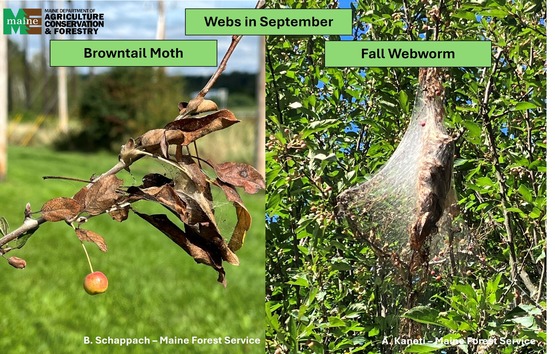
Browntail moth caterpillars skeletonize leaves and begin creating a web using silk on the leaf remains. A strong silk holdfast will tie the webbed leaves to the twig, Bangor, ME (left). Fall webworm caterpillars chew on leaves and continue expanding their web with silk, Old Town, ME (right). Note the size difference between the two webs.
In early September, browntail moth caterpillars will continue skeletonizing leaves, causing the leaves to die and turn bronze. The silk on browntail webs is very minimal at this time, with fine, gauzy silk covering some leaves and thicker, thread-like trails along the twigs and connecting leaves to twigs.
As we approach autumn, browntail caterpillars will continue covering skeletonized leaves with ever-thicker white silk, building their winter hibernacula. When the weather gets colder, the caterpillars will become dormant and remain inside their webs throughout the winter. These webs are easiest to spot in the winter once the rest of the leaves fall because they will look like leaves left on the trees. Silk wrappings shining in the sun will give away their true nature.
Fall webworm webs are much larger than browntail webs in early September, with more obvious silk webbing that spans a few branches and multiple leaves. Dead leaves can be seen inside of fall webworm webs. Once the fall webworm caterpillars mature, they will leave their webs and make their way into the soil beneath their host trees where they will pupate. Since they overwinter in the soil and not their web, they do not use their web anymore and the web will break down naturally.
|