Browntail Moth Update #8: June 7, 2024
At all of our monitoring sites, browntail caterpillars continue to grow up to 1.5 inches in length. If you are seeing less crawling browntail caterpillars, please remember that even if the caterpillars have left an area, that area will still have toxic hairs present. Please take caution while performing outdoor yardwork near trees that have browntail to avoid contracting a rash from the toxic hairs - wear long sleeves, eye protection, closed-toed shoes, and gloves.
Browntail caterpillars have another week or so of feeding and growing before they begin to form pupal packets, where they tie a few leaves together and hide inside to begin pupating. During their time in the pupal packet, the caterpillars are inactive as their bodies transform into flying adult browntail moths.
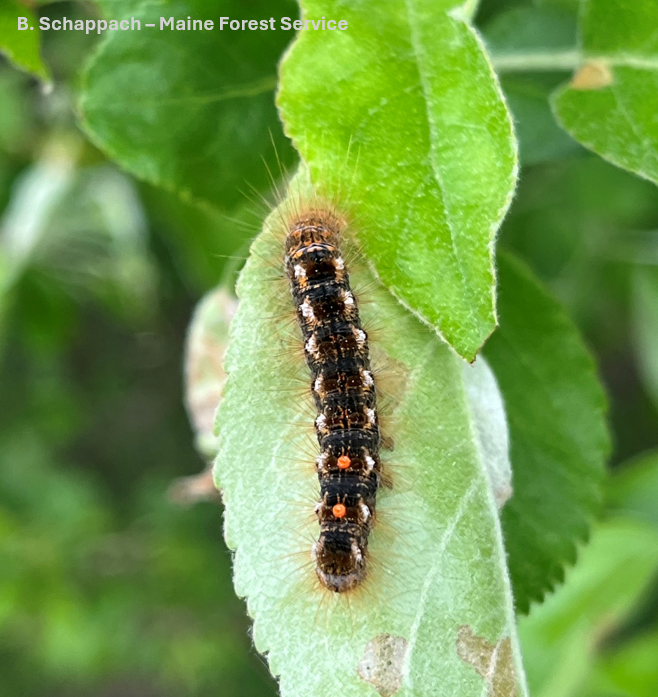
A browntail caterpillar that is nearly full sized at 1.5 inches in length. Lincoln, ME
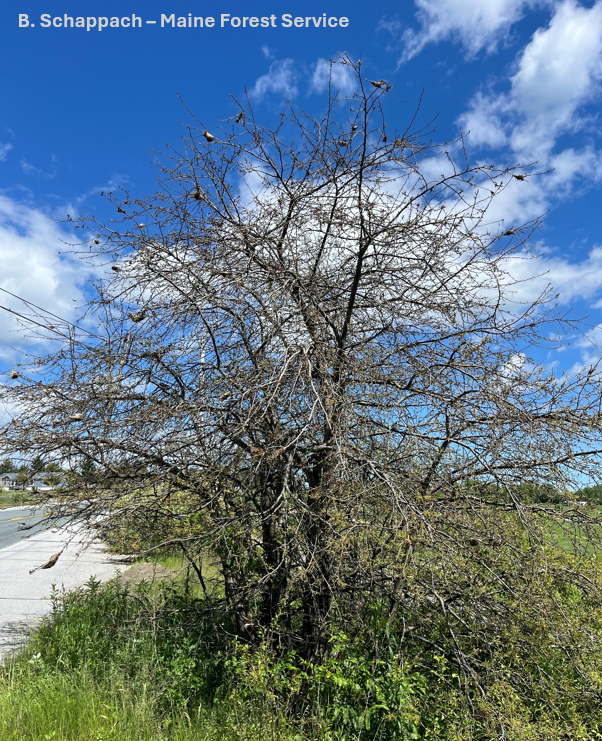
In higher infested areas, complete defoliation of their host trees may be seen. Although defoliation is a stressful event for trees, a healthy tree will be able to use its stored resources to regrow new leaves for the summer. When the leaves are regrown, they are unlikely to be defoliated by browntail caterpillars again because the caterpillars will be adult moths at that time. In some areas with complete defoliation from browntail caterpillars, the trees have already begun to regrow their leaves.
Completely defoliated crab apple tree from browntail caterpillars. Note the visibility of the old winter webs on the tips of the branches, indicating this defoliation is from browntail caterpillars and not an outbreak of forest tent caterpillars. Hancock, ME.
Is it too late to treat my trees infested with browntail caterpillars?
Pesticide applications are most effective for browntail caterpillars when the pesticide product can take effect before late May. Treatments after May are not recommended and are not part of an effective integrated approach to management of browntail moth (or IPM strategy). This is because at this time, the caterpillars are quite large in size, there are already many toxic hairs in the environment, and the trees all have already been defoliated. It is best to wait to do pesticide applications for browntail next year, when the pesticides will be most effective at reducing browntail populations.
To have more effective control of browntail, plan to target the next generation of caterpillars by scouting out new winter webs this winter to determine which trees you may want to treat next spring. Then, remove winter webs in the winter and destroy the webs by placing them into a container with soapy water for a few days, or placing them into a contained fire. If web removal isn't possible, consider having your trees with browntail caterpillars treated by a licensed pesticide applicator during mid-April to early May to reduce browntail caterpillars.
Thank you for sending diseased browntail reports!
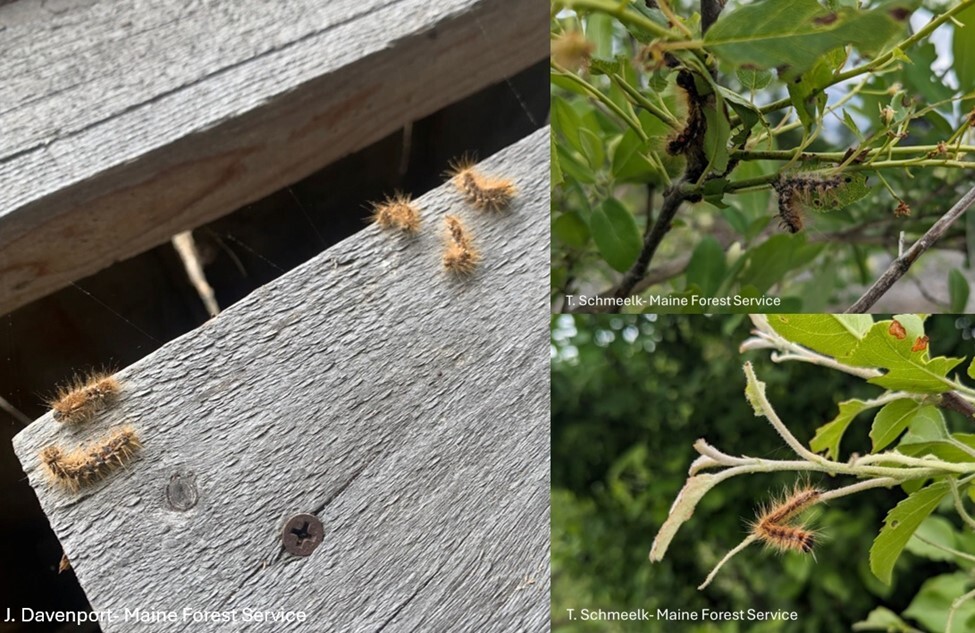
We continue to see fungal and viral mortality at some of our monitoring sites and other areas including Bradley, Brunswick, Old Town, Richmond, and Turner. Through public reports, we have also been able to confirm diseased caterpillars in Belgrade, Durham, Freeport, Leeds, Swanville and Waterville. Although we are seeing some diseased caterpillars, it should not be assumed this will lead to a widespread die-off of browntail caterpillars. More typically, the fungus or virus may be able to spread in localized areas, like the population on a tree or a cluster of trees.
Some signs of pathogens may be:
- White or yellow fungal spores on caterpillars (Fungus)
- Caterpillars hanging onto branches with just their rear prolegs (leg-like extensions of the exoskeleton) (Fungus)
- Liquid expulsion of the caterpillar guts (often the caterpillar rests in an upside-down "V" shape) (Virus)
- Swollen, puffy caterpillars (Virus or Fungus)
- Dead caterpillars (Virus or Fungus)
We welcome any reports from the public of diseased caterpillars. Please include a photo or two in your report so we may confirm pathogen presence.
Fungal-killed caterpillars observed in Turner, Brunswick and Bradley.
Natural enemies
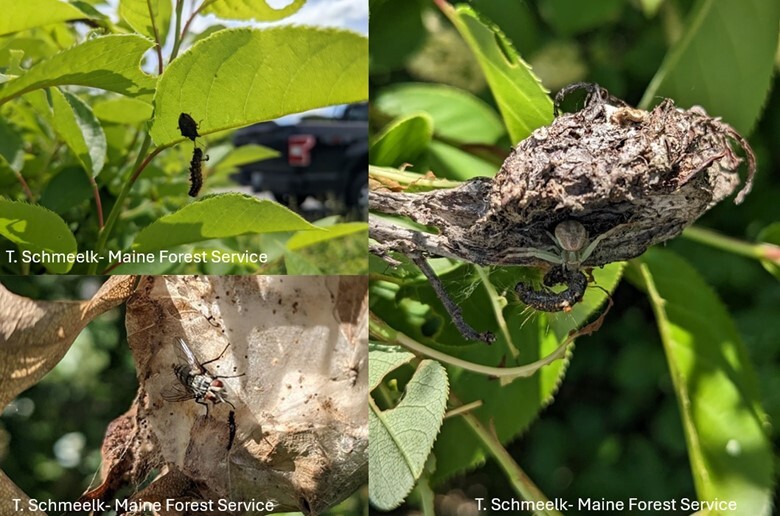
Predatory stink bugs, spiders, hornets, ground beetles and other insects have been observed feeding on browntail moth caterpillars. This week, we observed stink bugs and a predator wasp feeding on browntail caterpillars at some of our monitoring sites. Birds may also eat browntail caterpillars, however, many birds will avoid them because of browntail's irritating hairs. Although some of our native insects and birds can eat browntail caterpillars, they are not effective at controlling the population.
Some natural enemies of browntail moth include predatory stink bugs, crab spiders and parasitoid flies.
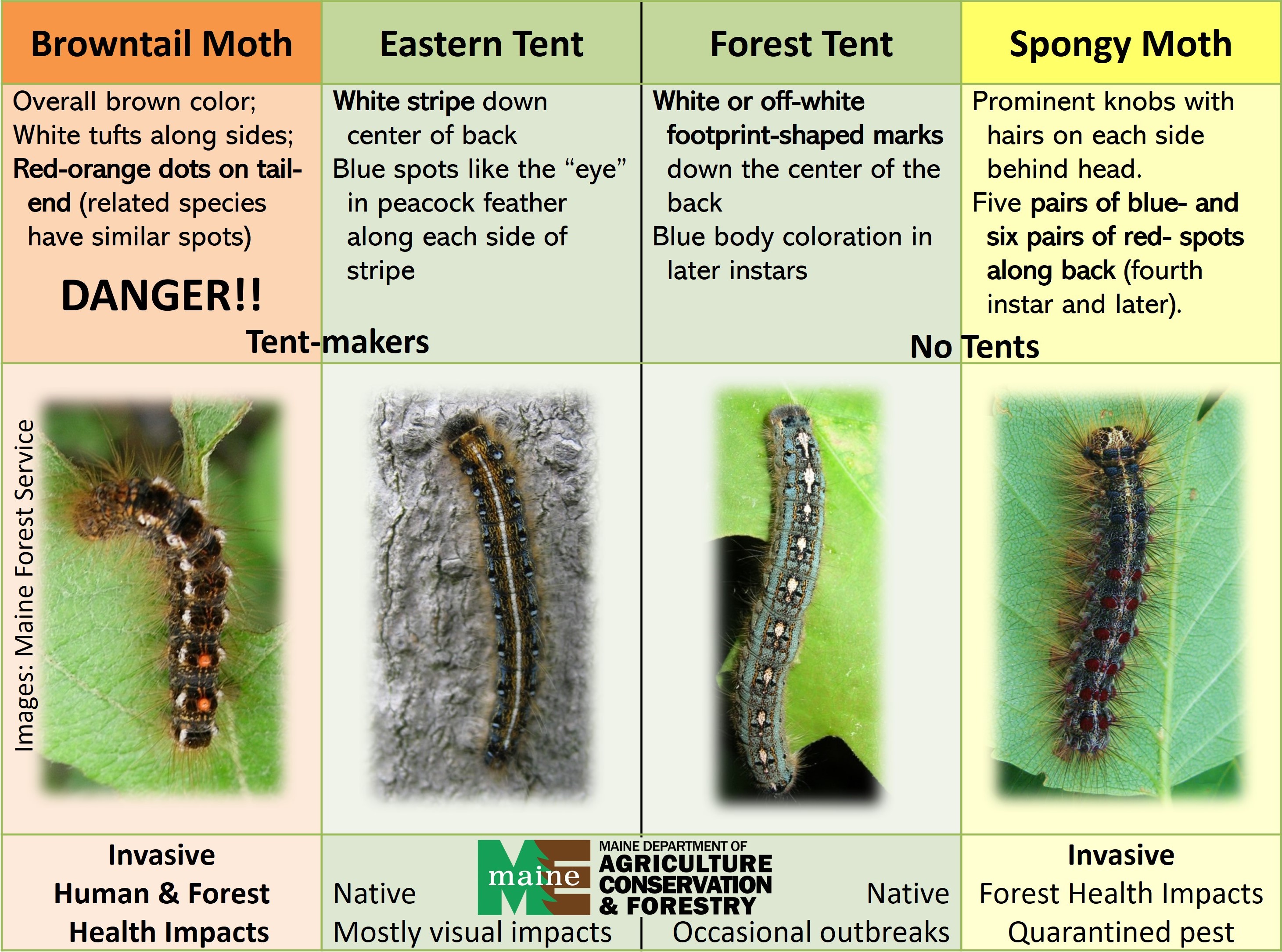
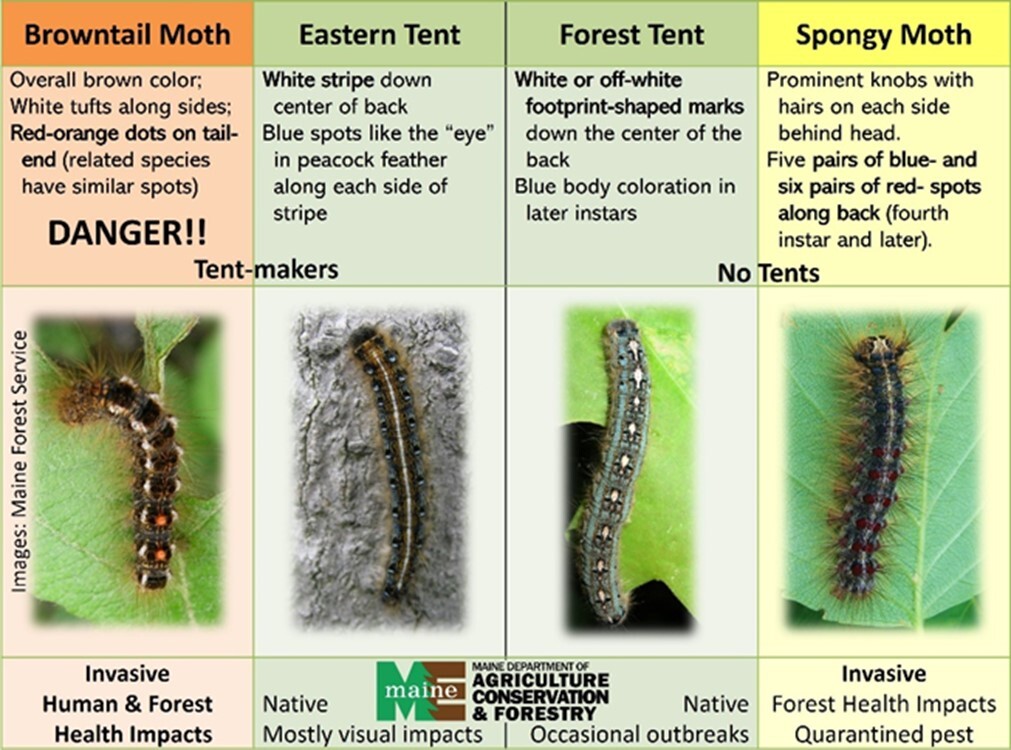
Which caterpillar is eating my trees?
Maine is home to many fuzzy caterpillars; while most of them go unnoticed, some make their presence known either by the damage they cause or by the structures they create as part of their life cycle. The chart below shows browntail moth caterpillars and three of the most common species with which they are confused. Notably, northern Aroostook County is experiencing an outbreak of the native forest tent caterpillar (often called army worms by locals). More information about forest tent caterpillar can be found in our May Conditions Report.
 Check out more helpful advice on management solutions for browntail on our frequently asked questions page:
|