Browntail Moth Update #3: May 3, 2024
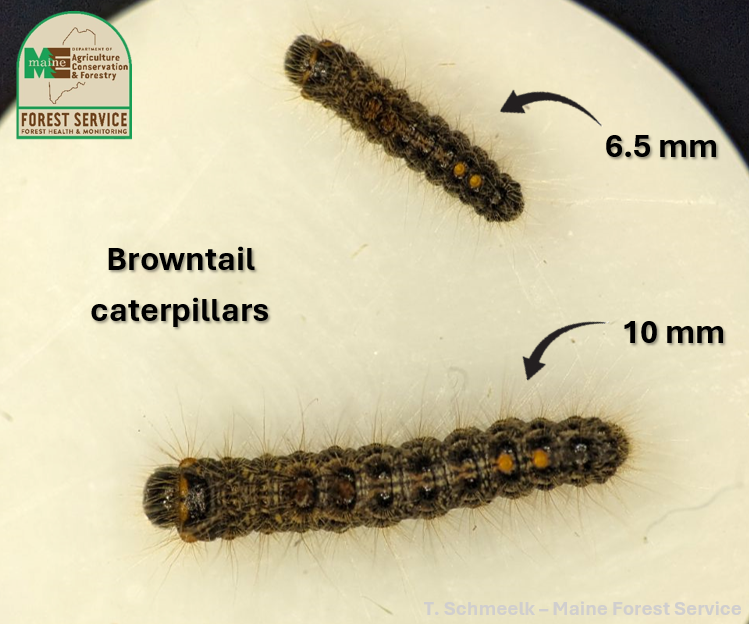
At two of our monitoring sites this week, we noticed some of the browntail moth caterpillars are at a later stage of development compared to other browntail caterpillars at the same site. Interestingly, we observed this phenomenon on cherry trees as the host at both sites with faster development (Brunswick and Unity). These larger caterpillars were around 10 mm, while the smaller ones were around 6.5 mm (see photo below). As the caterpillars grow, so does their appetite. Leaves of host plants at most of our sites are still unfurling, but with the forecasted warm weather, we expect the feeding damage to become more obvious in the next week or so.
The periodic rain we have been receiving this year is encouraging, since it is beneficial for the development of pathogens that can cause caterpillar disease as well as host growth/re-foliation. This is the “normal” spring precipitation we like to see, unlike last year, where we had a very wet spring and summer which may have hampered some disease development. It is theorized that the fungus that attacks browntail caterpillars needs dry periods in between rain events in order to produce spores, a crucial component to spreading the fungus to other nearby caterpillars. In the coming weeks, we will be on the lookout for disease outbreaks caused by the pathogens that attack browntail.
Two browntail caterpillars from different sites under magnification; note the size difference indicating different developmental stages (instars). The smaller caterpillar is about 6.5 mm in length, whereas the larger caterpillar is about 10 mm in length.
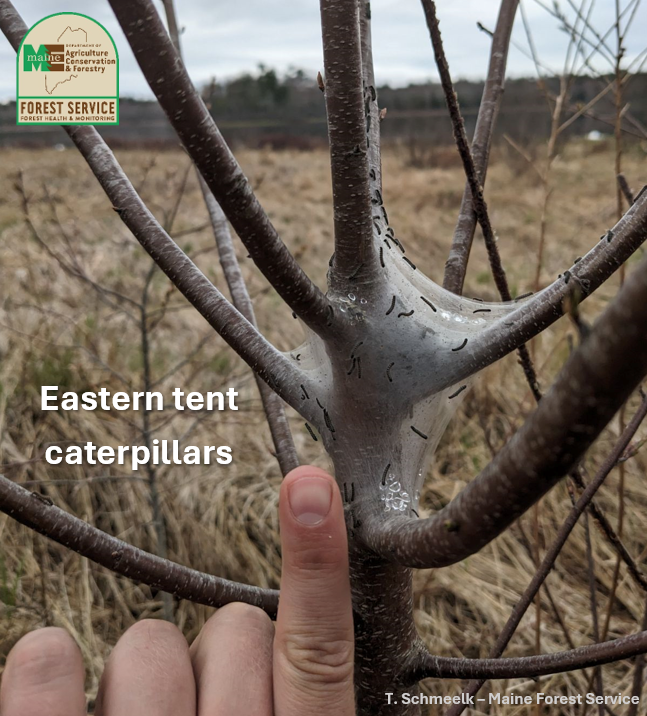
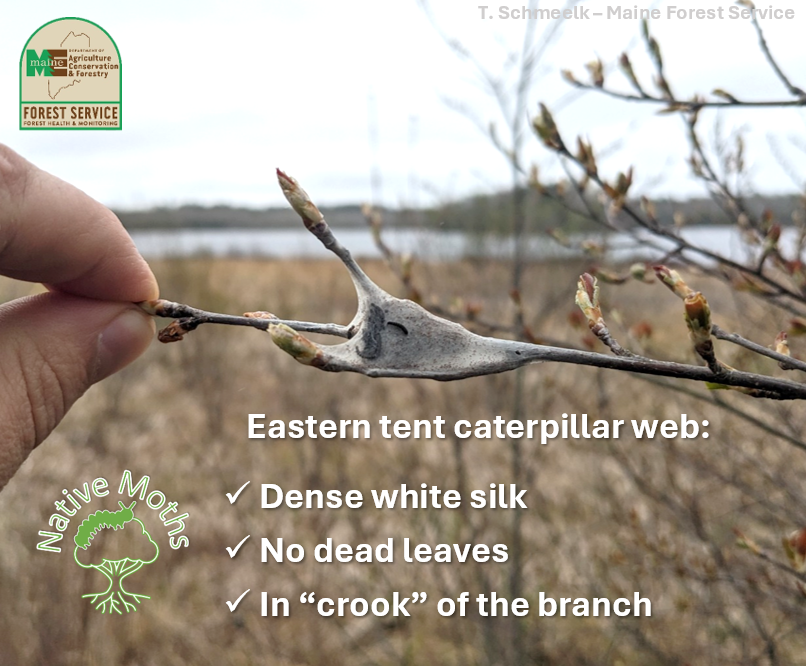
As mentioned last week, browntail caterpillars have begun producing silk and expanding their winter webs. There is a native look-alike, called eastern tent caterpillar, that can be confused for browntail moth webs at this stage in development. Two key differences between the webs of these species are the size and position on the host plant. The silken nests of our native eastern tent caterpillars start small but can grow quite large, reaching around the size of a football and are attached to the tree where the branches meet the trunk. The silk that the eastern tent caterpillars make is also denser, creating a white screen that is hard to see through. Additionally, eastern tent caterpillars lack the two characteristic orange spots on the tail end of the caterpillar.
One place eastern tent caterpillars create their webs is at the base of a branch where the branch meets the trunk. This is the same eastern tent caterpillar web from last week and has already doubled in size, Belfast ME.
Another place eastern tent caterpillars make their webs is further out on a branch where the twigs meet the branch. Note that eastern tent caterpillar webs do not have any incorperation of dead leaves into their webs, unlike browntail webs.
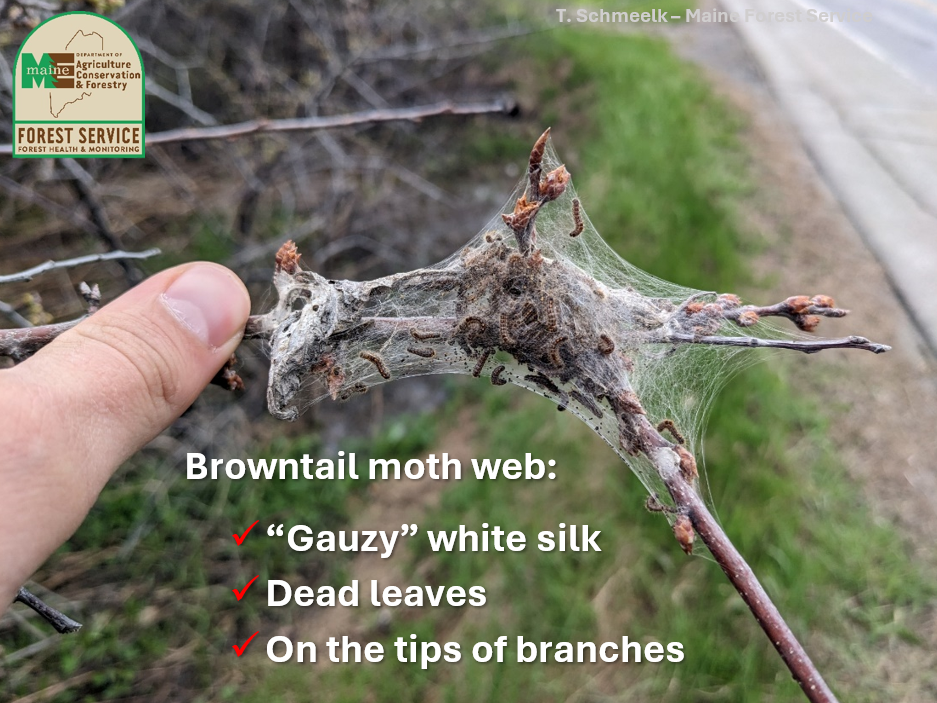
Browntail moth winter web with “gauzy” white silk characteristic of spring activity, Unity, ME.
Non-native browntail winter webs are the size of your palm or smaller, are constructed in late summer and early fall on the tips of the branches and are comprised of silk that also incorporates the leaves on the branch tips. As the caterpillars become active in the spring, they travel in and out of the web, and the web can become surrounded by gauzy silk similar in texture to that made by the eastern tent caterpillar. Browntail moth caterpillars are dark brown and have two orange spots towards the rear of their bodies. As the caterpillars molt, they develop white stripes due to white tufts of hair on each segment.
Browntail Moth in New Hampshire
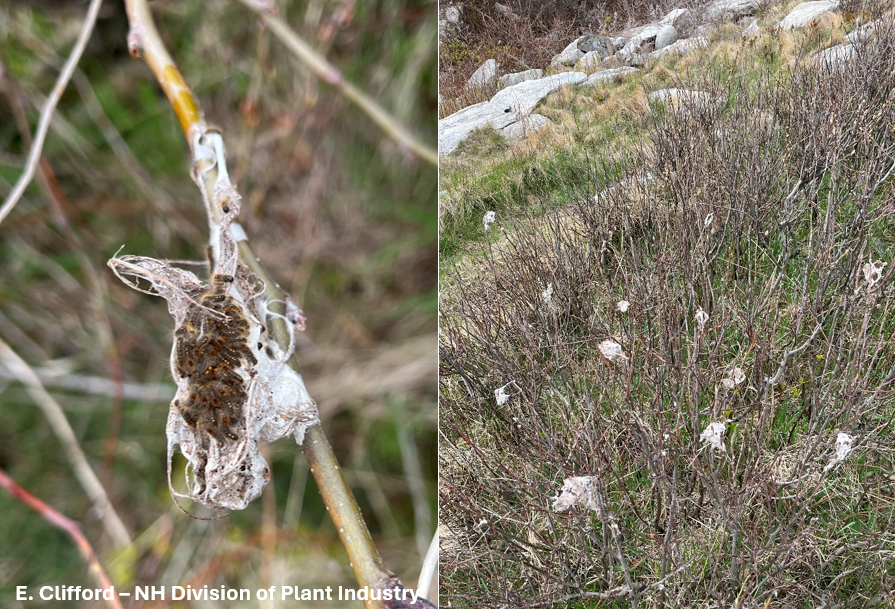
On an interesting note, browntail moth caterpillars have been confirmed in New Hampshire. We last received anecdotal reports of their presence in seacoast New Hampshire from a USDA Animal and Plant Health Inspection Service biologist at a professional meeting in 2010. This report came into our NH forest health colleagues from NH Division of Plant Industry staff. The browntail caterpillars were found on Star Island on the NH side of Isle of Shoals. The webs are present on low shrubs as the island is largely devoid of trees.
Browntail moth webs and caterpillars on Star Island, NH just over the Maine border. Photos: Erika Clifford NH Division of Plant Industry.
We have updated our interactive browntail moth map with winter web data from this past winter and aerial survey data from last year. This map can be used to better understand the possible impacts of browntail moth in your area, however, please be aware that it is not exhaustive. These are broad-scale surveys that do not completely cover the impacted areas.
|