Browntail Moth Update #2: April 26, 2024
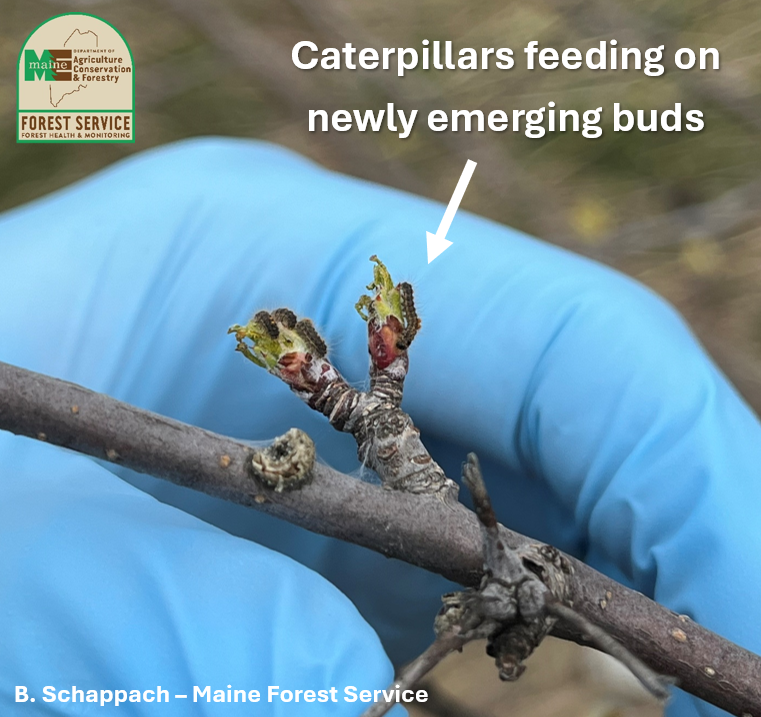
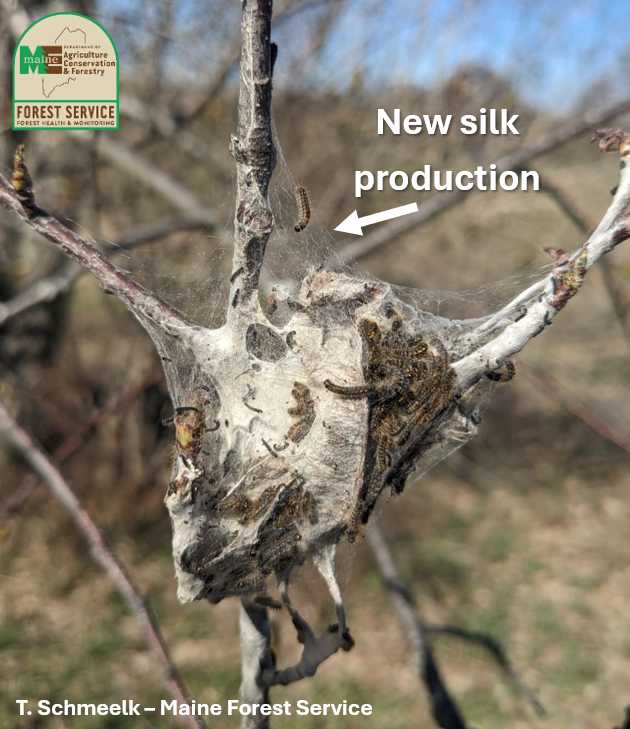
This week, we observed browntail moth caterpillar emergence at all our monitoring sites. At this time of year, browntail caterpillars are enjoying the sun as much as we are; you can often find them basking on their winter webs. Our abundant sunshine these past few days has allowed these caterpillars to bask and molt (shed their outer skins) at least once since their emergence last week. Browntail caterpillars can be seen chewing away at newly emerged buds from their host plants (oak, cherry, apple, crabapple, elm, birch etc.). Their goals at this stage are to eat and grow, and expand their webs by producing silk with help from an insect organ called a spinneret.
Browntail moth caterpillars are enjoying their meals of newly emerged buds of their host plants. Around this time of year, the caterpillars produce silk.
Browntail moth caterpillars are producing gauzy silk to expand on their winter webs. Sometimes, browntail and eastern tent caterpillars can be found on the same host plant as seen in this photo.
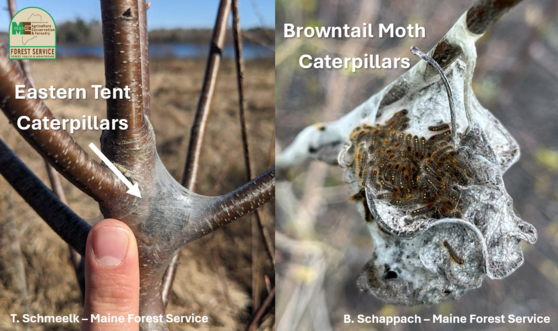
While browntail caterpillars are busy making silk pathways on their host plants, another caterpillar is also hard at work making silk tents and trails: our native eastern tent caterpillar. At this time of year, both caterpillars are roughly the same size, but there are ways to tell them apart:
-
Location of the web. Browntail caterpillars make their winter webs on the tips of the branches, whereas eastern tent caterpillars will be creating silk "tents" in the crooks of the tree near the truck.
-
Caterpillar appearance. Browntail caterpillars are dark brown and have two orange spots at the end of their body. As the browntail caterpillars grow, they develop white stripes along their backs. Unlike browntail, eastern tent caterpillars do not have the two characteristic orange spots at the end of the caterpillar.
-
Size of the web. Browntail webs tend to only be as large as the palm of your hand, whereas eastern tent caterpillar webs can get as large as the size of a football.
Eastern tent caterpillars (left) make their silk tents in the crook of the tree near the trunk, whereas browntail expand their winter webs on the tips of the branches (right). Note that when both species of caterpillar are this small, both will return to their tents at night.
We have updated our interactive browntail moth map with winter web data from this past winter and aerial survey data from last year. This map can be used to better understand the possible impacts of browntail moth in your area, however, please be aware that it is not exhaustive. If you see browntail in other areas of Maine, please help us improve this information and report your detection to the Maine Forest Service using our online form.
|