Browntail Moth Update #16: August 15, 2023
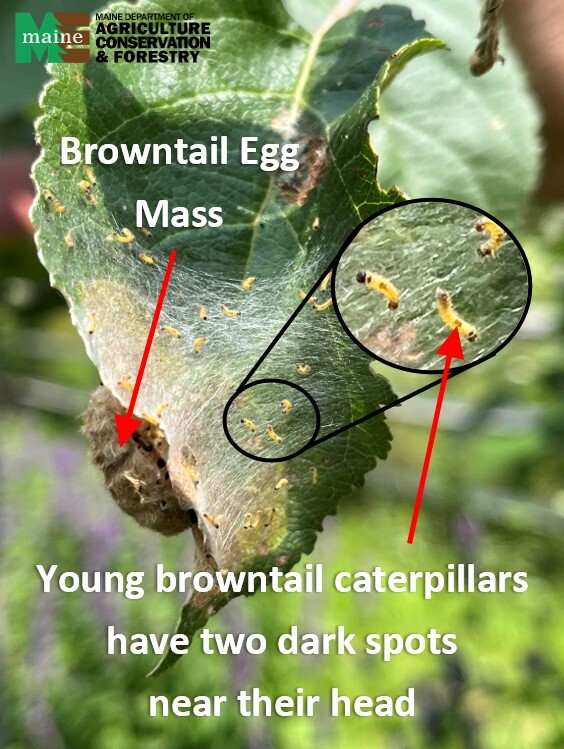
Browntail moth (BTM) egg masses across the state began hatching the week of August 7. Newly hatched caterpillars are pale yellow in color, with a black head and two dark spots near their head (see photo below). These young caterpillars will feed communally on host plants from now until the end of September or the beginning of October, depending on the weather. Damage this time of year is generally not a serious health issue for the plants. The BTM caterpillars will also start building their winter web for shelter through the coldest months.
Image: Browntail moth caterpillars have emerged from their egg mass to construct silk webs and skeletonize leaves of their host tree. Old Town, ME.
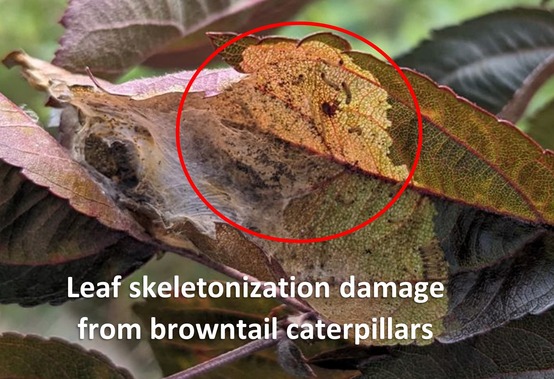
As the young caterpillars feed, they graze on the outer surface of the leaf without consuming the entire leaf. This damage is called skeletonization and causes the leaf to die and turn a copper color. When we perform our aerial BTM surveys in the late summer, we use this damage to help identify where BTM populations are severe. We are starting to see some skeletonization damage visible from the ground, notably on I-95 in a stretch from Orono to Bangor and in Hampden and Etna. In these trees, leaves on the outer tips of the branches are a copper hue.
Image: BTM caterpillar skeletonization damage; note the small caterpillars in the upper center of the photo.
Although it is much less common this time of year, exposure to hairs from previous seasons’ caterpillars can still cause skin irritation. These exposures often happen during activities that stir up hairs in the environment during dry conditions such as performing yardwork or closing camp. Caterpillar hair exposure can also happen through contact with old pupal cocoons which are often still attached to host foliage/ sheltered areas, or surfaces on which hairs settled that have not been washed clean. The caterpillars now feeding on the leaves are unlikely to cause a reaction in most people.
Summer treatment of the very young browntail caterpillars can be difficult for a few reasons:
- The leaf skeletonization damage from the younger caterpillars can be difficult to detect.
- Caterpillars in late summer are not necessarily found on the same trees they defoliated in the spring, although this is possible in areas with high populations. If you can’t tell if there are newly hatched caterpillars in your trees, plan to observe them more closely over the winter and decide whether and how to treat them before spring. Please do not treat uninfested trees.
- Caterpillars produce silk and feed under it, therefore, pesticides sprayed on leaves or other non-systemic pesticides may not be as effective.
- Trees in late summer may be less effective at absorbing and spreading injected pesticides throughout the tree’s leaves and therefore treatment may not be as effective.
Small caterpillars in August: Browntail or Fall Webworm?
Our native fall webworm (Hyphantria cunea) is a moth that has a caterpillar form that is easily mistaken for the browntail moth caterpillar. Both insects are active in August and these small caterpillars can be found eating the same host plants and trees, and creating filmy silken webs. So how can you tell the difference?
-
(Carefully) Check the web! Oftentimes, fall webworm webs will be larger than browntail webs during late summer.
-
Are there silk 'highways'? In late summer, browntail caterpillars will build white silk highways to help them travel in their host trees. In trees with fall webworm, although there is silk, they do not create readily observed trails.
-
Look at the caterpillars! If you can safely reach the area where the caterpillars are, check for two dark spots toward the head of the caterpillar, if present, these are browntail caterpillars. If not present, they are fall webworm caterpillars. Young browntail caterpillars also tend to be smaller (about a quarter of an inch) compared to fall webworm (often longer than a quarter of an inch).
|