Once in a Blue Supermoon - Tonight!
You'll not get this chance to view a Blue Supermoon for another fourteen years, so get out tonight and enjoy the view. For the most dramatic size effect, view the moon rising from the horizon at about 7:30 p.m., then watch as it ascends the darkening sky. It will be officially at the peak of full at about 9:30 p.m.
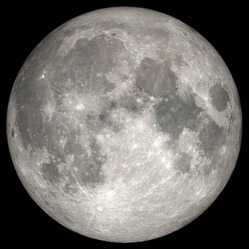
No, the moon won't be blue, but it will be at its brightest and appear about 7% larger than usual because it will be at its closest point to Earth along its elliptical orbit. The next chance to view a full Supermoon will be on September 29 - the Harvest Moon.
Blue Moon can mean the second full Moon in a calendar month, as is this one, or the third of four full Moons in a season.
There have been times when the moon has appeared blue after large forest fires and volcanic eruptions from the huge amount of uniformly tiny particles released into the air. When Krakatoa erupted in 1883, ash clouds filled the sky. The fine particles scattered the red light (white light is ROY G BIV = Red, Orange, Yellow, Green, Blue, Indigo, Violet) while the other colors passed through. The moon and its moonbeams appeared blue and sometimes green for years after the eruption.
Learn more about the Blue Supermoon and cultural traditions at NASA's website.
(Moon photo courtesy of NASA)
Wishing you clear skies and great viewing!
|
Share Nature Note with your friends, family, teachers, scouts, and anyone you think might be interested. Here is how they can sign up for a free subscription:
Read back issues online.
Suggest a topic by email; put Nature Note in Subject line and email Jocelyn Hubbell.
|