Rainy Day Discovery: Ghost Pipe
 |
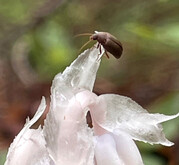
The recent rainy days have stimulated the Ghost Pipe (Monotropa uniflora) to emerge from the humus-rich duff of the forest floor. I've been seeing it in small clumps along my woodland walks. And various insects have found it too! Ghost pipe relies primarily on bumble bees for pollination, though flies and others will visit as well.
This white and sometimes pink plant does not have any chlorophyll, so it cannot make food as green plants do. Instead, it takes advantage of a mycorrhizal relationship between fungi and tree roots - a mutually beneficial (symbiotic) relationship between the fungi and tree. The tree roots provide essential nutrients to the fungi while the fungi make the tree more drought tolerant and help it to better absorb nutrients. The Ghost Pipe is a freeloader (parasite) on this arrangement, taking what it needs without contributing.
Look for Ghost Pipe, now through September, emerging after wet weather in moist, shaded Beech woodlands.
Fun Fact! - Emily Dickinson was fond of the Ghost Pipe. A drawing of it adorned her first book of poems (1890).
|
Share Nature Note with your friends, family, teachers, scouts, and anyone you think might be interested. Here is how they can sign up for a free subscription:
Read back issues online.
Suggest a topic by email; put Nature Note in Subject line and email Jocelyn Hubbell.
|