Browntail Moth Update #11: June 30, 2023
At all of our monitoring sites, we have complete pupation as the caterpillars have moved on to the next stage in their life cycle. We observed no active caterpillars remaining at our sites across the state (this is dependent on many factors and you may have active caterpillars in your area).
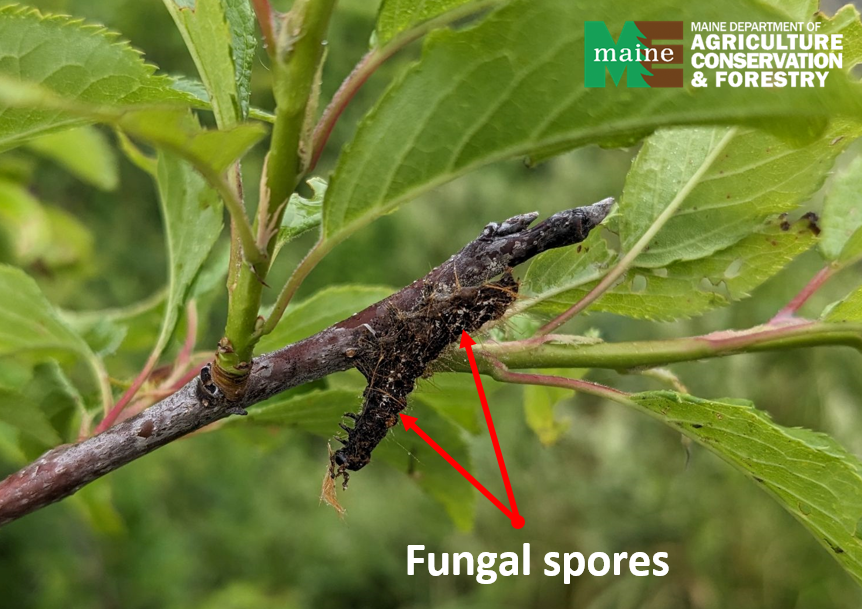
We are also pleased to report that in addition to the viral deaths we saw last week, we do have confirmed fungal mortality at many of our sites. Dead caterpillars clutching the branch with their prolegs (the leg-like structures at the tail end of caterpillars) is typical fungus-influenced behavior. As noted last week, many caterpillars died right before pupating and as the old adage holds true, better late than never.
Thank you to all who have sent disease observations; this will greatly help with determining where the disease outbreaks are occurring. Feel free to send us photos of diseased browntail caterpillars in your area by emailing foresthealth@maine.gov.
Fungus-killed caterpillar clutching a twig with its prolegs, Turner, ME.
The silky cocoons surrounding the pupae contain the last cast skin of the caterpillar and are full of toxic hairs. Many people become exposed to the hairs through encounters with the cocoons as they can pupate on buildings, vehicles, trailers, and host tree foliage. Residents should check vehicles and trailers for cocoons before driving away to prevent them from hitching a ride. People in areas with browntail moth populations should take precautions to minimize exposure to the caterpillars’ hairs. Remember, even if there are no active caterpillars in your area, the toxin in the hairs can remain stable in the environment for over 3 years.
We have collected pupae from our sites to estimate adult moth emergence and will post an update when we start seeing them. In preparation for adult moth emergence, homeowners should shift tactics to discourage attracting moths to their dooryard by keeping unnecessary outdoor lights off (or switching to yellow-colored bulbs) from now until the beginning of August.
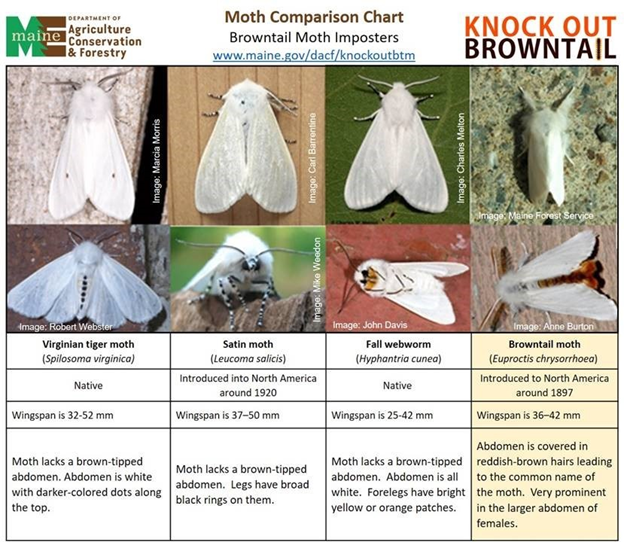
Many white moth species in the northeast are active around the same time as browntail moth. Please note that other species not in the chart below may also be confused for browntail moth; however, the three lookalikes below are the most commonly mistaken for browntail moth in Maine.
|