Browntail Moth Update #10: June 27, 2023
If you've been monitoring browntail caterpillar host trees this past week, you may be asking yourself, "Where are all the browntail caterpillars?" Across the state, more and more browntail caterpillars are beginning to form pupal cocoons, where they will remain until they emerge as adult moths. At our monitoring states, we observed more browntail caterpillars beginning the early stages of pupation (the process of becoming an adult moth). Some caterpillars are still active and feeding; however, as we near the end of June, caterpillar activity will continue to sharply decrease. Please be aware that these silky cocoons surrounding the pupae contain the last cast skin of the caterpillar and are full of toxic hairs; take precautions to minimize exposure to the caterpillars’ hairs.
 |
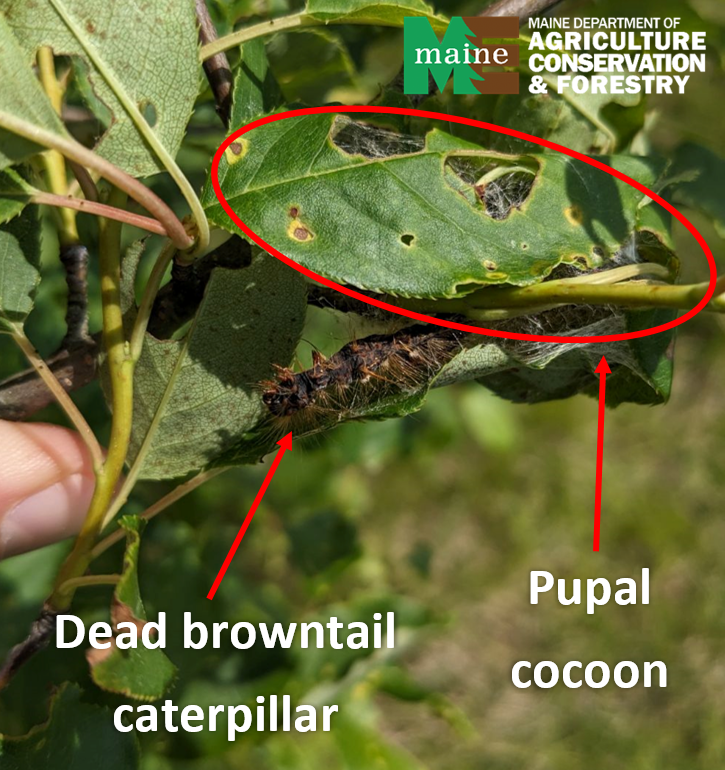
A pupal pocket contains multiple browntail pupae, where they rest and metamorphize before emerging as adult moths. Outside of this pupal pocket is a dead browntail caterpillar that likely died from a viral pathogen. Unity, ME.
Many people become exposed to the hairs through encounters with the pupal cocoons as the caterpillars can spin these cocoons on host tree foliage, buildings, vehicles, trailers, equipment, or other ideal locations.
To prevent spreading browntail to new areas:
- Check for caterpillars and cocoons that may be trying to hitch a ride.
- Use protective measures to avoid skin contact with the toxic hairs when carefully removing caterpillars or cocoons.
- Eliminate caterpillars and cocoons by squishing them, soaking them in a bucket of soapy water, or freezing them in a plastic bag or container before disposing of them in the trash. Note that only cocoons that pose a risk of being spread to new locations (i.e. on a vehicle, camper or trailer) should be removed; the cocoons are impregnated with toxic hairs and management of this life stage is not recommended.
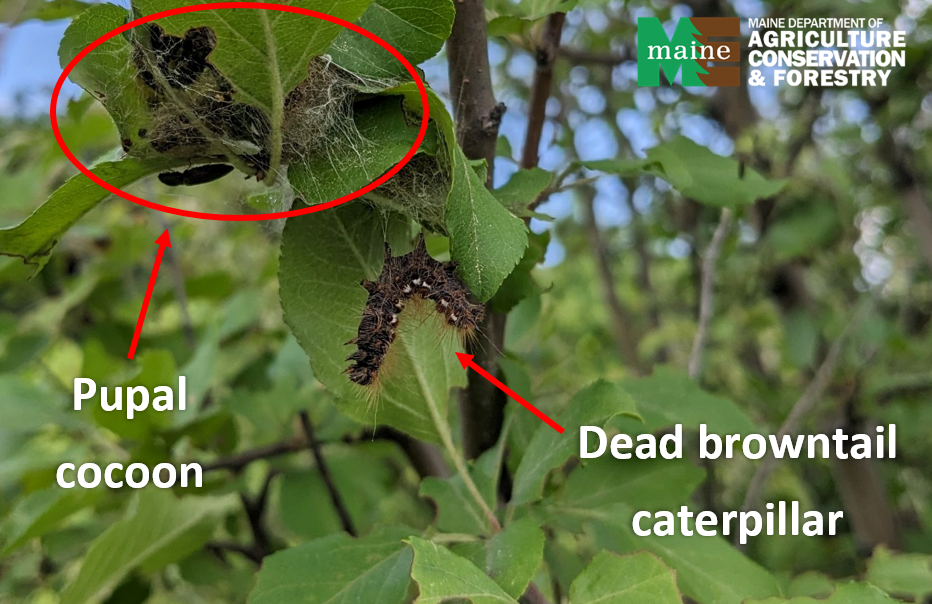
We are seeing some mortality of caterpillars at our sites, although, there is just a handful of dead caterpillars at each site. When caterpillars die from a viral pathogen, they latch on to a twig with their first set of prolegs and hang in a “U” shape. Eventually, these caterpillars will liquefy and their insides will drip onto foliage below, which may allow other caterpillars to encounter the viral pathogen. Interestingly, a large proportion of caterpillars look like they died as they were pupating (see photos). We will continue to monitor for further epizootic-caused mortality. As stated last week, there is some pupation occurring; however, there are still active caterpillars around.
A dead browntail moth caterpillar lays outside a cocoon with other browntail pupae. Turner, ME.
Limit outdoor lights in July
Pupation means we will soon see browntail moth flights. Nearly every year, we receive the first reports of adult moths sometime during the last week of June or first week of July. Usually, the peak of browntail moth adult activity is somewhere in mid-July and the last flights are toward the end of July and early August. Although some moths stick close to where they developed, others can travel long distances.
To reduce the attractiveness of your landscape to these travelers:
- Limit outdoor lighting in July.
- If you can’t eliminate lighting, consider switching to yellow-spectrum lights. Preliminary research by the Mech Lab at the University of Maine indicates that these yellow-colored lights are less attractive to browntail moth. Preliminary results from the lab also indicate that higher density browntail caterpillar populations develop near lights.
The Maine Forest Service would like your help in locating diseased caterpillars. Infected caterpillars will have a puffy, swollen appearance and are covered in whitish/yellowish dust which is spores of the fungus. As caterpillars succumb to the fungus, they will hold tight to the branches on which they die, which helps spread the browntail caterpillar-killing spores. Reports of ONLY DISEASED browntail caterpillars can be sent to foresthealth@maine.gov.
Thank you to those who have sent photos of diseased browntail caterpillars; let's keep the reports coming!
Will you have browntail moths flying in your area?
Maine Forest Service conducts surveys for browntail moth from small planes and from moving trucks. These are broad-scale surveys that do not completely cover the impacted area. You can get a general idea of where browntail moth is in Maine from our interactive map, updated with 2023 winter web surveys. To understand what browntail moth is up to near you, take a look at host plants for signs of caterpillar activity, and in this month of June, pupal cocoon formation.
|