Browntail Moth Update #7: June 2, 2023
Across Maine where browntail moth caterpillars occur they continue growing and feeding. Impacts from feeding are highly variable across the landscape. Trees in some areas like Brunswick are displaying the typical top-down defoliation characteristic of browntail moth activity this time of year while other areas are just beginning to show more visible damage in the upper canopies of some trees. The caterpillars have a little less than a month left of development before pupation; however this could be shorter depending on environmental conditions. As we have seen in previous years at some sites there are a small number of caterpillars that are much smaller than the rest of their cohort. This can occur for a variety of reasons including infection, parasitism, food quality and other environmental conditions.
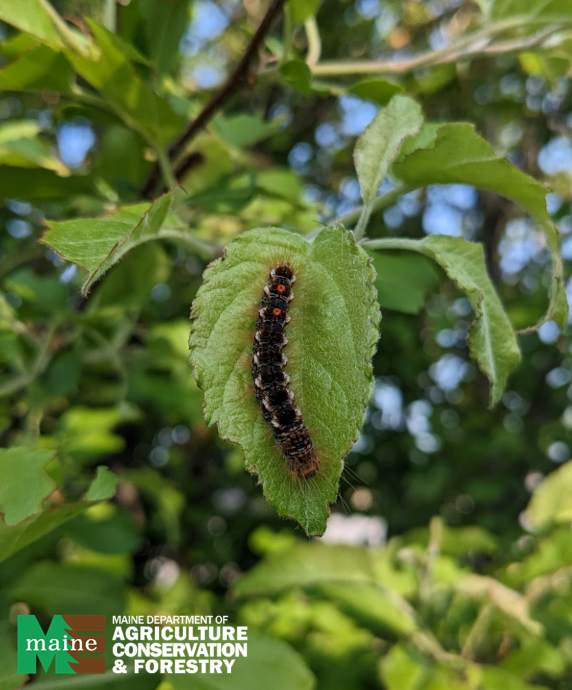
Resting browntail moth caterpillar, Turner ME.
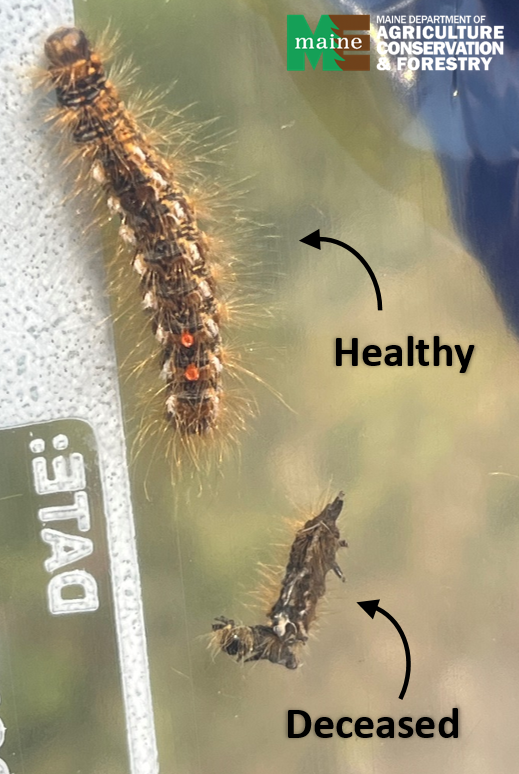
Most of this past May was fairly dry, so we have not yet seen the epizootic outbreaks of fungus and virus that we had been hoping for. That being said, we are still hopeful as we see some rain in the forecast for this coming week. We are still soliciting reports of diseased caterpillars from the public. Below is a comparison of a healthy caterpillar with one that has succumbed to disease.
Comparison of healthy BTM caterpillar with a cadaver, Skowhegan ME.
We will continue to monitor for disease-causing agents at our developmental monitoring sites and elsewhere in the coming weeks. However, we should caution that pockets of disease impact may be quite isolated.
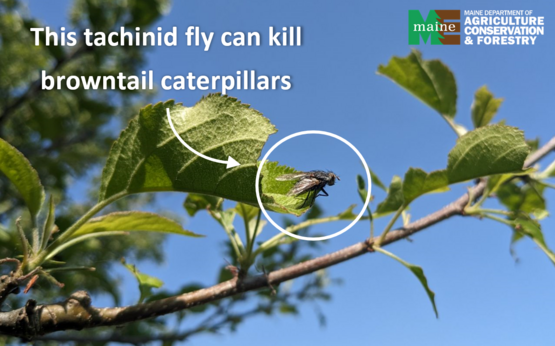
Although browntail moth is not native to North America, it does have natural enemies, some being native generalist predators like spiders or others having had human assistance in making the transatlantic journey from browntail’s native range. Many of the natural enemies, such as parasitoid flies and wasps from Europe, were part of a biocontrol program to help control spongy moth (Lymantria dispar) and browntail in the late 1800s and early 1900s. These predators and parasitoids by themselves are unfortunately not enough to prevent significant impacts here in Maine. This week we observed a crab spider making a meal of a caterpillar and a fly in the family tachinidae, which are wholly parasitic on various arthropods, at our monitoring sites. Other natural enemies of browntail moth include other predators, like beetles, hornets, stinkbugs, birds, small mammals, other parasitoid flies and wasps and diseases such as the fungus and the virus.
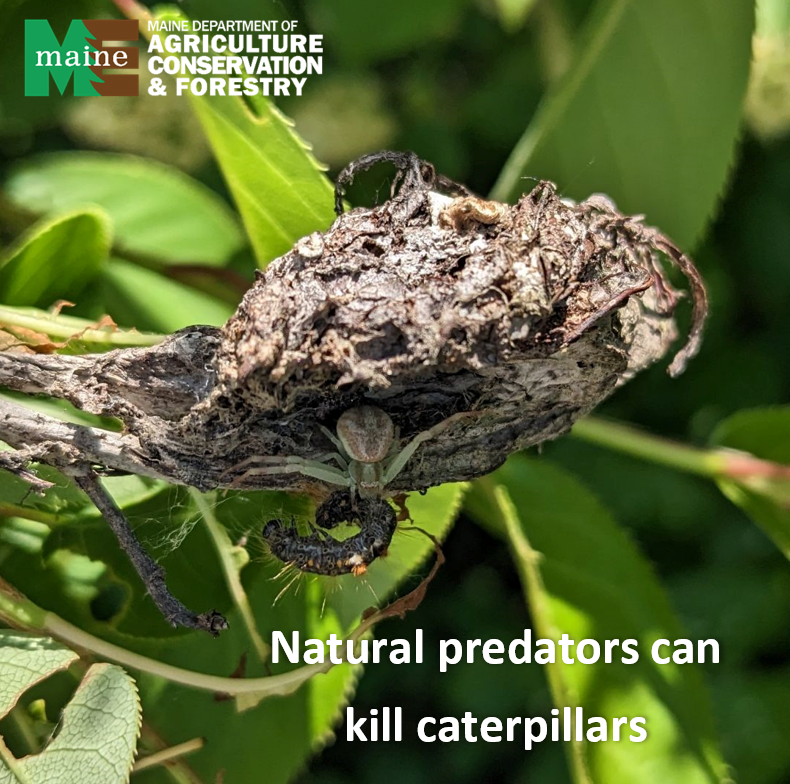 |
A crab spider enjoys a BTM caterpillar meal, Belfast ME.
A parasitoid fly in the family Tachinidae, found amongst BTM leaf damage, Dresden, ME.
To remove wandering caterpillars on your house:
- DO:
- Exercise caution when performing yardwork in high infestations by wearing personal protective equipment and avoiding contact when possible
- Use a strong jet of water to dislodge them from the side of your house
- Fill a wet/dry vacuum with soapy water and vacuum up the caterpillars. Let the caterpillars soak in the soapy water for a few days to kill them, then you can safely dispose of them in the trash
- Remember that the toxin in the hairs can remain active in the environment for up to 3 years
- DON'T:
- Touch the caterpillars. Be sure to wear personal protective equipment when in areas of high infestations
- Use a leaf blower to remove caterpillars; this will stir up the hairs and can cause rash
-
Treat trees on your property at this time with pesticides to target browntail caterpillars. Foliar, soil, or tree injection applications will not be most effective at killing browntail moth caterpillars past late May. Read more below.
Is it too late to treat my trees infested with browntail caterpillars?
Pesticide applications are most effective for browntail caterpillars when the pesticide product can take effect before late May. Treatments after that time are not recommended and are not part of an effective integrated approach to management (or IPM strategy). Since caterpillars are already wandering to new locations, targeted applications are not possible. Further, pesticide applications at this time of year are more likely to impact other living species in your trees, including pollinators and native insects, without effectively reducing the impacts from browntail. At this time, there are many shed caterpillar skins and toxic hairs that have already built up in the environment. To have more effective control of browntail, plan to target the next generation of caterpillars by scouting out new winter webs this winter to determine which trees you may want to treat next spring.
|