Jovian Joy - Jupiter
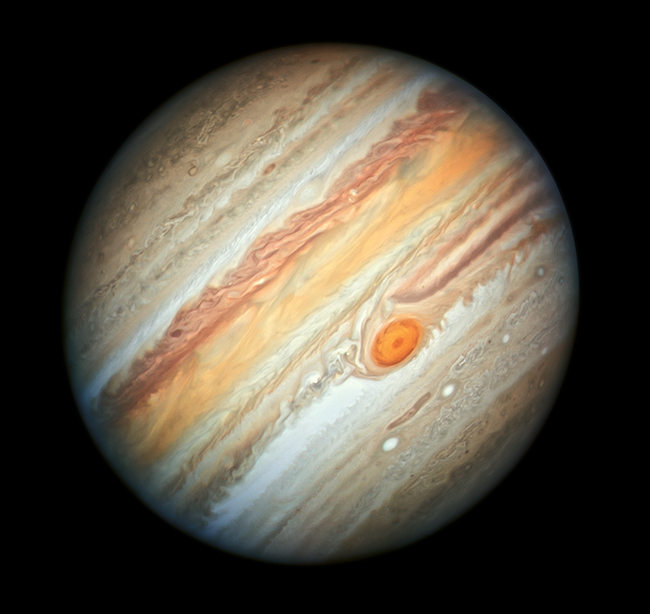
Jupiter image courtesy of NASA.
Jupiter is the closest it has been to Earth since 1963 and we will not see it this close again until 2129. (Jupiter was closest, at about 367 million miles from Earth, on September 26.) As it moves away, Jupiter continues to be incredible viewing. It is extraordinarily bright and easy to spot - look for it to rise in the east, opposite the setting sun. You may also be able to see the Galilean satellites, four of Jupiter's moons observed and recorded by Galileo Galilei in 1610: Io, Europa, Ganymede and Callisto (listed in order of increasing distance from Jupiter) with 7x50 or better binoculars. Better yet, check to see if your local library has a telescope for loan by visiting www.librarytelescope.org
- Jupiter has 80 moons, only 57 of which have been named. The remaining 23 are awaiting official names by the International Astronomical Union.
- Jupiter is the largest planet in our solar system - larger than 11 Earths, and larger than all the planets in our solar system combined! It does not have a solid surface like Earth. It is made of gas and called a gas giant.
- Jupiter's Great Red Spot is a raging storm that has been active for over 100 years. The storm is about two times as large as Earth.
- Jupiter's stripes are swirling clouds of ammonia and water floating in an atmosphere of hydrogen and helium.
- A day on Jupiter, called a Jovian day, is 10 hours long. A Jovian year is about 12 Earth years--- 365 days in one Earth year X 12 = 4,380 days! (One year is the time a planet takes to complete one orbit around the sun.)
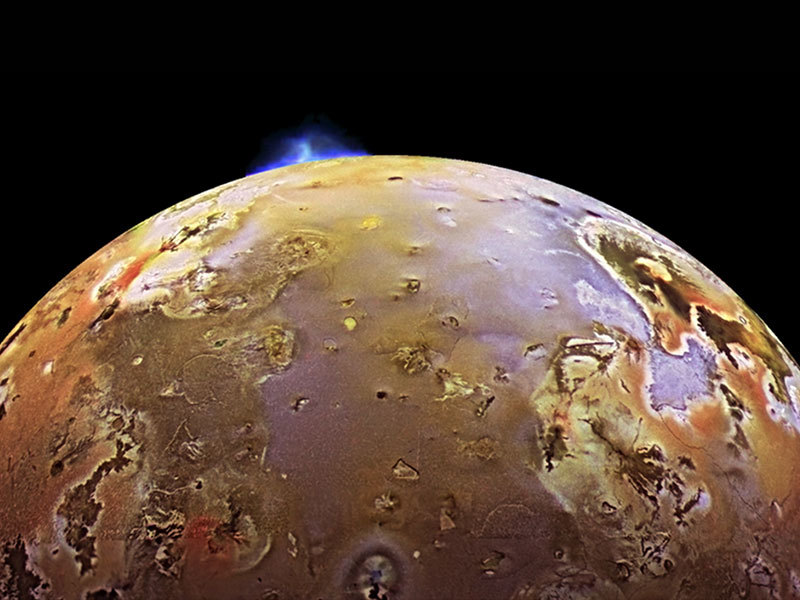
- Io, shown in the photo below, is renowned for its volcanic activity - the most volcanically active object in the solar system.
View images and explore links to fun and interesting experiments and activities at NASA's Jupiter Resources web page.
NASA’s New Horizons spacecraft zipped past Jupiter, catching Io, the planet’s third-largest moon, enduring a volcanic explosion. Image courtesy of NASA's Goddard Space Flight Center, NASA/JPL/University of Arizona.
Share Nature Note with your friends, family, teachers, scouts, and anyone you think might be interested. Here is how they can sign up for a free subscription:
Read back issues online.
Suggest a topic by email; put Nature Note in Subject line and email Jocelyn Hubbell.
|