Basking Beauty - Common Gartersnake
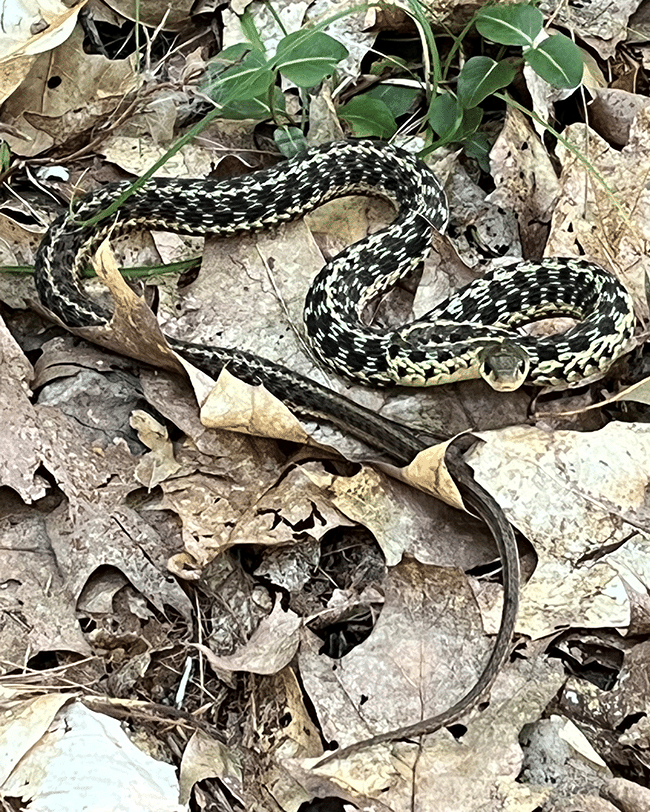
Common Gartersnake (Thamnophis sirtalis) in a woodland. Photo by Jocelyn Hubbell.
Just this week I met a basking beauty, a Common Gartersnake, while I was on a walk in the woods. It was resting in a pool of sunlight on the trail, but I did not see it until it started moving off the trail having felt the vibrations of my footfalls on the path. Luckily it stopped just a few feet away and I was able to get a good look and a photo before I moved on so it could return to its basking spot.
Autumn is a great time of year to watch for snakes. They, like us, are out on sunny days to soak up the sun before winter arrives. Unlike us, they are ectotherms – they do not produce their own body heat – and depend on the environment for their body temperature. Snakes need to warm up to get going on these chilly days so you may be more likely to see them basking along sunny trails. A fully warmed snake will most likely sense you coming and be well off the trail before you pass by. A snake that is still warming up may be slow to move. If you see it from a distance, be polite and let it keep its spot. Enjoy the moment, observe it quietly from several feet away, then walk well around it so you do not scare it off.
Just like you, snakes do not like being snuck up on… it may be that you find yourself jumping back at seeing a snake at the same time it senses you and moves away. Their senses are different from ours. Snakes do not have external ears but have an inner ear that is connected to the jawbone. This allows snakes to sense vibrations through the ground with their jaws. It is thought that they have limited to no ability to hear vibrations through the air. Snake vision has a limited color range of blues and greens, and most are sensitive to UV light – meaning they can see well in low light conditions. A snake that is starting the molting process has a reduced ability to see as the skin over the eyes turns a milky blue obscuring its vision and will be much more sensitive to being disturbed.
The Common Gartersnakes is:
-
Harmless, shy, and non-aggressive.
-
Well camouflaged – its body markings help conceal movement and prevent detection.
-
Viviparous – gives birth to live young rather than laying eggs. Gestation is 90-100 days. The young are born from July to mid-September. Viviparous snakes have advantages that egg-laying snakes do not – there is no predation of a nest of eggs, and the young develop faster.
-
A prey animal (hunted by) owls, hawks, herons, bitterns, rails, turkeys, crows, jays, and other birds, mink, otter, skunks, raccoons, opossums, foxes, shrews, bullfrogs, large predacious fish, and other snakes. If captured, they emit a foul musk odor, thrash violently to escape, or may even bite.
-
An opportunistic eater who will eat a variety of small animals, including frogs, toads, salamanders, earthworms, mice, fish, slugs, leeches, millipedes, insects, and spiders.
-
The most common snake seen in Maine. It is one of nine species of snake that live in Maine. (The Timber Rattlesnake would have been our tenth species but has been extirpated and not seen since the 1860s.)
-
Not active during the winter. It bromates, often with other snakes, in a state of awake inactivity with an extremely reduced metabolic activity that includes a much-reduced body temperature, breathing, and heart rate.
-
Thought to be named for the resemblance of their stripes to the old-fashioned garters once used to keep men’s socks up.
Learn more about the Common Gartersnake and all the snakes of Maine.
Share Nature Note with your friends, family, teachers, scouts, and anyone you think might be interested. Here is how they can sign up for a free subscription:
Read back issues online.
Suggest a topic by email; put Nature Note in Subject line and email Jocelyn Hubbell.
|