New Bedrock Geologic Map Released
The Maine Geological Survey is pleased to announce the publication of a new bedrock geologic map, Bedrock geology of the Phippsburg quadrangle, Maine, by the late Professor Arthur Hussey (Bowdoin College, emeritus), David West, a professor at Middlebury College in Vermont, and Amber Whittaker, a senior geologist at the Maine Geological Survey. The published map is based primarily on the compilation of information gleaned from over a thousand field station entries recorded in the quadrangle by Professor Hussey and represents on-going efforts to provide detailed bedrock geologic maps of the mid-coast region.
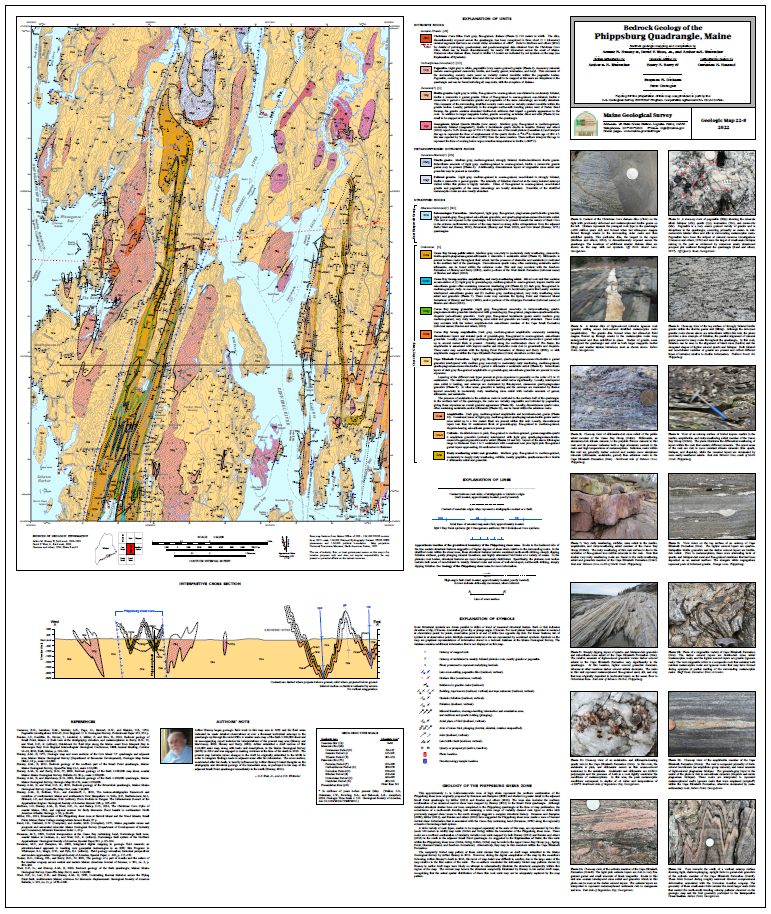 |
The Phippsburg quadrangle is underlain by deformed and metamorphosed Ordovician rocks of the Casco Bay Group and a variety of intrusive igneous rocks. The metasedimentary dominated Cape Elizabeth Formation underlies the majority of the quadrangle and includes mappable amphibolite, coticule, and rusty-weathering schist members. Map-scale, shallow-plunging upright folds control the map pattern in the eastern portion of the map. The central portion of the quadrangle contains a 1- to 2-kilometer-wide zone of high strain that represents the northern continuation of the Phippsburg shear zone mapped previously in the adjacent Small Point quadrangle. A variety of rock types are within the boundaries of the shear zone and some may represent units in the upper Casco Bay Group. All the stratified rocks have been metamorphosed to amphibolite facies conditions and are commonly migmatitic. These rocks have been intruded by a wide variety of igneous rocks, including numerous small pegmatite bodies that were the target of small-scale feldspar mining in the past.
Bedrock maps provide a basic information source that can contribute to understanding groundwater quality, groundwater flow and contaminant transport, soil chemistry, distribution of mineral resources, and engineering properties relevant to construction projects. Additionally, in that these maps provide information on the history of the earth, they are important educational tools for both geologists and non-geologists.
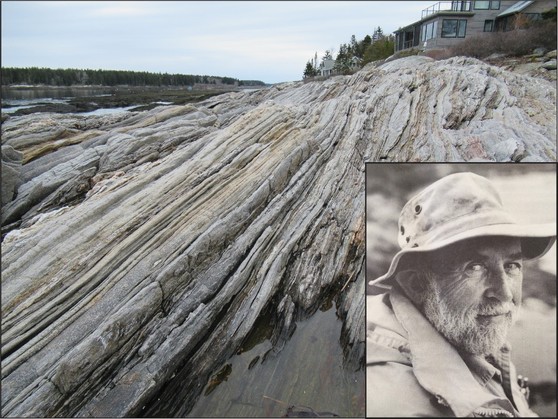 Steeply dipping layers of quartzofeldspathic granofels and mica schist of the Cape Elizabeth Formation (David West photo). Inset photo of Professor Arthur Hussey.
|