Oxeye and Moon: Daisy in Bloom
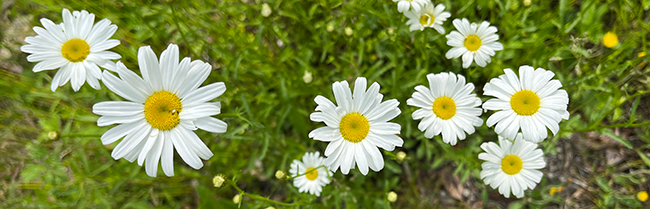
Daisies in bloom along a roadside. Photos by Jocelyn Hubbell.
Daisies are in bloom along roadsides, in free-growing lawns (growing tall after No Mow May), and in meadows. The oxeye daisy, also commonly called ox-eye, moon, and field daisy was introduced to New England from Europe and Asia where it is native. The daisy was and is still mostly valued as an ornamental, though in some areas it is considered an unwanted weed. Traditionally, it was also a kitchen herb. The raw leaves were eaten through much of the growing season.
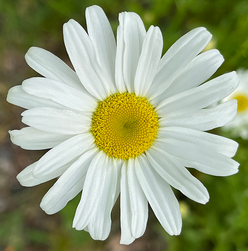
The flower head of the daisy is made up of two types of flowers. The yellow cone-shaped disk flowers make up the circular central area. White strap-shaped ray flowers encircle the outer edge of the "ox-eye" of disk flowers.
Take a magnifying lens on your next meadow hike. If you spot a daisy use it to inspect the disk flowers. How many do you think the ox-eye holds?
Count the ray flowers too. Compare your counts of ray and disk flowers on several daisies. Are they consistent numbers? Why or why not?
Did you ever make daisy chains as a child, or pluck the ray flowers to make a wish? Where do you think these games originated...and how long ago?
Continue your learning journey with these resources:
|
Share Nature Note with your friends, family, teachers, scouts, and anyone you think might be interested. Here is how they can sign up for a free subscription:
Read back issues online.
Suggest a topic by email; put Nature Note in Subject line and email Jocelyn Hubbell.
|