How to Create a Trap Tree to Monitor for Emerald Ash Borer Workshop – Greenwood
Date: May 7, 2022
Time: 9:00 AM - 10:30 AM
Location: Noyes Mt. Preserve, 172 Richardson Hollow Road, Greenwood, Maine
Join Maine Forest Service Entomologist Colleen Teerling and District Forester Mike Richard to learn how you can participate in the early detection of emerald ash borer infestations in Western Maine.
Participants will learn about emerald ash borer's lifecycle and how to create a "trap tree" on their property that can aid in detecting infestations within the region.
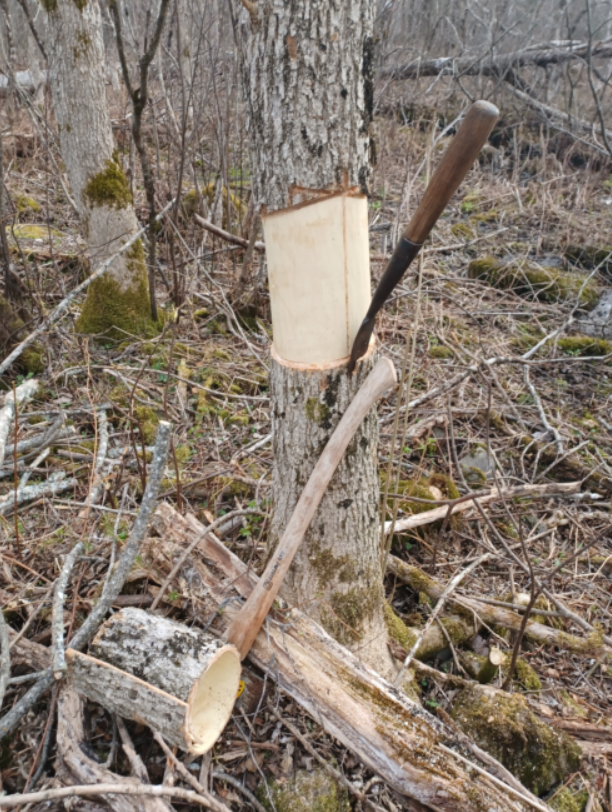 Ash tree girdled to monitor for emerald ash borer (Image Courtesy Ernest Carle)
For more information or to pre-register please call District Forester Mike Richard: 207-441-3276 or michael.b.richard@maine.gov.
This program is offered by the Western Foothills Land Trust, Maine Woodland Owners, Oxford County Soil and Water Conservation District and the Maine Forest Service.
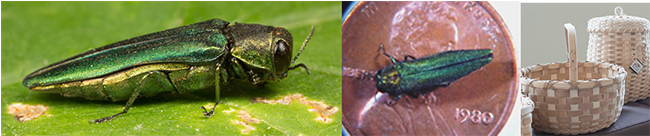 It may seem incredible that an insect, so tiny it can rest on a penny, can cause so much damage to ash trees and threaten the cultural lifeways of the Wabanaki, but it is here and the threat is real. Ash trees are important to forest ecology, and the brown ash, AKA black ash, (Fraxinus nigra) is used by Wabanaki for basket making. Maine Indian Basketmakers rely on ash to make Indian ash splint and sweetgrass baskets, the oldest documented arts tradition in New England.
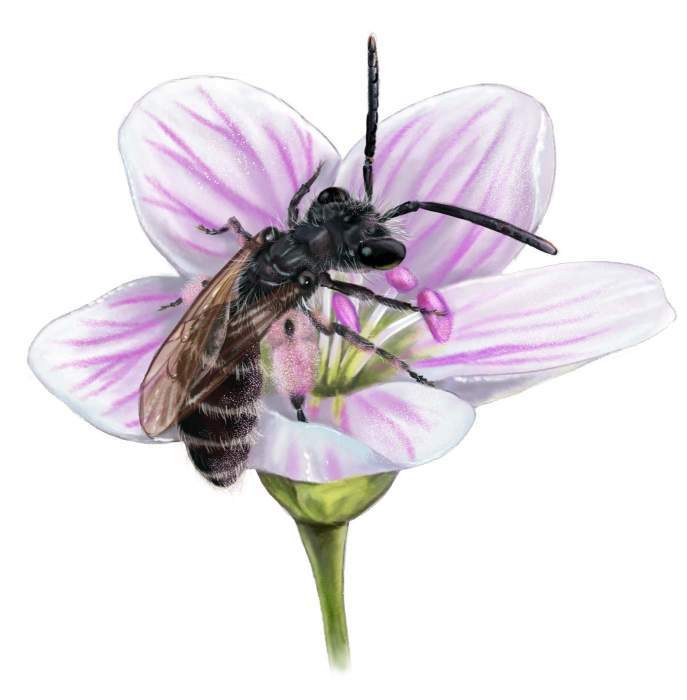 Northern Woodlands - There’s been considerable focus in recent years on enhancing bee habitat through meadow restoration and gardening with pollinator-friendly plants. But forests are also important to many bee species. New research by Rachael Winfree of Rutgers University shows that forest bees are also integral to the health and productivity of ecosystems across the region.
In a 2021 study, Winfree’s lab compared bees in forests to those in more familiar open habitats such as fields and developed areas. The researchers were hoping to determine how many species were found only in forests (termed forest-associates) and how other factors, such as forest size and age, affect the diversity of bee populations. They collected bees from forested and open sites across New Jersey, Pennsylvania, and New York and reviewed museum collections to see if they could draw any correlations between historic land use changes and bee diversity in the region. Read more...
Answering Four Common Carbon Questions
Biochar Use In Stormwater Management
Study Claims Living Walls Can Reduce Heat Loss in Buildings by Over 30%
May 7 - How to Create a Trap Tree to Monitor for Emerald Ash Borer Workshop - Greenwood
May 11 - The Science of Forest Carbon Management -Webinar
May 16 - Maine Arbor Day Celebration, Viles Arboretum. 1-3PM
May 16 - 22 - Maine's Arbor Week!
May 17 - Parks, Nature, Cities. Connecting to Health and Wellbeing.11AM
May 18 Forest Carbon Markets Overview and NRCS Forest Carbon Opportunities - Webinar
May 20 - Tree Planting and Mycorrhizal Fungi - How to Best Improve Soil Organisms for Shade Tree Vigor - Forestry Friday Webinar, 9AM
This webinar will be of interest to anyone who loves their shade trees. Dr. Anne Pringle, Univ. of Wisc., will discuss the importance of mycorrhizal fungi to tree vigor, if store purchased soil additives really work, soil transplants and invasive fungi. Dr. Pringle will highlight experiments trying to identify ways to improve urban and shade tree vigor.

|