Cunning Canine - Fox
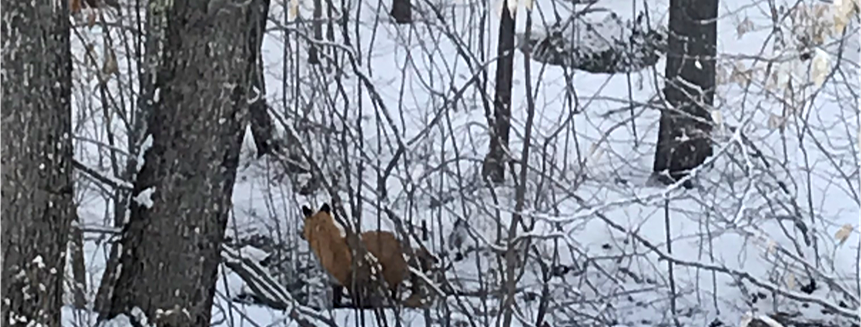
Red fox observed on March 10, 2022 while it was hunting.
Known for their intelligence, and called cunning because of some of their remarkable hunting strategies, foxes are always amazing to observe. A red fox recently caught my eye while I was enjoying an early morning coffee. I watched as it made its way around my home in search of food. It almost caught a grey squirrel that was not paying attention, made a few arching leaps with front foot pounces after something tunneling under the snow, and looked up at the mourning doves that were keeping a close watch from a not too distant tree. After about ten minutes the fox moved on out of view, and on I hoped to a successful morning meal.
I took the photo above through a window with my cell phone. It is not terrific quality but enough to mark a memorable moment without disturbing the fox. It was my best coffee break in a long time!
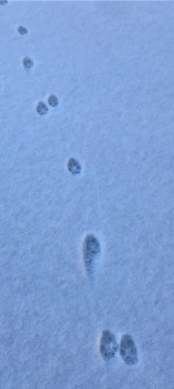
After it headed off I headed outside to have a quick look at its tracks. They were beautifully formed in the shallow snow across the driveway, and each footprint measured about one inch wide and two inches long. I use my fingers to measure. Width being the from the tip of my thumb to the first knuckle, and length being the tip of my index finger to the second knuckle. I've measured my fingers so they make great in-field stand-ins for a ruler.
Interesting Facts
- Foxes are more tolerant of living near people than coyotes. This tolerance helps foxes to avoid coyotes, which are fox predators.
- Foxes can climb trees but Gray Foxes (Urocyon cinereoargenteus) are better climbers than Red Foxes (Vulpes vulpes).
- Both red and gray foxes live in Maine but the grey fox is not statewide. It's current range is in the southern and mid-coast areas.
- Foxes are omnivores, meaning that they eat a wide variety of plants and animals. Lean more about foxes and what they eat at this Maine IFW webpage about foxes.
|
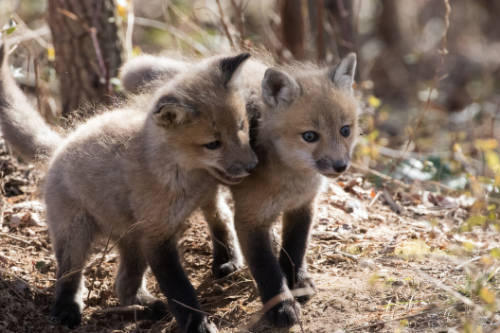 |
Two red fox kits (young) exploring the woodlands near their den. Photo courtesy of the U.S. Fish and Wildlife Service.
Activities for Children and the Young at Heart
- Visit your local library and see how many books you can find that feature folklore about foxes. Check a few out to read. Can you tell what people thought about foxes by reading the stories? Did they admire them? Did they fear them? Was it a combination? Why do you think this is?
-
Learn about foxes at the Maine IFW fox webpage. What do you find most interesting? What do you admire about foxes?
- Find out what color foxes eyes are when they are born. What color where your eyes when you were born?
- Make a game of fox trivia and play it with your family or friends. One person reads the clues to the others, who as individuals or in teams, ring in to try to answer.
- Keep a watch for foxes or their tracks - which are easiest to see in snow, or in light mud. This Maine Animal Tracks poster will help you on your next tracking adventure!
- Find out how many kinds (species) of foxes live throughout the world. Do they all live in the same kind of habitats?
Share Nature Note with your friends, family, teachers, scouts, and anyone you think might be interested. Here is how they can sign up for a free subscription:
Read back issues online.
Suggest a topic by email; put Nature Note in Subject line and email Jocelyn Hubbell.
|