Bent, Scattered, Reflected: Blue
Have you ever seen snow or ice glow a beautiful turquoise blue? On your winter explorations keep an eye on snow and how it reflects light. Compare snow on level ground to that on rolling hillsides to snow that is mounded up and has cracks and hollows. I've seen a turquoise glow shimmering from narrow cracks in snowbanks along driveways and roads.
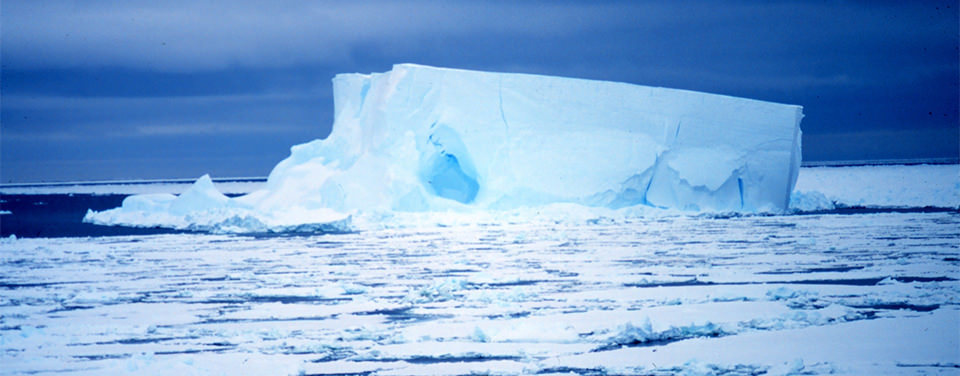
Iceberg in the Ross Sea, Antarctica. NOAA image.
Why does snow, ice, glaciers and icebergs sometimes glow blue? Color is all about light and how it is either absorbed, reflected, bent, or scattered when it hits an object or surface. We see light as a transparent brightness, called white light. White light is actually made up of colors. If you've seen a rainbow you know what they are. Can you name them? Remembering ROY G BIV may help... Red, Orange, Yellow, Green, Blue, Indigo, and Violet.
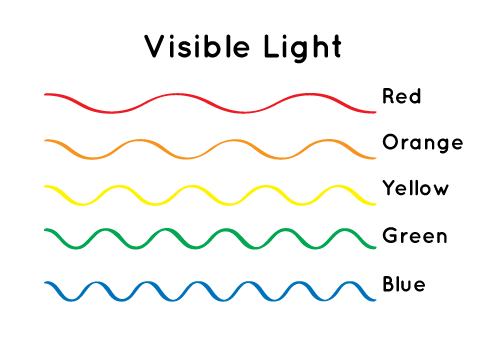
Light moves in a straight line, but with side-to-side waves as it does. Each color within white light has a different wavelength. Look at the drawing below. Which color has the shortest wavelength - the shortest length between a low point in the wave and the next highpoint? Which color has the longest wave?
Wavelengths of light compared. NASA image.
You only see the light that is not absorbed by the object. So, when you look at the iceberg photo - what light is being absorbed and what light is being scattered and reflected back?
Remember - light moves in a straight line unless something gets in its way, then depending on the surface condition of what it hits it is either absorbed (taken in), reflected (like your image by a mirror), bent (as a by a prism), or scattered (by fine a particles in the atmosphere or in water). Blue light is scattered more than other light because it travels in smaller wavelengths. Think about this then describe:
- Why is a the sky often blue? And on some days a deeper blue than others?
- When does a sky appear red? Why?
- Why does the ocean surface and coastal waves often appear blue or turquoise blue?
- What could make the ocean appear green or brown?
Activities for Children and the Young at Heart
-
Make a Rainbow. You'll need: a glass of water; small mirror that can be placed in the glass; a flashlight, a room that can be darkened. Then: Place a glass of water on a table. Put the mirror in the water at an angle. Darken the room. Shine the flashlight beam on the mirror. What do you see? Experiment by changing both the depth of the water in the glass and the angle of the mirror. Predict what will happen before you make a change and note if you hypothesis was correct. Why do you think rainbows form during a rain shower or when the sky is filled with mist?
-
Make a Light-reflecting Snow Sculpture. Build up a large mound of snow then carve out deep and shallow cracks, large and small recesses, and add angles to the top and sides of your sculpture. Watch it at various times of day - during the angled light of morning and later afternoon and the more overhead light of noontime. Note the time and sky conditions when you observe color changes to your sculpture.
-
Keep a Blue List or Play Blue Bingo. Make a note of all the times you see blue in nature: plants, animals, rocks...Can you make a list now of all you've seen before? Create a bingo board for Blue and play Blue Bingo on your next road trip or outing. Add a few human-made objects to your blue list for a fun game adaption.
-
Blue Paint - Blue is a primary color, so you cannot mix two colors together to make blue, but you can change the hue of blue by adding other colors to it. And you can also make new colors. Try mixing blue and yellow. What color do you get?
Share Nature Note with your friends, family, teachers, scouts, and anyone you think might be interested. Here is how they can sign up for a free subscription:
Read back issues online.
Suggest a topic by email; put Nature Note in Subject line and email Jocelyn Hubbell.
|