Who Goes There? Owls!
Listening to the hoots, screeches and whistles of owls is a nighttime treat any time of year and most enchanting on a full moon winter evening. Eleven species of owls live in or visit Maine for all or part of the year. Listen for the:
-
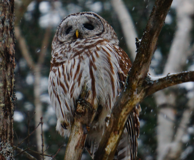
Who cooks for you, who cooks for you-all? of the Barred Owl (Strix varia)
-
Who Who's Awake? of the Great Horned Owl (Bubo virginianus)
These mnemonics, the words or phrases used to remember bird calls, will also help you to mimic the calls you hear. Compare them to the recordings that are available at each of the above links. As most bird watchers will tell you, bird watching really starts with bird listening. With a little practice you'll be able to identify birds just by their calls and songs.
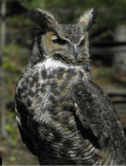
Great Horned Owls live throughout Maine and will be nesting soon. They pair up from mid-January to mid-March. Listen for pairs calling back and forth during this time as they raise their young. Keep your flashlight off or, better yet, red-covered so it does not disturb the owls, especially during the breeding and nesting season.
|
Barred Owls also live throughout Maine but prefer mature mixed forests with wetlands or waterways. Once they find a location they like, they like to stay put, but being very wary of Great Horned Owls, their primary predator, they will move around their territory or relocate to avoid them. So do not expect to hear Barred Owls where you hear or see Great Horned Owls. |
|
 |
Here are links for photos and information about the other nine owls that may be found in Maine: Barn Owl, Boreal Owl, Great Gray Owl, Long-eared Owl, Screech Owl, Northern Hawk Owl, Northern Saw-whet Owl, Short-eared Owl, and the Snowy Owl.
Interesting Facts
- Owls' wings are designed for silent flight. The ends of the feathers look frayed and tattered, but this is an adaptation that lets air move through the feather ends and results in very quiet flight.
- Owls have great vision and hearing. Their vision is adapted for night time hunting. Their hearing is so acute that they can hear a mouse scurry or squeak across the distance of a football field!
Activities for Children and the Young at Heart
- Using the owl links above make a chart of the owls that shows preferred habitat, preferred food, nesting season, and time of year when they would most likely be found in Maine. This chart will help you know when and where to listen for each owl.
- Go out on a night hike to listen for owls; or sit and listen from outside your home.
- Think about the silent flight of owls. There are two reasons why this is important... Hint - think of who might hear them... and who they need to be able to listen for.
- Go to a football or soccer field with a friend or family member. One of you stand at each of the field. Can you hold a conversation if you are whispering? How loudly do you need to talk to hear each other?
- Read Owl Moon, a picture book, by Jane Yolen
- Read One Man's Owl by Bernd Heinrich, or his One Man's Owl - The Naturalist's Notebook.
Share Nature Note with your friends, family, teachers, scouts, and anyone you think might be interested. Here is how they can sign up for a free subscription:
Read back issues online.
Suggest a topic by email; put Nature Note in Subject line and email Jocelyn Hubbell.
|