Fascinating Freeze: Frost
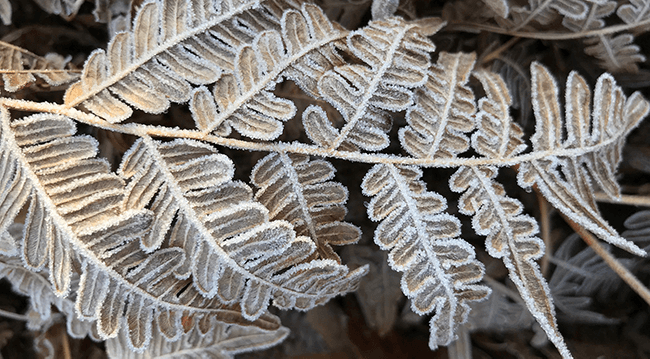
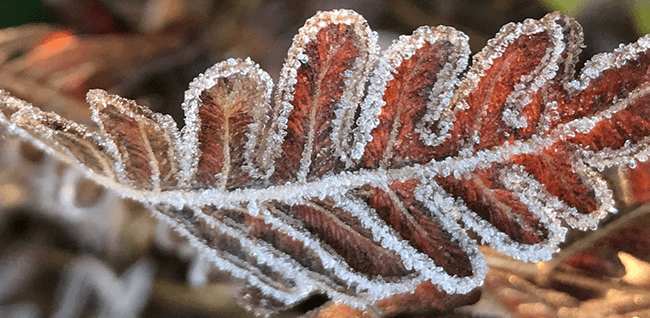
Early morning walks are magical this time of year...just look for the glistening of frost covered leaves, ferns and grasses. On hillsides and warmer areas you may see sparkling morning dew, water droplets that condensed from the water vapor in the air as temperatures cooled the previous night, rather than frost. As you descend into a low-lying area use all your senses to see, feel, and smell the temperature change. Can you find the point on the hillside where on one side of you is dew and the other is frost?
Interesting Facts
-
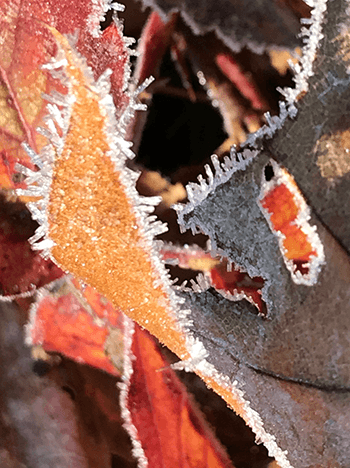
Jack Frost is the personification of frost and frosty cold temperatures. Have you ever heard someone say, "Jack Frost is nipping at your nose"? Have you ever felt that sensation?
- There are many different kinds of frost: window frost, hoarfrost or radiation frost, rime, and advection or wind frost among them.
-
Rime of the Ancient Mariner by Samuel Taylor Coleridge is a rhyming poem about rime.
- Frost can damage fruits, vegetables and growing plants. Plants naturally hold water within their stems, branches, roots and fruits. As the water within the plant freezes into solid ice it expands and can destroy plant tissue. This is why in preparation for winter many plants drop their leaves, send their food reserves deep into their roots, and go dormant. Other plants die off above ground, losing all their above ground stems and foliage, but retain their below ground roots, corms, or bulbs that will lie dormant until springtime when they will send up new above-ground growth. Still others, that are not adapted to survive winter, will die off completely.
|
Activities for Children and the Young at Heart
- Head out on a frost hike. Try an out-and-back hike so that you are returning on the same path you went out on. Are the frosted areas still frost covered on your return? Why or why not?
- Look for stories, poems, songs and artwork about frost. How many can you find? Which do you find the most interesting. Does it inspire you to write or make art of your own about frost?
- Find the origin story of Jack Frost. How far back in time did this story start? Where did it start? Why did it start? Have you heard of other story characters with frost in their names?
- How many different kinds of frost can you find? Under what conditions does each type form?
- Make a list of your favorite plants. Find out if they can survive winter and how they do it.
- How do farmers and fruit growers protect their crops and fruits from frost? How do they know when a frost will occur? Here are some resources to get you started:
- Plan a vegetable garden - it can be virtual or one you plan to actually plant next year. What plants are more cold tolerant than others? This University of Maine Cooperative Extension guide to planting a vegetable garden will help you learn more.
 |
Share Nature Note with your friends, family, teachers, scouts, and anyone you think might be interested. Here is how they can sign up for a free subscription:
Read back issues online.
Suggest a topic by email; put Nature Note in Subject line and email Jocelyn Hubbell.
|