Twiggy - Northern Walkingstick
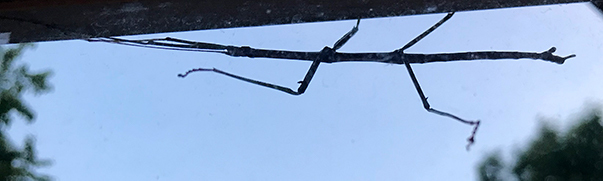
Maybe some of you remember Twiggy, Dame Lesley Lawson, and think of her and the 1960's on any mention of twigs. Like Twiggy, today's creature feature is very slender - stick-thin as Twiggy was. It appeared on a recent morning clinging to the outside of a second story window. Below is my photograph.
Northern Walkingstick clinging to the outside of a window.
I'd not seen a Walkingstick for many years so was very excited to see this one, but hoped it would move on from its exploration of the house exterior back to the safety of the the adjacent woodland where it would naturally blend in and be camouflaged from crows and other birds that find it a tasty meal.
August is a good time to be on the lookout for walkingsticks. These solitary insects are now looking for each other; they breed August through October. Gestation is a short 11 to 17 days (maturation of eggs in the womb), then the female drops the eggs, one at a time, while she is perched high in a tree. The eggs land in the leaf litter below where they will overwinter until springtime. Hatching begins mid-June and lasts through July. Successful hatching is dependent on moist conditions to soften the egg's normally hard casing, allowing the walkingstick nymph to break through. Once hatched, the nymph will crawl up a tree, generally in the cover of darkness, and start feeding on leaves. Nymphs molt four to six times before becoming an adult. They are reproductively mature at 80 days.
Interesting Facts
- Females are larger (longer) than males and have both brown and green coloration. Males are all brown. Length ranges from about 2.75 to 3.75 inches.
- Walkingsticks can regenerate (grow back) their legs. They will release a leg to a predator, such as a bird, so that they may escape and regrow the leg.
- When predators are present the walking stick will draw in its legs so that they are close to its body to more closely resemble a twig. They will remain motionless until the predator is gone.
- Walkingsticks are skeletonizers. This means that when they eat leaves they leave nothing but the leaf veins when finished.
- Adult walkingsticks prefer to feed on oak leaves, but diet varies by availability. Nymphs are voracious (always hungry) and less choosey about what they eat.
- Much is unknown about walkingsticks, including their: lifespan, communication, and the size of their territory.
- They are very rarely seen due to their spending most of their time high in treetops, their well camouflaged body, and their very slow movement.
- The eggs of walkingsticks look like seeds and contain a chemical that attracts ants. It is thought that the ants take the eggs back to their nest, feed on the attractant, then leave the egg, unharmed, at the bottom of their nest. In this way the egg is protected from predators while it overwinters. The Northern Walkingstick (Diapheromera femorata) egg looks like a bean (legume) seed.
Activities for Children and the Young at Heart
- Can you find the head end of the walking stick in the photo? Hint: the head end has long antennae that are about 1/3 of the total body length of the walkingstick, and the front pair of legs are generally stretched out along the antennae when the walkingstick is at rest.
- How many legumes can you name? Do you know what their seeds look like? How many kinds are in your kitchen? Or, in your local grocery store? How many legumes do you eat?
- Build a model of a walkingstick. Use paper scraps, wire scraps, or other easily recycled materials. Maybe you have fallen twigs in your yard that you can use. If you prefer drawing, make a sketch. How many of its body parts can you name or label?
- Learn more and view photos of Northern Walkingsticks at iNaturalist.
- View the Giant Walkingstick and compare it to the Northern Walkingstick and other insects. Does the Giant Walkingstick live in Maine? What is the extent of its range? Hint: This BugGuide source may help.
Share Nature Note with your friends, family, teachers, scouts, and anyone you think might be interested. Here is how they can sign up for a free subscription:
Read back issues online.
Suggest a topic by email; put Nature Note in Subject line and email Jocelyn Hubbell.
|