Tenacious - Milkweed for Monarchs!
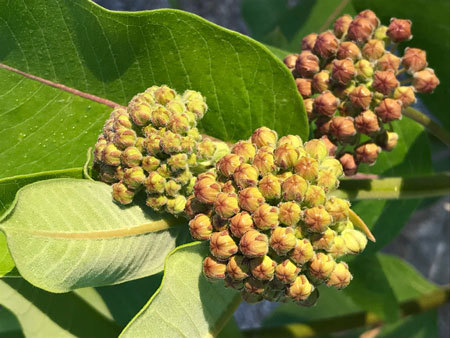
Milkweed flower buds.
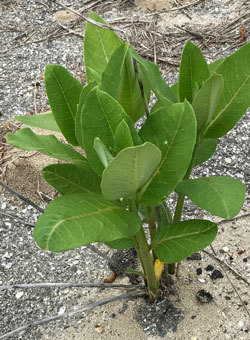
On a recent walk I was struck by the tenacity of a common milkweed plant (Asclepias) I saw growing up through layered asphalt and gravel. The power of nature to persist and endure human-created impacts always amazes me. But, this tenacity and persistence does not mean that we do not need to consider our impact on nature, or turn away from our responsibility to nurture nature and live in balance with all life on Earth. We need to be just as tenacious and persistent in our partnership with all these lives.
Milkweeds are in partnership with the insects that pollinate them. The partnership benefits both the milkweed and the pollinators: the milkweed provides nectar - a food source for the insects; the insects aid in pollination - which allows the plant to produce seeds.
Milkweeds form paired sacs of pollen (pollinia), rather than individual grains, and rely on large butterflies to carry them from plant to plant.
|
Interesting Facts
- Large butterflies are the best pollinators of milkweed.
- Insects that feed on milkweed nectar but are not strong enough to lift the nectar sacs have to work hard to be released from the flower. Why does this benefit the milkweed? Do you think an insect that has to struggle so hard after a sip of nectar is likely to try feeding on milkweed again? Will it try a different plant?
- Monarch butterflies lay their eggs on milkweeds - one egg per leaf. When the caterpillar emerges from the egg it is very hungry. What do you think it eats?
-
Monarchs overwinter in Mexico. They migrate north in the springtime. The monarchs that reach Maine have been born along the northward migration route. The last generation of the summer born in Maine will migrate back to Mexico.
Activities for Children and the Young at Heart
- Find a milkweed plant in a field. Watch it grow and observe the insects that visit it when it flowers. Do you think all the insects will be flying insects? Make you predictions then record what you observe.
- Consider planting a milkweed in your yard or garden as part of a butterfly garden.
- Learn about the lifecycle and migration of monarch butterflies at MonarchWatch.org Check out their Monarch Waystation Program, gardening tips, and citizen science / student-scientist research programs.
- Learn how to say butterfly in Spanish (mariposa) and consider finding a pen pal in Mexico to chat with about the monarchs - what they need there, and what they need here in Maine to survive.
- Think about how we are all connected and that our actions will always circle back to us eventually. What are some things you can do to help make good connection circles? How many lives can you name that are connected to the milkweed-insect circle?
Share Nature Note with your friends, family, teachers, scouts, and anyone you think might be interested. Here is how they can sign up for a free subscription:
Read back issues online.
Suggest a topic by email; put Nature Note in Subject line and email Jocelyn Hubbell.
|