Moccasins and Slippers of Forest and Field - Maine's Orchids
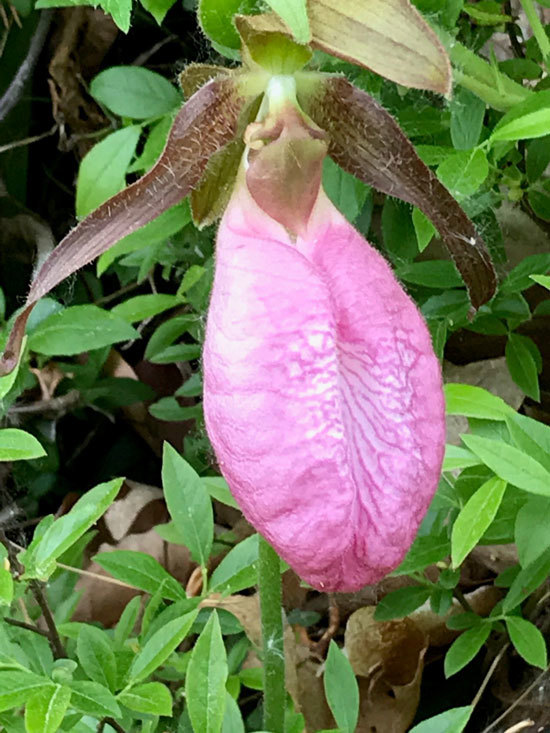
Moccasins and slippers tip toe through Maine's forest and fields - these silent beauties are of the botanic kind - Maine's wild orchids! And, now is the time to view them. I've spotted Moccasin Flowers, also known as Pink Lady's Slippers (Cypripedium acaule), over the last week. It is one of many Lady's Slipper orchids.
Pink Lady's Slipper or Moccasin Flower (Cypripedium acaule). All photos by Jocelyn Hubbell.
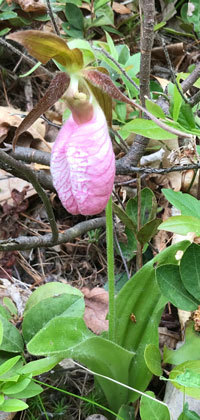
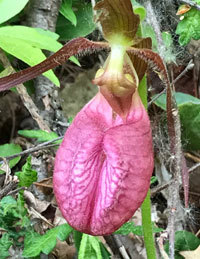
Pink Lady's Slippers can be a showy bright pink (magenta) or a deep pink (mauve). In a group of five that I am watching develop, there are four magenta and one mauve Lady's Slippers.
Once you see one Lady's Slipper, look for others within three to five feet of the first. Be sure to:
- Look from a fixed point - keep still in your spot so that you do not step on one by mistake.
- Enjoy them where they are. This will help them thrive. Maine's wild orchids need special conditions and do not survive transplanting.
- Look for them again each year - during late May and early June - and note if they have returned to the same location or if they are "tip toeing" into another area. Why do you think the plants may stop growing in some areas and move into others?
Since 1998 the Coastal Maine Botanic Gardens has studied and conducted surveys of the Pink Lady's Slippers that occur naturally at the Garden. The main goal of their study has been to keep the orchids thriving at the garden for visitors to view while recording data that will, when analyzed, add to the documented natural history of the orchids. Their questions include:
- How often will a single plant flower in a 20-year period?
- How do single plants form clumps of multiple flowering plants?
- How do the groups of plants affect each other? What are the population dynamics?
|
 |
|
Interesting Facts
- There are at least 25,000 species of orchids worldwide. Only about 10,000 of these are found in the tropics.
- Orchid plants and flowers range from tiny to huge. Some orchid plants have weighed in at a ton with sprays of flowers over twelve feet long and individual petals up to 30 inches long!
|
Activities for Children and the Young at Heart
- What common name would you choose for the Pink Lady's Slipper if you were the one to name it? Why?
- Keep a look out for Lady's Slipper orchids when you are hiking. Visit the U.S Forest Service Guide to the Lady's Slipper Orchids to learn more about the many kinds and their distribution in the USA.
- Learn about Maine's Lady's Slippers and about the two that are of special concern or endangered in Maine, courtesy of the Maine Natural Areas Program:
- Visit the Coastal Maine Botanic Gardens and see how many Pink Lady's Slipper Orchids you can spot. Ask about their research. I visited several years in a row just to see how the pattern of flagged orchids changed from year to year.
- Compare and contrast The Showy Lady's Slipper to the Pink Lady's Slipper. How are they alike and how are they different?
- Did you know that there are other kinds of wild orchids in Maine? Take a guess about how many there are, then start researching! Can you find out the smallest and largest Maine orchids?
Share Nature Note with your friends, family, teachers, scouts, and anyone you think might be interested. Here is how they can sign up for a free subscription:
Read back issues online.
Suggest a topic by email; put Nature Note in Subject line and email Jocelyn Hubbell.
|