May 15 – 22, 2021
Maine celebrates Arbor Week and National Invasive Species Awareness Week.
Today, the Maine Department of Agriculture, Conservation and Forestry is celebrating Acer rubrum - the Red Maple.
The red maple tree (Acer rubrum) has a native range that extends from Newfoundland to Florida, the only tree species to do so. It is common in the forests of Maine and New England and contributes significantly to the beautiful fall foliage that attracts millions of people to the area every year. In fact, the fall colors of the red maple tree are so attractive that many ornamental cultivars have been bred and sold all over the U.S. With names like 'Red Sunset' and 'October Glory', these ornamental versions of the native red maple adorn many a residential landscape.
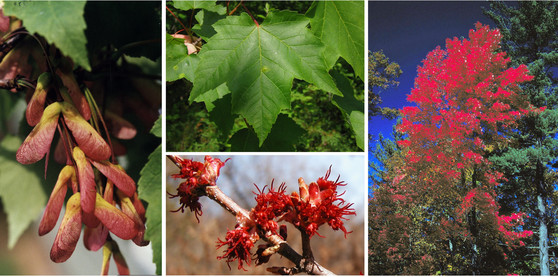 |
Features of the red maple tree (Acer rubrum) – left, winged fruit about ¾” long (photo by Bill Cook, Michigan State University, Bugwood.org); top center, leaf has 3-5 lobes with V-shaped notches (photo by Keith Kanoti, Maine Forest Service, Bugwood.org); bottom center, flowers are produced in the spring before bud break (photo by Dow Gardens, Bugwood.org ); right, a red maple tree in the fall (photo by Robert L. Anderson, USDA Forest service, Bugwood.org)
Two important invasive insects prefer red maple over most other trees, so learning to recognize these insects will go a long way to saving the iconic red maple. Thankfully neither have been found in Maine, but please keep your eyes out and report any suspect finds to bugwatch@maine.gov. Don't forget to get pictures.
The Asian longhorned beetle (ALB) has yet to be found in Maine, but its ability to show up in a new area without being detected for many years makes it a major threat. By the time the adult beetle is noticed, hundreds to thousands of trees are likely already infested.
ALB attacks many types of deciduous trees, but its favorite host in the U.S. seems to be red maple. Early detection efforts focus around surveying maples trees outside areas of known infestations. Today, ALB is known to be in 4 states - Massachusetts, New York, Ohio, and South Carolina - but it used to be in Illinois and New Jersey before it was successfully eradicated. Yes! ALB is one of the few invasive pests that can be eradicated from the U.S., but successful eradication relies on early detection.
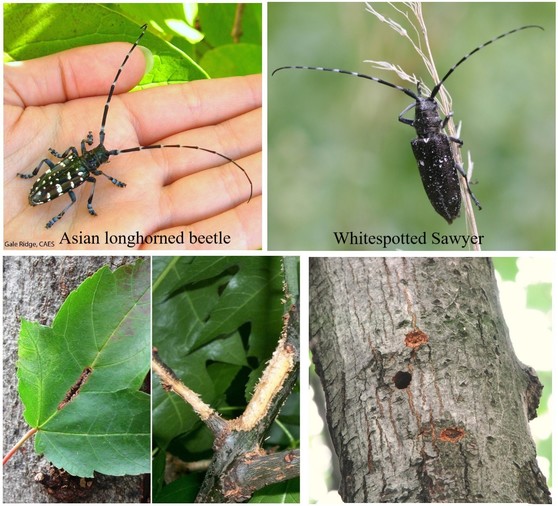
Learning to recognize early signs of ALB! Right now, a lookalike longhorned beetle native to Maine has emerged from its coniferous hosts but there are helpful ways to tell them apart. But if you have doubts, take some photos and send to us anyway.
The Asian longhorned beetle adult is a large glossy black beetle with very long antennae. Maine has native woodboring beetles that look similar, like the whitespotted sawyer. If you see a longhorned beetle in May or June, it is NOT ALB. Look for the white dot behind the neck area and the textured bronzy wing covers of the sawyer beetle (photos by Gail Ridge, CAES; Whitney Cranshaw, CO State University ). Other signs of an ALB infestation are chewed veins of broadleaves and large round holes near chewed depressions on the bark of maple trees (photos by Bugwood.org)
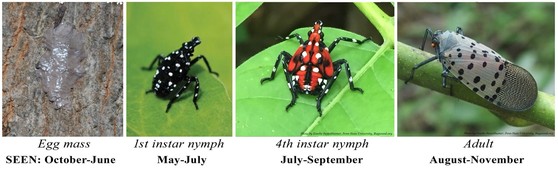
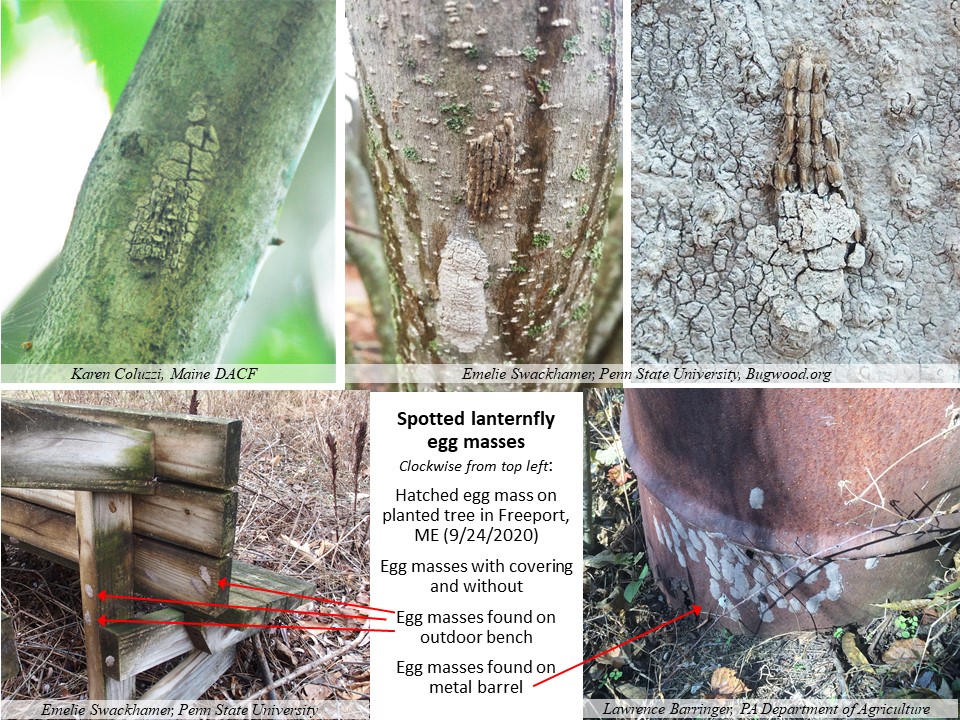
The spotted lanternfly (SLF) is another insect not detected in Maine, but its ability to hitchhike and spread rapidly has many plant health professionals very concerned. With a host list of over 100 plant species, including the highly invasive tree of heaven (Ailanthus altissima), SLF is a major threat to fruit industries, horticulture, and forestry. SLF adults prefer to lay eggs on maple trees, including nursery stock that is shipped around the country. Egg masses are difficult to see, but please keep your eyes open for them especially on red maple nursery stock.
This time of year, small black and white nymphs are hatching from the overwintering egg masses. Please report to bugwatch@maine.gov if seen. (photos by Emelie Swackhamer, Penn State University, Bugwood.org)
If you see either of these insects or signs of infestation, please take photos or collect the actual insect and let us know! Bugwatch@maine.gov
Invasive Species Events During Maine Arbor Week and National Invasive Species Awareness Week, 2021
Check out Maine Arbor Week events presented by the Maine Audobon.
Spread awareness and celebrate the state's trees.
Take your National Invasive Species Awareness Week commitment beyond this week. Tell your friends, family, neighbors and others about invasive species! It's a big state, and we can't get the word out to everyone without your help. Encourage them to get involved with National Invasive Species Awareness Week in their own way. Here are some resources to help get started:
|