May 15 – 22, 2021
Maine celebrates Arbor Week and National Invasive Species Awareness Week.
Today, the Maine Department of Agriculture, Conservation and Forestry is asking residents and visitors to take time out this week and learn about non-native, invasive trees that harm our forests and other natural areas.
We all love trees, but a few of them don’t love us back. Some trees are invasive bullies that don’t provide the food resources needed by Maine’s birds and critters. They also spread into areas where we don't want them, competing with our native trees and changing our forests. These two trees highlighted here are so bad that they are no longer allowed to be sold in Maine and many other states.
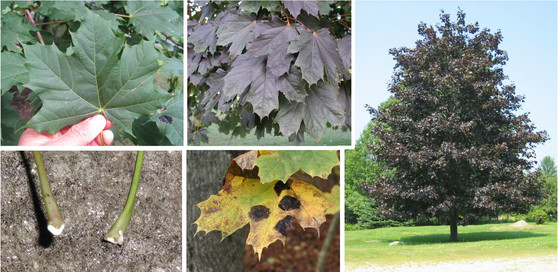
One of the worst offenders is Norway Maple (Acer platanoides), which is native to Europe and thrives in a wide variety of conditions. Norway maple is a prolific seed producer and sprouts everywhere. Known by some of its cultivars, Crimson King and Emerald Queen, it is a rapidly growing tree that has been planted across Maine as a street and shade tree. With the intense shade it casts, it takes over entire forest areas, crowding out the native red maple and the sweet sugar maples. Yet the insects that feed our birds do not find it tasty and its deep shade weakens and kills many forest wildflowers. Because of its aggressive nature, Norway maple is considered to be a serious threat to our native plants and it should not be planted in Maine.
Norway maple can be distinguished from other maples by the leaf shape, which is generally wider than long, and the milky sap that exudes from the leaf stem when broken. Norway maple leaves are also highly susceptible to tar spot, a fungal disease that doesn't hurt the tree but often ruins its appeal.
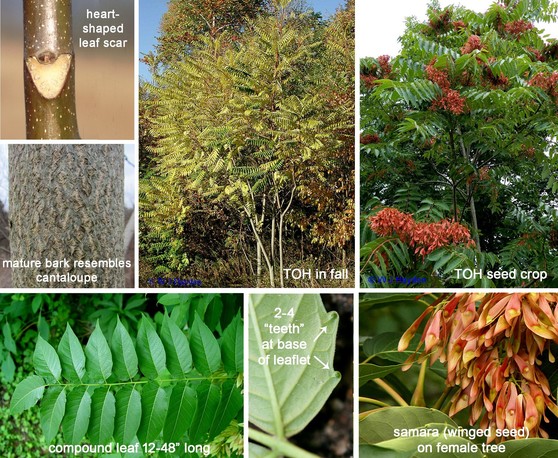
Tree of heaven (Ailanthus altissima) is a non-native tree from China that was introduced to the U.S. in the late 1700s as an ornamental. Because of its hardiness and ability to grow in harsh environments, it was widely planted as a street tree. Today, it is considered one of the most noxious plants due to its severe invasiveness and its foul odor.
Other characteristics that make this tree so bad is that it inhibits the growth of beneficial native plants, reducing food sources for native insects, leading to less food for baby birds. And tree of heaven is the preferred host to the destructive spotted lanternfly (Lycorma delicatula), an invasive insect wreaking havoc on grapes, hops, maples, and apples in Pennsylvania and New Jersey.
Little is known about the distribution of tree of heaven in Maine (biologists know of a handful of locations in southern Maine), so we welcome reports of sightings of this tree. By learning to identify and report tree of heaven, you can help biologists keep spotted lanternfly out of Maine, and keep tree of heaven from taking over valuable habitats. Please become familiar with this tree; it looks a lot like sumac (Rhus spp.), with important differences as indicated in photos below.
Please report any sightings of tree of heaven to invasives.mnap@maine.gov
- May 18, 2–3pm, The Model Legislative Framework for State Aquatic Nuisance Species (ANS) Programs and Resource Toolkit for Local Governments
- May 19, 12-1pm or 7-8pm, Gardening the Beech: Balancing Two Options
- May 19, 2–3pm, The Regulatory Process for Classical Weed Biological Control
- May 20, 12-1pm, Diseases of Landscape Trees
- May 20, 2–3pm, Aquatic Plant Management Priorities
- May 21, 2–3pm, A Comparison of State Noxious Weed Lists and The Western Weed Action Plan
Check out Maine Arbor Week events presented by the Maine Audobon.
Spread awareness and celebrate the state's trees. Take your National Invasive Species Awareness Week commitment beyond this week. Tell your friends, family, neighbors and others about invasive species! It's a big state, and we can't get the word out to everyone without your help. Encourage them to get involved with National Invasive Species Awareness Week in their own way. Here are some resources to help get started:
|