A Beautiful Unfurling: Ferns
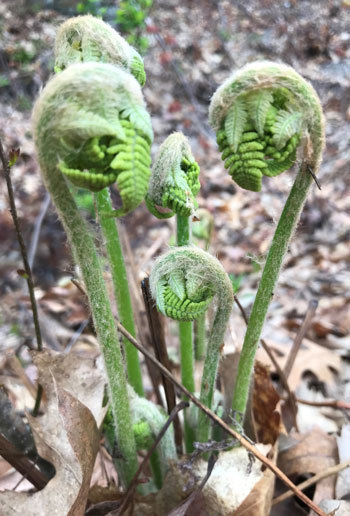
A fern beginning to unfurl fronds. Photo by Jocelyn Hubbell.
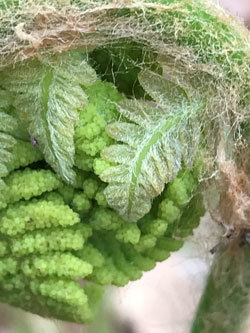
The unfurling or unrolling of a fern frond is fascinating to watch. Look now in woodlands, along wet woodland edges, and wetlands for ferns in the fiddlehead stage. It starts as a slow reveal but can be over in a matter of a few days once it begins.
In the meantime, take a look at these photos. Inside that tightly rolled fiddlehead is an entire frond, or leaf. Tiny leaflets (pinnules) are waiting to expand and flatten outward on either side of a stem. As a group, the pinnules are just one section, or one pinna, of the entire leaf. The fern frond is made up of many pinna.
The fern pictured here has a hairy stem - a good sign that is not the edible variety of fiddlehead.
|
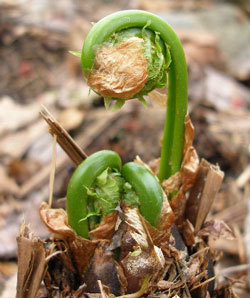
Ostrich ferns in fiddlehead stage are sought after for eating - a springtime Maine tradition - and are sold at farmer's markets, roadside stands, and grocery stores. Other fiddleheads are not edible, so make sure you know what you are eating. The University of Maine Cooperative Extension bulletin Facts on Fiddleheads describes how to identify, harvest, cook, and preserve fiddleheads. (Ostrich fern fiddlehead photo by David Fuller, U-Maine Extension.)
Please remember that recreational fiddlehead gathering is allowed on the Bureau's Public Lands, but not allowed on Maine State Parks. Please harvest sustainably where you have been given permission to do so.
Interesting Facts
- Fiddleheads get their name because they look like the scroll of a violin or fiddle.
- Ferns are ancient plants. Some first appear in the fossil record 360 million years ago! Compare that to when dinosaurs show up in the fossil record - about 230 million years ago.
- Ferns come in many shapes and sizes. If you are interested in planting native ferns on your property, check out this guide by the Wild Seed Project.
Activities for Children and the Young at Heart
- Check out the Fern Coloring Pages provided by the US Forest Service.
- Record the number of different kinds of ferns you see during outside explorations. How are they similar? How are they different?
- Look at one fern frond. Does it have pinna, and pinnules? Do you see a repeating pattern? If so, what is it?
- How many kinds of ferns exist in Maine? How many in the USA? How many in the world? Make a guess first, then search for the answers. Of all you find, do you have a favorite? Why?
- Look up the rules of principles of sustainable harvesting/picking of wild food plants. How many lists can you find? Do they agree? Why is it important to share? Who are we sharing with? Is it just other people, or do others need the wild edibles that we eat to survive as well?
|
Share Nature Note with your friends, family, teachers, scouts, and anyone you think might be interested. Here is how they can sign up for a free subscription:
Read back issues online.
Suggest a topic by email; put Nature Note in Subject line and email Jocelyn Hubbell.
|