Spring Run: Return of the Fishes
The spring run – the return of fishes - is just beginning. American eel elvers are the first to arrive, followed a few weeks later by River herring. American shad arrives next, coming in just before alewife. Blueback herring arrive last, late in the alewife run. The different species of fishes co-evolved to interact in a web of life. Arriving river herring provide a protective predator cover for juvenile Atlantic salmon (called smolts) as they migrate out to sea. Even freshwater juvenile mussels (called spat) develop at just the right time to catch in the gills of the incoming river herring to travel upstream with them.
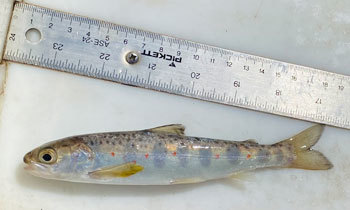
Atlantic salmon smolt on 3/14/2021 in Sandy River caught on its way out to sea. Photo courtesy of Maine Department of Marine Resources.
Eels are fascinating and the least understood. Mature eels (8-25 years old) leave the brackish/freshwater growing areas in the fall (August to November), migrate to the Sargasso Sea – an area of the Atlantic Ocean east of the Bahamas and south of Bermuda – where they spawn (lay eggs) during the late winter then die. The eggs hatch after several days. Each egg develops into a larva that looks like a willow leaf. The larvae drift in the ocean for several months. Those that survive predation enter the Gulf Stream current and are carried northward to the coast of North America. On this journey the eels grow from leaf-shaped to eel-like and transparent. They are now called “glass eels”. As glass eels leave the open ocean to enter estuaries and ascend rivers they are called "elvers". This migration occurs in late winter, early spring, and throughout the summer months. Some elvers may remain in brackish waters (mixture of ocean and fresh water) while others swim rivers far inland. On each stage of their life and leg of their journey the eels are predated. What percentage of eggs do you think survive to grow to adults?
See Nature Note 21 for related alewife research and restoration of the Cobbossee watershed.
Thank you to Steve Brook for suggesting the topic and providing notes to get me started!
Interesting Facts
- Eels are the only catadromous fish on the east coast – they spawn in the ocean and migrate to fresh water to grow to adult size.
- Shad have long been called, “poor man’s salmon.”
- Alewife return to the lakes and ponds the were born in. Alewives are a key food source for many fishes, including cod, haddock, and striped bass, and are a traditional early spring table food for Mainers. They are also caught for lobster bait.
Activities for Children & the Young at Heart
- Watch the run of fishes – start looking now through about Memorial Day. These resources will help you get started:
a. Maine Alewife Trail Map by MaineRivers.org
b. The Androscoggin River Fish Passage in Brunswick is located behind (north of) Fort Andros and just across the street from Brunswick’s 250th Anniversary Park.
c. Milford Dam fishway on the Penobscot River at Brookfield Energy – opened for 2021 on 4/15. The Penobscot River is known for the largest Atlantic salmon run in the USA. Read about 2020.
d. Webber Pond outlet in Vassalboro - Boat launch and nearby Wildlife Habitat Area.
-
Fish Returns Trap Counts by the Maine Dept. of Marine Resources.
a. Try making an artistic fish migration chart to tell the migration story of one or several species. For inspiration view the art of Maine artist Jill Pelto.
- Learn about the Citizen Science Project to collect data about Rainbow Smelt - A partnership of the Downeast Salmon Federation, The Nature Conservancy, and the Maine Dept. of Marine Resources in collaboration with the Gulf of Maine Research Institute.
- Learn more about river restoration and the impact of dams to fishes, other wildlife, and the people of the rivers. Here are a few resources to get you started:
a. Restoring the Penobscot River:
i. The Nature Conservancy
ii. The Penobscot Nation
iii. View Celebrating the Progress for the Penobscot River on the Natural Resources Council of Maine website.
b. Restoring Maine Rivers – Alewife restoration on the Kennebec and Androscoggin Rivers:
i. Senator George J. Mitchell Center for Sustainability Solutions
Share Nature Note with your friends, family, teachers, scouts, and anyone you think might be interested. Here is how they can sign up for a free subscription:
Read back issues online.
Suggest a topic by email; put Nature Note in Subject line and email Jocelyn Hubbell.
|