Nature Note

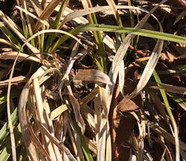
This is my favorite time of year to discover who is wearing the green. I walk the fields looking for the first green shoots of grass pushing up though snow or layers of matted brown blades from last year’s meadow. I greet the leaves of plants that are activating their chlorophyll to catch sunlight and make their first fresh food of the season.
Photo: Blades of grass just beginning to green up in a meadow.
|
Plants, just like us, need food. But unlike us – they can make it. Aha! you say – we make food all the time, you say… we make cakes, and salads and all sorts of breakfasts and lunches and dinners and desserts. But that is not making food… that is using food items to make special meals. Plants make (synthesize) food. They take non-food items and make food! Amazing! Even more amazing is that none of us would survive if they did not make food. For not only do we eat plants, and eat other creatures that eat plants, but we also breathe oxygen… which is what plants give off as a byproduct of making food. We and the plants, and all creatures, are part of an amazing interdependent circle of life.
To make food, plants take in water (H2O) from the soil through their roots. They take in carbon dioxide (CO2) from the air through tiny holes in their leaves, as well as through their stems, roots, branches and even flowers! They also catch sunlight – using chlorophyll - which is green and made in the plants by their chloroplasts. I call the chloroplasts the kitchen of the plant, for this is where the water and the carbon dioxide and the energy from the sunlight come together and food is made! The resulting food is a kind of sugar called glucose. And the byproduct O2, the oxygen we need to breathe, is released to the air. Thank a green plant for your next breath and for your next meal too!
Interesting Facts
- Green plants are called autotrophs because they make their own food.
- Photosynthesis means “putting together with light.”
- Formula for Photosynthesis:
6CO2 + 6H2O + Light energy → C6H12O6 (sugar/glucose) + 6O2
Activities for Children & the Young at Heart
- Go on a green scavenger hunt to see who is starting to “wear” the green. Here’s how: Make a list of the green plants you usually see during the summertime then, list in hand, head outside during spring to see which plants are greening up.
- Keep a green journal. Keep track of which plants are green year-round, and when others start greening up during the spring and summer. Extensions: Look back in your green journal year by year. Can you predict when certain plants will green up? Will plants green up on the same day each year? Why or why not? When plants drop their green leaves what does this mean… are they still making food? How do they survive over the winter? Keep track of bloom times and seed times too.
- Do you see any plants that are never green? How do you think they get their food?
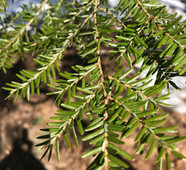
- Are there any plants that are always green, no matter the season? Some are called evergreens. Where do you find them? Why do think they stay evergreen?
Photo: Hemlock branch with needles (leaves).
|
Share Nature Note with your friends, family, teachers, scouts, and anyone you think might be interested. Here is how they can sign up for a free subscription:
Read back issues online.
Suggest a topic by email; put Nature Note in Subject line and email Jocelyn Hubbell.
www.ParksAndLands.com
|





