Nature Note

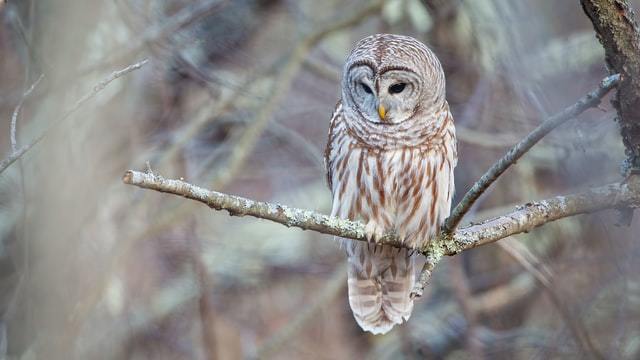
This time of year I spend extra time listening to the sounds coming from the evening woods. Sometimes a gruff, almost barking throat-clearing call, Who cooks for you! Who cooks for you-all?! resounds through the still night. Some evenings I just listen... others I call back with with a Who cooks for you? of my own to see if the caller will come closer to find out who is calling back from within their territory. Though they call year-round, courtship begins in February followed by breeding, which begins in March.
Once you've heard a barred owl in the wild, you'll not forget the call or the pneumonic birders use to mimic it. Listen to their vocalizations at All About Birds then take an evening woods walk to listen for barred owls. A mature forests with a mixture of trees and nearby water is the best location, but a walk down quiet forested lane is good too. It is easiest to spot the owls when they are at forest edges that meet paths or country roads, fields or waterways.
Barred owl (Strix varia) photo by Philip Brown on Unsplash.
Interesting Facts
Activities for Children and the Young at Heart
-
Listen to the calls of the Barred Owl, then practice mimicking it using the Who cooks for you? Who cooks for you-all?! pneumonic.
- Owls have silent flight. Think about why and how this is. Write down your ideas then do some research to find out about it! (Hint: feathers, and hearing is important - in more ways than one.)
- Next time you go for a hike listen for all the animals sounds. Do they stop when you enter the area? Do they get louder? Who is calling out and why?
- What else can you learn about the Barred Owl? Make your own list of most interesting facts and share it with your friends and family.
Share Nature Note with your friends, family, teachers, scouts, and anyone you think might be interested. Here is how they can sign up for a free subscription:
Read back issues online.
Suggest a topic by email; put Nature Note in Subject line and email Jocelyn Hubbell
|