Woods Wise Wire
Date & Time:
February 17th at 8 am
Topic:
As announced last June, FONS (Forest Operations Notifications) transitioned to the online Forest Online Resource Tool (FOResT) on 01 January, 2021.
To help landowners, loggers, and foresters become familiar with the new online system, the Maine Forest Service will offer a public, online overview and demonstration session on FOResT on February 17th.
This session will contain:
- 40-45 minute overview of FOResT followed by 15-20 minutes for attendees to ask questions.
- 10 minute break
- 1.5 hour in-depth demo of FOResT followed by 30 minutes for attendees to ask questions
Sign up for the February 17th session
If you have any questions or have trouble signing up, contact the Maine Forest Service at forestinfo@maine.gov or 207-287-2791.
There is no maximum number of attendees. These sessions will be repeated throughout the winter to ensure that people have multiple opportunities to attend.
In addition to February 17th, future sessions will begin at 8 am on the following Wednesdays:
- March 3rd
- March 17th
- March 31st
Invitations to each of these sessions will be sent out for you to sign up. Updates on scheduling and other information regarding FOResT will be announced via MFS’s electronic newsletters for landowners, foresters, and loggers.
All sessions will be recorded for those who are unable to attend or would like to review what was covered.
For more information about FOResT and to view recordings of previous sessions visit: https://www.maine.gov/dacf/mfs/rules_regs/forest_home.html
The Maine Forest Service says to take this heads up literally: look up at the trees around you for signs of browntail moth winter webs. If you think you’ve found it in an area without documented high populations, let us know. If you don’t know whether where you’ve found it is of interest, please report it.
The detection of browntail moth in Smyrna is not as surprising as it might seem. Why? Among the reasons:
- In recent years, the adults have been captured in light traps in almost every corner of the state (the northwest corner of Maine is an exception)
- It’s not the first time it has been found there, browntail moth webs and caterpillars were found at least as far north as Houlton in the early 1900’s
- Its population today is at a historic high
- A dry spring in 2020 supported continued population growth, producing a bumper crop of moths in July
- It is easily moved by people as mature caterpillars, pupae and adults, other stages are readily moved on live trees and shrubs (that’s how it got here from Europe)
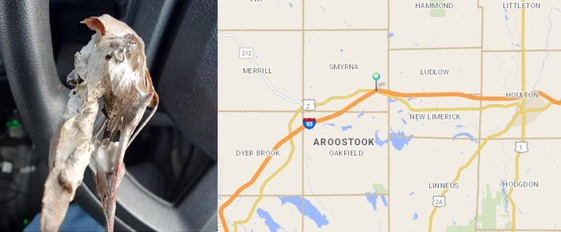
(left) Browntail moth web collected in Smyrna, ME in January 2021, (right) location of web detection. This web was found and collected by Maine Forest Service Forest Inventory staff. Images: Maine Forest Service, Maine DOT Public Map Viewer.
We still talk with Mainers familiar with browntail moth who think that it is just a coastal phenomenon. That was nearly true in the last outbreak which ended in the early 2000’s, but the Maine Forest Service has been reporting inland populations in places like Augusta since 2007, and significant populations in Bangor beginning in 2018.
We encourage all Mainers to become familiar with the winter webs of browntail moth. The Maine Forest Service conducts broad scale surveys for the pest, but to understand how it might impact day-to-day life where you are, inspect the trees around you.
Remember these tips:
- Survey on a sunny day with the sun at your back
- Inspect the tips of the branches on hardwood trees especially oak, apple and other fruit trees
- Look for shining silk tying last-year’s leaves to the branch; binoculars help. Web form varies quite a bit, sometimes they are the size of a large fist, sometimes they are a single leaf without much silk, they always have white strands of woven silk holding the leaf tight to the branches.
Resources for survey and management, including a formal survey protocol, can be found on our website. An informal survey should help you decide whether to consider management of this pest. Again, if you find this pest in areas where it is not abundant, please report it.
For more information reach out to us by email or through our web form.
Contributors: Allison Kanoti, Tom Schmeelk, Aron Bishop, Bill Phipps
|