Nature Note

Pitch Pine (Pinus rigida Mill.) is a most beautiful and gnarly growing tree of well drained sandy soils and humid conditions. Their form, to me, brings to mind Japanese gardens, the art of Arthur Rackham, and the stories of Dr. Seuss.
The common name, Pitch Pine, refers to the large quantities of resin obtained from the trees for use in the traditional building of wooden sailing ships. Resin was also made into pine tar and used as axel grease. Other common names, Torch Pine and Candlewood Pine, refer to the use of its pine knots as torches when attached to a stick or as candles when set in a holder and lit.
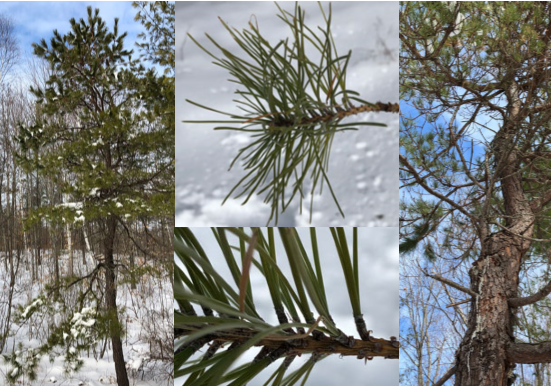
Pitch Pine in snowy woods. Needle details: right angles to twig and bundles of three on short stalk off twig. View up tree trunk showing bark and gnarly growth habit.
Standing only 30 to 40 feet at maturity, this slow grower - a one-year tree maxes out at barely 1/2-inch tall - is resistant to fires, salt and nutrient poor soils. This adaptation to harsh conditions is just one reason why it is an important keystone species and is planted by conservationists and forest managers to reforest bare, sandy soils and worn-out land. It takes hold where other trees and plants cannot initially grow but once the Pitch Pine is established (about five years) they will flourish. Pitch Pine communities rely on disturbance, such as wildfires, for their on-going health. In areas where wildfires cannot be allowed to take hold and prescribed burns are not feasible the selective harvesting of competing tree species can mimic nature and provide the some of the same natural benefits while providing a renewable resource for building materials and other uses.
It is important that Pitch Pine Communities thrive. At the northern most reaches of its range, Pitch Pine has five community types in southern and central Maine. An amazing array of wildlife, including vast numbers of moths and butterflies, are dependent on these communities:
-
Pitch Pine - Heath Barren,
-
Pitch Pine - Scrub Oak Barren,
-
Pitch Pine Bog,
-
Pitch Pine Dune Woodland, and the
- Pitch Pine Woodland
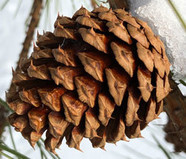
Pitch Pine cones take two years to mature but may remain on the tree for 10-12 years. At maturity they are about 3-1/2 inches long and egg-shaped. Each cone scale has one sharp barb pointing outward from the underside of the scale tip to protect the maturing seeds from hungry squirrels and other animals. Although each seed has a wing they are not easily dispersed by wind, but rely on wildlife or the fierce wind of forest fire microclimates to transport them to new locations. Both serotinous and nonserotinous cones are produced. Serotinous cones are adapted to survive fires and only open to disperse their seeds after being exposed to intense heat.
|
Interesting Facts
- Pitch Pine cones are prized by wreath makers.
- Pitch Pine needles may frequently be seen growing directly out of the trunk.
- Commonly used as "fat wood" for fire starting.
- Mature (nonserotinous) cones open gradually during the mid-winter.
- Sprouts may form from stumps and roots
Activities for Children & the Young at Heart
1. Pitch Pine poetry - Write a poem, whether a haiku, free verse, or some form of rhymed verse after visiting a pitch pine tree. (For locations see the Pitch Pine Community links above.) Before you start writing close your eyes and recall all that you saw. When you open your eyes write about what appeared most vivid in your recollection.
2. Draw your favorite tree - Does it share any similarities with a Pitch Pine? If so, what are they?
3. Get to know the conifers - Wintertime is a great time to get to know the conifers, as most of their leaves, commonly known as needles, remain on the tree over the winter. Use the Forest Trees of Maine to get to know the Pines and Spruces and other confers.
4. A nature mystery to solve - Why might the nonserotinous cones open midwinter? How might the seed benefit? How might others benefit?
Share Nature Note with your friends, family, teachers, scouts, and anyone you think might be interested. Here is how they can sign up for a free subscription:
Read back issues online.
Suggest a topic by email; put Nature Note in Subject line and email Jocelyn Hubbell
|