|
Having trouble viewing this email? View it as a Web page. 
|
|
Nature Note

Exploring right after a fresh snowfall is a terrific time to look for the telltale signs of all the creatures that have gotten out before you. Finding their footprints, or tracks, in the snow is the beginning of a mystery… what animal made the track and why were they out and about?

Carefully walk beside the tracks rather than on top of them. Look closely at the individual tracks as well as the series, and you can learn lots of details about animal that made them. What direction is the animal traveling? Is it a straight path, are they following a trail? Did their track path cut across your trail? Are all the tracks the same? Does it look like one animal traveling alone, a group of the same kind of animals, or one animal following another kind? How about the size of the tracks? Does it look like the track was made by a small or large animal? How big are the tracks? Do they sink deeply into the snow, or stay shallow, or on top of the snow? Are they four-footed or two-footed? What shape is each foot? What shape is each set of tracks (either the pattern of the four feet, or the two feet). Does the animal have toenails that appear in the track? Can you tell if the animal is walking, trotting, running or leaping?
|
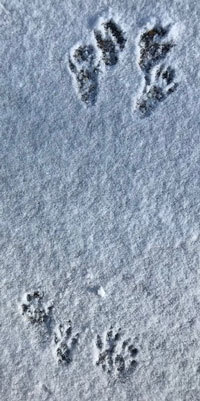
Recording what you see, either by drawing the track or taking photographs that you can study in detail later, will help you learn and remember tracks. A simple track guide, such as this Maine Animal Tracks poster by the Maine Department of Inland Fisheries and Wildlife is helpful to have on hand too. Just print, fold and put in your jacket pocket.
Interesting Facts
- People who are experts at following animal footprints are called trackers.
- Trackers look for other clues (called signs) that the animal may leave behind such as scat (droppings), hair, and scrapes or scratch marks.
|
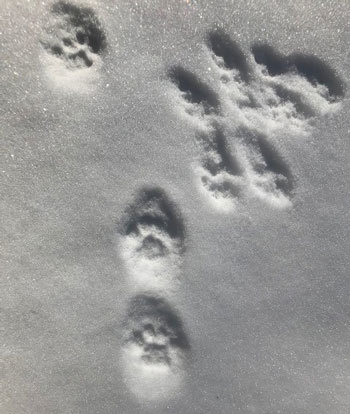
Activities for Children & the Young at Heart
- Look at the Maine Animal Tracks poster. Which track looks most like your own foot? What animal is it? Is it the front foot or the hind (back) foot? Which track looks most like your hand?
- How many animals have front and hind feet that look alike? How many of them have different shaped front and hind feet? Why do you think this is? (Hint: think about your own hands and feet and what they do for you… Remember: form follows function.)
- Can you identify any of the prints in the photos on this page?
- Make a list of all the clues you can find that an animal has passed by. As you learn more about tracking add to your list.
Share Nature Note with your friends, family, teachers, scouts, and anyone you think might be interested. Here is how they can sign up for a free subscription:
Read back issues online.
Suggest a topic by email; put Nature Note in Subject line and email Jocelyn Hubbell.
|
|
|




