Nature Note

On occasion those of us living in the north country are lucky enough to view one of nature's most marvelous light displays... it may start as a pulsing wave of mesmerizing green light, or appear as long fingers reaching across the sky... taking many shapes and forms as the evening wears on. The Northern Lights, also known as the Aurora Borealis, are formed by the natural release of light from the collisions of electrons (negatively charged particles) with oxygen and nitrogen in Earth's upper atmosphere above the Arctic. They are viewed best from the upper latitudes near the Arctic during a clear, dark night close to midnight. As evening becomes morning the Aurora will appear less distinct and more cloudlike. It may even appear to blink on and off until sunrise when the dawning of the sun will obscure the Aurora from view.
Auroras are also formed by other charged particles, such as positively charged protons, but we cannot generally see them. The charge of the particle and its acceleration by the solar wind combine to impact the vividness of the light (the amount of energy released).
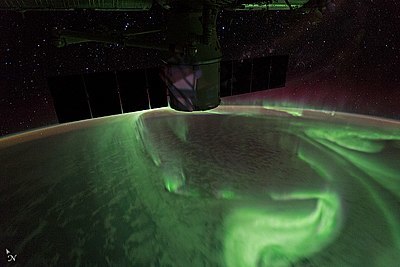
Auroras that form over Antarctica are called the Southern Lights or Aurora Australis. (Photo, courtesy of NASA, is the Aurora Australis as seen from the International Space Station.) Earth's magnetic field holds the charged particles over the polar regions - centered at the magnetic poles. Auroras are studied and tracked by NASA and NOAA because they impact high frequency radio transmissions and GPS (Global Positioning System) devices and the Global Navigation Satellite System (GNSS). View the Aurora Forecast by the National Oceanic and Atmospheric Administration (NOAA). Read their tips on viewing Auroras, and about Auroras and Space Weather.
Interesting Facts
- Auroras occur on most planets in our solar system.
- Aurora refers to the name of the Roman goddess of the dawn who announced the sunrise each morning.
Activities for Children & the Young at Heart
- Learn about Neon lights. Compare and contrast how they work to how Auroras form.
- Watch an Aurora, whether online or in nature, and record the different colors and shapes you observe.
- See what else you can learn about Auroras... is there one season of the year when they are most likely? Are there most prevalent colors or shapes? Can all animals see Auroras, or are some better able to than others? Why?
- Use a compass to locate magnetic north. What is the difference between True north and Magnetic north? Why does this make a difference when reading a map and using a compass for direction finding?
|
Share Nature Note with your friends, family, teachers, scouts, and anyone you think might be interested. Here is how they can sign up for a free subscription:
Read back issues online.
Suggest a topic by email; put Nature Note in Subject line and email Jocelyn Hubbell
|





