Nature Note

Crystals of ice float through the sky, shimmering as they catch the angled morning sunlight, then gently land to join the thousands of others that fell to the ground before them. Each of my footsteps produces a muffled squeak… I breathe in and my nostrils stick together… yes, it is cold… and snow is falling… but I’ll have to wait for another snowfall to make a snowman!
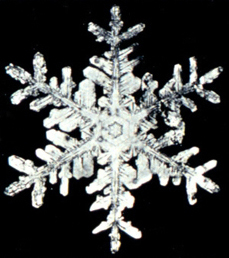
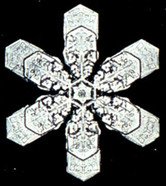
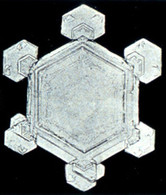
Though no two snowflakes are exactly alike, they all share some characteristics. Do you know what they are? Look at the three snowflake pictures. How may arms, or main points, does each have? Do you count six? What is the shape that forms the center of each flake? It is tiny in the top two photos, but very large in the bottom photo. It is six sided… a hexagon.
Snowflakes are made of one or more ice crystals. They form when water vapor freezes onto a tiny particle of dust. The ice crystal grows until it is so heavy that it falls as a snowflake.
|
Interesting Facts
- The dust particle that starts off a snowflake is called a nucleating agent.
- You can go to college to study snow science.
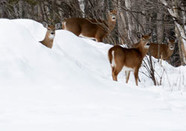
- Snow acts as a great blanket covering the ground. A very cold winter without snow kills off more plants and animals than a very cold winter with snow. Can you think of why? When might deep snow be a hard on animals?
|
Activities for Children & the Young at Heart
1. Look at water vapor… your body makes it all the time… do you know how to see it? Go to a window – preferably a cold window – and stand very close and give it a strong blast of your breath… what do you see? Why do you think you make water vapor? Where else can you observe water vapor forming?
2. Go on a winter walk. Can you smell the snow? What sound does in make under your feet? What shapes can you make with it in your hands? Is it packable or does it powder through your mitts? Can you breathe well through your nose or do your nostrils stick together? Keep a winter journal, record the temperature before each walk and then compare what you see, hear, and smell during each walk.
|
3. Build a snowman or snow fort or snow sculpture. What temperature is it outside when you can pack snow rather than cut snow blocks? Is the snow freshly fallen or has it been on the ground for days?
4. Read Snowflake Bentley by Jacqueline Briggs Martin to learn how a little boy in Jericho, Vermont followed his passion to study snow.
Photo credits: Snowflakes courtesy of NOAA; Deer in snowdrift at Mount Blue courtesy of Bruce Farnham.
|
Share Nature Note with your friends, family, teachers, scouts, and anyone you think might be interested. Here is how they can sign up for a free subscription:
Read back issues online.
Suggest a topic by email; put Nature Note in Subject line and email Jocelyn Hubbell.
www.ParksAndLands.com
|





