|
Having trouble viewing this email? View it as a Web page. 
|
Nature Note

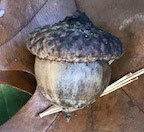
The acorn is amazing! It is a protein-packed and nutrient rich nut that is full of high calorie fats. Oak trees produce acorns just when many woodland animals need to rely on them as food in the autumn and over the winter months to springtime when other food sources will become more plentiful. Jays, turkeys, woodpeckers, mice, squirrels, raccoons, deer and bear eat acorns. As much as 25% of a deer’s autumn diet can be acorns. Very interesting, because acorns contain toxic tannins. Animals that eat lots of acorns have adapted to the tannins and can digest them or they have developed strategies to not get poisoned. Some animals wait until the acorns have aged on the forest floor and have been exposed to numerous rainfalls - soaking the acorn through and leaching out the tannins. Some animals select the acorns with less tannins. White oak trees produce acorns with less tannins. Their flavor is nutty and not astringent like the high tannin red oak.
|
Interesting Facts
• Oak trees produce the most nuts when they are not crowded by other trees and competing for sunlight, water and nutrients.
• Acorns can take up to two years to mature, depending on the species of oak tree.
• Easily cached and stored, because of thick outer shell, by birds, squirrels, and people.
• A traditional use of acorns is the making acorn flour. The acorns are put through several long cold water soaks and rinses to remove the tannins before the nutmeat is ground to flour. (Nutrients include calcium, phosphorus and potassium, and niacin.)
Activities for Children & the Young at Heart
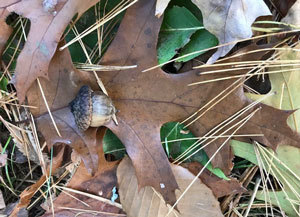
- Use the Forest Trees of Maine to identify the kind of oak tree that produced the pictured leaf and acorn.
- Go on an oak exploration hike. How may kinds (species) of oaks can you find? What is the same and different about the areas (habitats) where you find the different oak species?
- Collect a few acorns for the following experiments:
a. Drop an acorn on a very windy day. Is it blown away by the wind or does it fall straight down? Test this at least three times. Based on your observations is wind an efficient way to move acorns to a new location well away from the tree that produced them? What moves acorns?
b. Crack* open an acorn. What do you see? Are there different: colors, textures, shapes? Draw what you see, then continue taking apart, dissecting, the acorn. What is the purpose of each part? Besides being a food source, what is the ultimate purpose of the acorn that only a few get to fulfill? (*Hint: a garlic press is a safe tool for starting a crack in the shell. Then use a metal spatula or table knife to widen the crack and divide the acorn in two. Use a toothpick or nut pick to dissect the inside parts of the acorn.)
|
Share Nature Note with your friends, family, teachers, scouts, and anyone you think might be interested. Here is how they can sign up for a free subscription:
• Text DACF NATURE to 468311 OR Subscribe online
Read back issues online.
Suggest a topic by email; put Nature Note in Subject line and email Jocelyn Hubbell.
|
|




