Nature Note

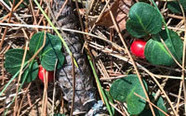
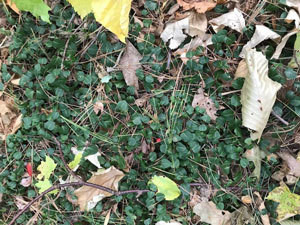
The bright scarlet berries of Partridgeberry (Mitchella repens) make a joyful addition to any hiker’s search for the colors of Autumn. Look up to the trees to enjoy the leaves in all their blazing glory this fall, but then look down and see what awaits at your feet. Partridgeberry is a native perennial of shady forest floors rich in organic matter. All of an inch or two high, the creeping vines with evergreen leaves spread along the forest floor and root from stem nodes as they grow. I’ve seen mats of partridgeberry up to twenty feet across.
|
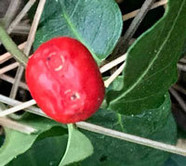
The springtime flowers are dainty, and trumpet shaped with four points. They start out pink and usually turn brilliant white by the time they fully open. Flowers are paired – they are joined together underneath the petals - sharing a round of sepals, which in unison are called the calyx. These paired flowers must both be pollinated for a single berry to form. The berry carries the mark of having been formed by the pair, as it has two dimples – remnants of each flower’s pistil.
|
Interesting Facts
• In the flower pair - one flower has a short pistil and long stamens, the other a long pistil and short stamens. This is to ensure that the flowers do not share pollen with each other and will be independently pollinated by insects.
• Mitchella, of the scientific name, was given to this plant by Carolus Linnaeus to honor his friend John Mitchell, a doctor who developed a treatment for yellow fever.
• repens means creeping or lying flat on the ground.
• Traditional uses include a tea made of the leaves to ease the pain of childbirth.
• Common names include: Twinberry, Running Box, and Pigeon Plum.
|
Activities for Children & the Young at Heart
- From just the name of this plant, who might you expect eats the berries?
- Find a patch of partridgeberry this autumn that you’ll be able to return to during spring to see the flowers. Look carefully to see where they are joined.
- Next time you walk in a woodland pay close attention to the forest floor. Make a note of all the tiny plants, insects, and everything you see connected to the forest floor. Try it as an Alphabet Hike. Can you either find things that look like the letters of the alphabet or whose names begin with each letter of the alphabet?
Share Nature Note with your friends, family, teachers, scouts, and anyone you think might be interested. Here is how they can sign up for a free subscription:
Read back issues online.
Suggest a topic by email; put Nature Note in Subject line and email Jocelyn Hubbell.
|





