Project Canopy
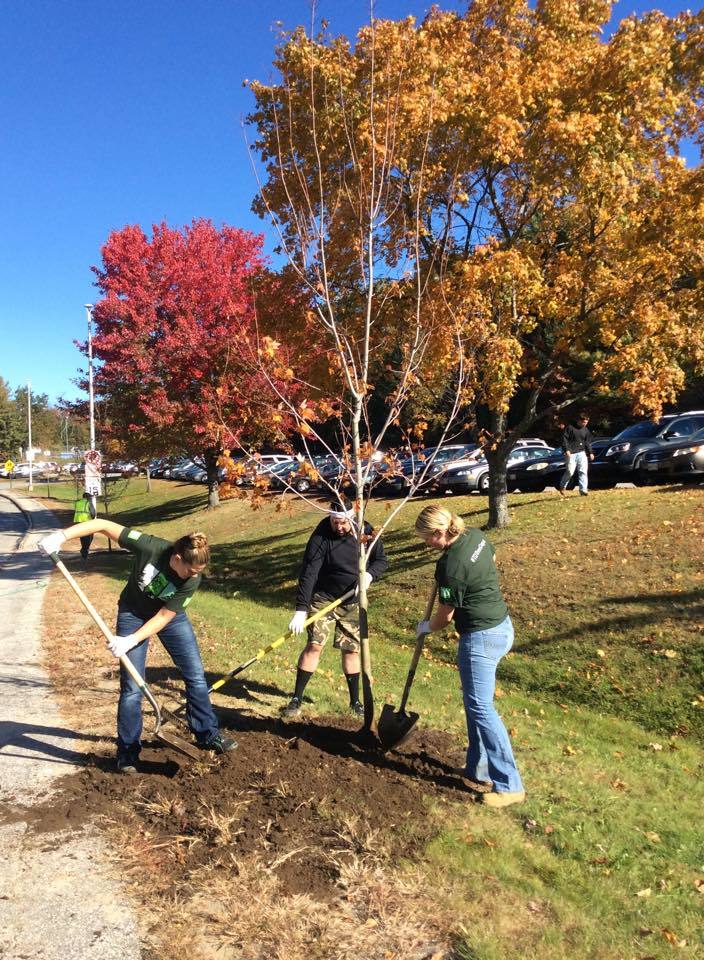 AUGUSTA - The days are getting shorter, and some mornings have a definite chill in the air. With fall closing in fast, many folks are winding down garden planting. We may think of spring as the traditional time to plant trees, but that’s not necessarily true. In most of Maine, there are still PLENTY of growing days yet. Trees love the cooler weather in which to put down roots. In colder locations, fall planting can be risky.
The Maine Forest Service recommends early fall planting for most of Maine: When planting trees in the fall, the general rule is to plant them by Indigenous Peoples’ Day to give the roots time to establish before the ground freezes, and the cold weather shuts down growth. Tree roots need soil temperatures of at least 55° (at a 6-inch depth) and take approximately six weeks to get established. Just like planting trees at any other time of the year, be sure to mulch well (this helps to keep the soil warmer longer) and water well until the ground freezes. Don’t prune your newly planted tree, or you’ll encourage top growth instead of where it’s needed at the roots.
Some trees do better than others when planted at the growing season’s end. In general, plants with shallow, fibrous root systems do better with fall planting than those with a deep taproot. “Planting trees in early September provides enough time for root growth and establishment at the new site before soil temperatures drop and trees enter their dormancy period. This prepares trees for a head start on vigorous growth in the spring,” says Maine Forest Service Forest Pathologist Aaron Bergdahl.
Whatever time you decide to plant trees in your yard, make sure you put the “right tree in the right place.” Trees that grow 80-100’ tall don’t belong under power lines, and, likely, a weeping willow or river birch won’t be happy in that hot, dry corner of your yard.
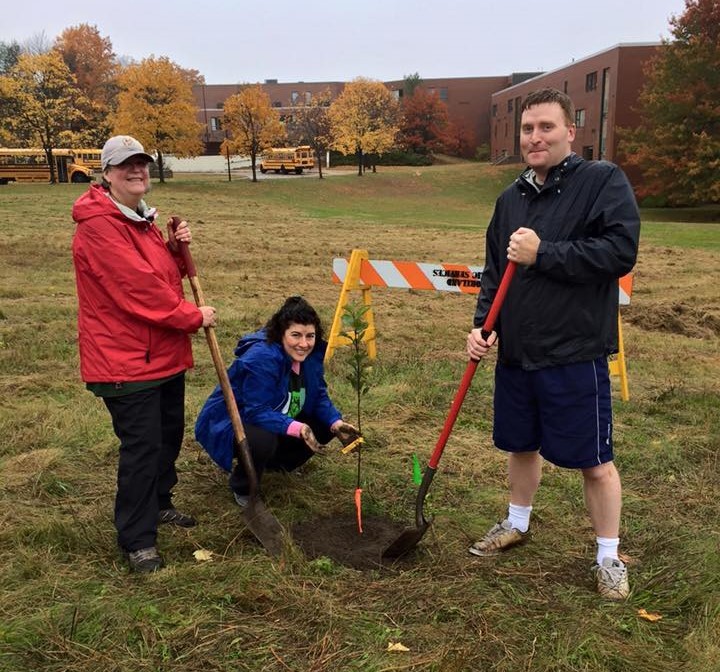 When choosing what type of tree to plant, look into whether the tree is likely to become a problem in natural areas in the future by consulting the advisory list from the Maine Natural Areas program. Be aware there are some species on the advisory list that are also illegal to import, export, buy, sell or intentionally propagate such as Norway and amur maple, tree-of-heaven and princesstree. The ban includes all cultivars, varieties and hybrids of these plants.
Be sure to research what will be needed to maintain the tree in the landscape. Some trees, such as true ashes (Fraxinus spp.), will require frequent insecticide treatments as emerald ash borer spreads. The Maine Forest Service cautions to avoid planting green, white and black/brown ashes. Several sites have excellent information that sums up some of these considerations for different species. If you don’t find the information on the species you wish to plant, ask our experts.
Trees are an easy and inexpensive way to save energy, clean your air and water, increase your property value and improve your and your family’s well-being. Properly planting the right tree in the right place can bring you decades of enjoyment.
Several tools exist to assist you in selecting the best tree for your landscape, try:
https://www.mortonarb.org/trees-plants/tree-and-plant-advice/tree-species-list/filters
https://www.arborday.org/shopping/trees/treewizard/GetZip.cfm
https://species.itreetools.org/selector/
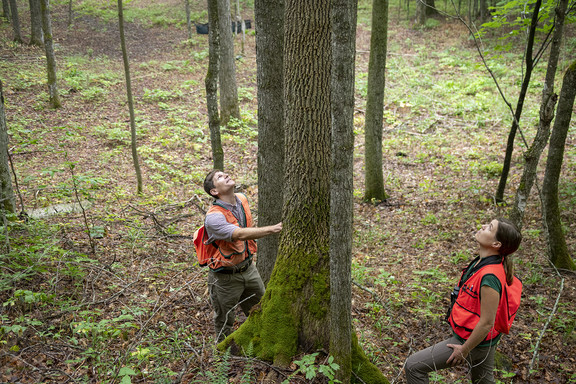 VSJF.org - Long valued for timber, recreation, wildlife habitat, and solace, Vermont’s forests are being recognized for providing another, more global, benefit: carbon storage.
Situated within the largest remaining intact temperate broadleaf forest on the planet, Vermont forests are part of a critical natural resource in the fight against climate change. Biologically adept at both drawing carbon out of the atmosphere through photosynthesis, and storing carbon within their roots, trunks, and leaves, trees have an important role to play in the global effort to curb greenhouse gas emissions and ensure a healthy planet for future generations. And, thanks to a combination of growing carbon markets and some innovative thinking by Vermont’s forest industry, landowners stand to benefit from managing their forests for carbon storage.
Unlike the large tracts of forestland being managed for carbon storage in other parts of the world, 80 percent of Vermont’s forested land is privately owned, with a majority of parcels totaling 50 acres or less. Smaller parcels and multiple landowners complicate the extensive inventorying and monitoring requirements of entering forested land into a carbon market, the mechanism for monetizing forests for climate benefit, making the process prohibitively expensive for many. Read more...
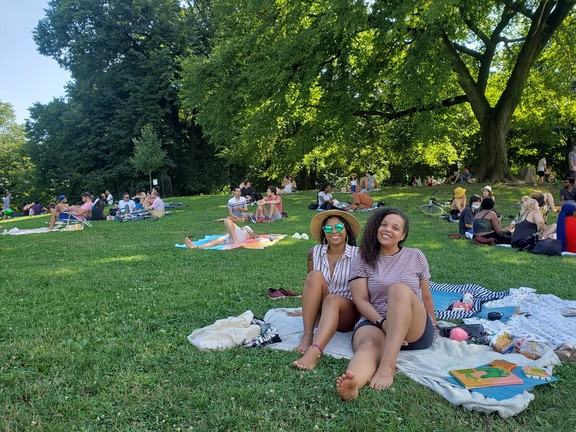 SCIENCE FRIDAY - Taina was sitting with a friend in the shade cast by a large tree in Prospect Park in Brooklyn, NY on a Saturday afternoon in late July. Throughout the city, it was another scorching day for a population that had endured one of the world’s deadliest COVID outbreaks just months earlier.
“The heat is way too unbearable to be doing anything else but sitting in the park in the shade and kind of just enjoying that fresh breeze and that shadow,” said Taina, who asked Science Friday to use only her first name. “I live in Bushwick, and it takes me a while to get all the way across Brooklyn.”
As pollution traps heat and pushes temperatures upward around the world, residents of its cities are experiencing the sharpest changes, with forests and other cooling landscapes replaced by pavement and other hard surfaces that absorb heat. But the heat is being felt unevenly, with the legacy of redlining and urban development keeping wealthier and whiter neighborhoods cooler than poorer and browner ones. Read more...
Field monitoring of urban trees is essential to learn how urban forests change over time. Many arborists and urban forest managers worldwide seek to understand how their tree systems are faring in terms of growth, health, and mortality. The Urban Tree Growth & Longevity Working Group of the International Society of Arboriculture has developed standard protocols and effective strategies for long-term data collection. This new guidance, which includes a Field Guide, Resource Guide, and companion training videos, gives detailed instructions for how to record a small set of variables consistently over time that will support adaptive management. The intended users are any urban forestry professionals who intend to carry out field-based tree monitoring, whether with arborists, interns, or citizen scientists.
Sept 2 - Webinar: NYC ReLeaf Creating Connections: Volunteers and Professionals Part 1, 9am EDT.
Sept 9 - Webinar: NYC ReLeaf Creating Connections: Volunteers and Professionals Part 2, 9am EDT.
Oct 9-11 - Maine Maple Producers Weekend
Grant cycle open for Land and Water Conservation Fund
Communities intending to submit grant applications are required to request Maine's pre-approval site inspection by October 31, 2020
AUGUSTA - The Land and Water Conservation Fund (LWCF) 2020-2021 grant cycle is open and accepting applications for acquiring public land, developing recreation facilities, and renovation of existing outdoor recreation facilities from eligible applicants. Qualified applicants must request a pre-approval site inspection by October 31, 2020, at 11:59 p.m. If the proposed project is approved for application, the project sponsor will be encouraged to submit a complete application packet by the end of May 2021. The grant application and support documents are posted online. The maximum grant award for this round will be $500,000. There is currently no minimum award level, but applicants considering a request of $20,000 or less should discuss their project ideas with the grant manager before applying.
The Land and Water Conservation Fund Act of 1964 (LWCF) was established to assist federal, state, and local governments acquiring and developing public outdoor recreation facilities. Administered at the federal level by the National Park Service and at the state level by the Bureau of Parks and Lands, LWCF grants can provide up to 50% of the allowable costs for approved acquisition or development projects for public outdoor recreation.
Learn more about the application process by visiting the Maine Bureau of Parks and Lands' Land and Water Conservation Fund webpage.
Free Invasive Forest Pest Webinars
Maine Association of Conservation Districts is offering free regional webinars to highlight how to protect Maine forests from invasive forest pests. Webinars will be presented by local Soil & Water Conservation District (SWCD) staff and will focus on statewide and regional pest problems. ME Department of Agriculture, Conservation & Forestry staff will also be on hand with information on current local forest pest management issues.
Presentations are scheduled for:
- Wed, September 23 from 3-4 pm (Knox-Lincoln SWCD);
- Thu, October 1 from 4-5 pm (Cumberland SWCD);
- Wed, October 7 from 3-4 pm (Penobscot SWCD); and
- Tue, Oct 13 from 9-10 am (Central Aroostook SWCD).
There are already several invasive forest pests targeting Maine’s trees and spreading throughout the state including emerald ash borer, hemlock woolly adelgid, browntail moth and winter moth. And, there are additional invasive forest pests in neighboring states that we don’t want moving to Maine, such as Asian longhorned beetle, spotted lanternfly and oak wilt, all of which have the potential for devastating effects on forest, landscape and agricultural tree species. Join us to learn how to identify and report sightings of these potential threats – and how to keep them out of Maine.
Webinars are free and sponsored by a grant from USDA-APHIS. Participants may attend any webinar that is in their region or at the most convenient date and time. Pre-registration is required. Participants will receive information on how to join the webinar after they register. For questions or more information, please contact Hildy at Knox-Lincoln SWCD at 596-2040 or hildy@knox-lincoln.org.
|



