Nature Note 16: Teddy Bear & Turtle: Clavate Tortoise Beetle

Having trouble viewing this email? View it as a Web page. Bookmark and Share

Nature Note

Nature Notes Header

Teddy Bear & Turtle: Clavate Tortoise Beetle

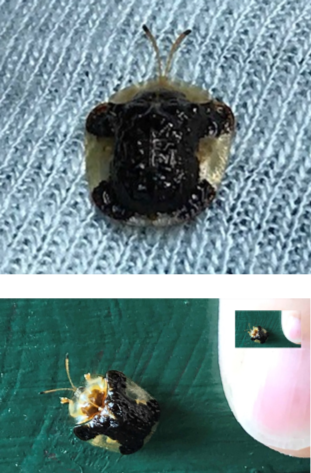
I had two visits this summer, a few days apart, by a most interesting little bug that resembles both a teddy bear and a turtle. The first landed on my shirt. The second landed beside me. I was able to snap a photo with the tip of my pinkie finger near it for a size reference. The inset photo in the bottom picture shows the beetle at approximate full size. Its body is all of 5 to 7 mm long.

Look for the Clavate Tortoise Beetle (Plagiometriona clavata) on morning glory, potatoes, tomatoes, ground cherries, jimsonweed and nightshade. Though some gardeners consider them a pest, the tortoise beetle does not gather in great numbers and what little it eats of these plants is not harmful – just cosmetic. I take great joy in seeing them in all their life stages and happily share my gardens with them.

Tortoise beetle montage: beetle enlarged in two shots and one approximate life size.

Interesting Facts

  • Females are larger than males.
  • Larvae (immature beetles) use their own frass (droppings) and leaf litter as camouflage to hide from predators. They collect it with a special appendage at the hind end of their abdomen and can lift it onto their back as needed.
  • Life stages are egg, larvae, and adult.
    • Egg photo at bugguide.net
    • Larva photo at bugguide.net - the larva is carrying frass and leaf litter on its back.

Activities for Children & the Young at Heart

  1. Go on a bug search. Note numbers of unique kinds and their sizes. Do you find more than one kind of bug a on single plant? Draw, photograph, observe… be sure to let them stay safe where you find them.
  2. Find a place that you can visit daily or weekly to see what bugs are there. It need not be a big space, a couple of plants on a patio or deck will do, or a small patch of grass, garden or woods. Vary your visit times, morning, midday, before dusk, and nighttime if you can. Do you find the same bugs each time? Record what you find by day and time and note the weather too.
  3. Visit Bug Guide, hosted by the University of Iowa and maintained by volunteers, at https://bugguide.net

Share Nature Note with your friends, family, teachers, scouts, and anyone you think might be interested. Here is how they can sign up for a free subscription:

Read back issues online.  

Suggest a topic by email; put Nature Note in Subject line and email Jocelyn Hubbell.