Nature Note

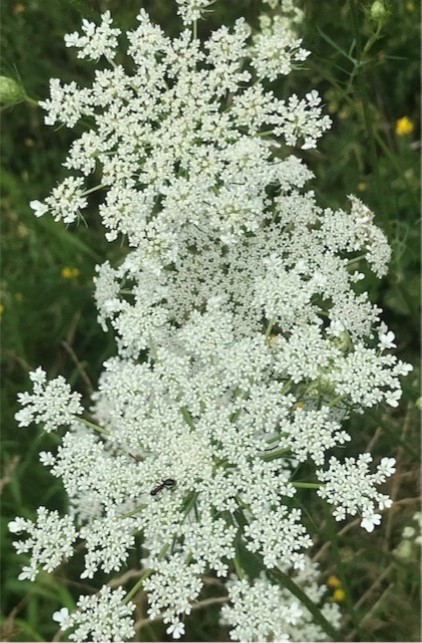
As a young girl I loved exploring the fields of wild grasses and flowers near my home. It provided endless hours of entertainment – spying on woodchuck, deer and ground nesting birds; watching bugs and ants crawl, climb, and carry; and examining all the holes, rocks, trees and plants I came across in my daily visits. Queen Anne’s Lace has always been a favorite field flower of mine. I marveled over the flat cluster of tiny white flowers and looked for the one deep purple/burgundy center flower. I watched ants crawl the tall hairy green stems. And through watching the ants, plus mishearing the plant’s name, for years I thought it was called Queen Ant’s Lace. But no, it is Queen Anne’s Lace (Daucus carota). Other common names are Bird’s Nest, Bishop’s Lace, and Wild Carrot.
Legend has it that the flower was named for Queen Anne of England who, while sewing lace, was pricked by her needle. One drop of her burgundy blood landed in the center of the lace in a floret. Not all Queen Anne’s Lace has the central dark flower but, look for it next time you see the flower along a roadside or in a field.
|
 |
|
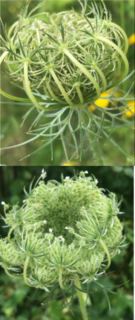
The flower cluster is tightly curled and opens as the flowers mature and are ready for pollination. The top photo shows it fully open.
Interesting Facts
- Naturalized to North America by settlers who grew it in kitchen gardens as an herbal edible medicinal plant. (Warnings – do not eat unless expert; may be confused with other members of the carrot family that are poisonous: the very deadly poison hemlock (Conium maculatum), fool’s parsley and water hemlocks. Handle plant with care –leaves may cause dermatitis especially when wet.)
- Biennial – meaning it takes two years to mature. Flowers in second year.
- Some farmers grow it as an overstory plant to lettuce. The Queen Anne’s Lace shades and provides cooler moister air for the lettuce.
- It is listed as a noxious weed in some states. Seeds can lay dormant in the soil for up to five years. Learn about the invasive plants in Maine at the Maine Natural Areas gallery listing.
|
 |
|
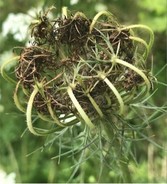
After pollination the flowers cluster curls to protect the developing seeds.
Activities for Children & the Young at Heart
- How many plants can you find that form flat-topped flower clusters (umbels)?
- List and draw all your favorite flowers. Are they similar or different? How?
- Get involved with iMapInvasives by reporting invasive species online.
|
Share Nature Note with your friends, family, teachers, scouts, and anyone you think might be interested. Here is how they can sign up for a free subscription:
Read back issues online.
Suggest a topic by email; put Nature Note in Subject line and email Jocelyn Hubbell.
Dear Readers, please help spread the word about Maine's Economic Recovery Grant Program. Click on the picture below to visit the grant website. Deadline is Sept. 9, 2020.

| 




