|
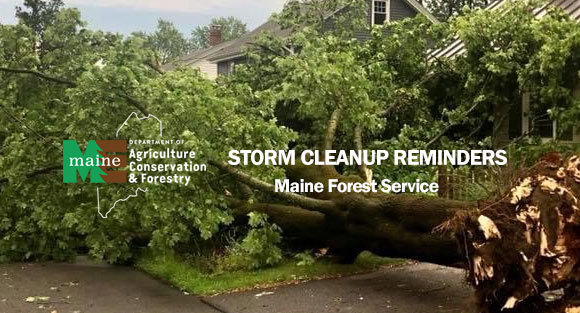
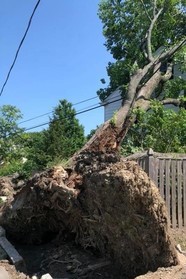
AUGUSTA - The recent storm resulted in many fallen trees and branches. If you are involved in storm cleanup, please be safe and also help keep Maine’s forests healthy.
After power and other utilities have been restored, property owners will be faced with the issue of what to do with storm-damaged trees. Project Canopy, a program of the Maine Forest Service (MFS), offers tips and helpful guidance to property owners faced with questions about what to do with downed trees, limbs, and branches.
-
Trees and branches on homes and around power lines — Homeowners need to find immediate solutions for trees and branches on their homes. Branches and trees on power lines should be dealt with by calling local power companies. Even if a hanging limb is clear of power and utility wires, homeowners should rely on professionals to assess the severity of the damage before trying to repair or remove the branch.
-
Injured trees requiring climbing or chainsaw work — Call a licensed arborist for help. Arborists are tree care professionals who are trained to assess and correct storm-damaged trees. They also have the experience needed to diagnose how much of a tree can or should be saved. Homeowners should be wary of those offering fly-by-night, emergency tree-cutting services. Always ask for proof of licensing, insurance and work references. Find more information about working with arborists in Maine at: https://www.maine.gov/dacf/php/arborist/index.shtml.
The Maine Forest Service reminds you that the woody debris created by storm damage may harbor insects or diseases that are harmful to our forests. Moving that debris long distances can spread pests to new areas. Be aware that there are rules, known as quarantines, that impact transport of some woody storm debris:
- Movement of ash (Fraxinus spp.) from areas within the Emerald Ash Borer Regulated Area (www.maine.gov/eab). The restriction in this case extends to mixed hardwood chips.
- Movement of Larch (Larix spp., Pseudolarix spp.) from areas within the European Larch Canker quarantine.
- Movement of Hemlock (Tsuga spp.) branch/top material from areas within the Hemlock Woolly Adelgid quarantine.
- Movement of Pine (Pinus spp.) from parts of Maine within the Pine Shoot Beetle quarantine to Washington and Aroostook Counties.
You can learn more about quarantines that affect woody storm debris at https://www.maine.gov/dacf/mfs/forest_health/quarantine_information.html
If you suspect you've found damage from an invasive insect such as emerald ash borer or Asian longhorned beetle please take photos and report it at https://appengine.egov.com/apps/me/dacf/mfs-tree-ailment.
|
ABOUT MAINE FOREST SERVICE
Established in 1891, the MFS mission is to protect and enhance Maine's forest resources through forest fire prevention; technical assistance; education and outreach to a wide variety of audiences; and enforcement of the State’s forest protection laws. MFS offices are located throughout the state and provide Maine citizens with a wide range of forest-related services. For more information visit www.maineforestservice.gov or call (207) 287-2791.
###
|