Nature Note

 |
|
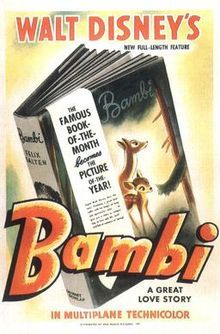
The white-tailed deer of Maine have a special connection to Disney’s Bambi movie. Originally, Walt Disney wanted Bambi to be a mule deer and his illustrators were instructed to use these native California deer as their model for drawing Bambi. This idea did not last long.
Jake Day, an avid outdoorsman from Maine, was working at the time for Disney Studios as an illustrator/animator. He was adamant that he’d change Walt’s mind. Jake believed Bambi should be a white-tailed deer, like those found in his native Maine.
(Image at left is 1942 movie poster. Image below is of Maurice 'Jake' Day.)
|
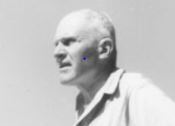
Jake returned to Maine to photograph the Katahdin region’s plants, deer and landscape. He believed that not only must Maine’s deer be the model for Bambi, but that Maine’s beauty was the best example for the illustrators and animators to use as scenery for the movie. His landscape photographs were excellent, but the deer photos did not show motion. Jake knew they needed to study how fawns walk and move to have the best chance of making accurate animations. So, two four-month-old Maine fawns were sent by railcar to the Disney studios in Hollywood as the models for Bambi and Faline, his sweetheart.
Through the wisdom and tenacity of Maurice ‘Jake’ Day of Damariscotta, Bambi was a white-tailed deer and the movie was made even more beautiful with scenery inspired by Maine.
White-tailed deer (Odocoileus virginianus) may be found in meadows, farmlands, woodlands, and even suburbs where they may become garden pests. They forage on a variety of highly nutritious plants, grains and nuts, aquatic plants, lichens and mosses. Nuts – known as hard mast – include acorns and beech nuts. When no other more nutritious food is available the deer will eat the twigs and buds of dormant trees and shrubs. Their stomachs are specially adapted to allow this varied diet which gives them the greatest ability to put on fat for the winter.
|
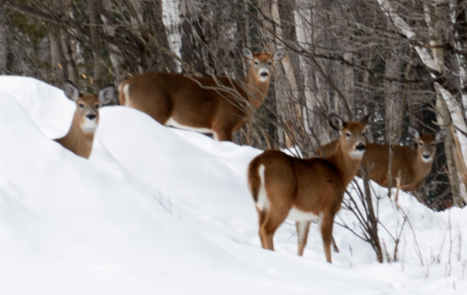
By late autumn, if they find enough forage, the accumulated fat can be as much as 25% of the deer’s body weight. It builds up under the skin, around their organs, between layers of muscle, and in the hollows of their bones. During the winter, the fat is reabsorbed as needed to supplement inadequate diets of woody browse. Without this ability to store and reabsorb fat the deer would not survive winter.
(Photo of white-tailed deer at Mount Blue State Park by Bruce Farnham.)
|
Mid-June is peak fawning season in Maine. A doe (female deer) will give birth to one to three young, which are called fawns until they lose their spots. The fawn is licked clean and fed by its mother, then left bedded down in a hidden spot while she forages within hearing distance. The doe visits the fawn only to let it suckle milk until it is old enough to follow her. She keeps her visits at a minimum so that predators will not follow her or sniff out her path to the fawn, which during its first weeks of life has virtually no scent. So, remember a lone fawn is not an abandoned fawn.
Fawns are camouflaged from predators by their spots and red-brown hair. To a color-blind predator red and green look very alike, so the red hair is not easily seen against green grasses and plants. The fawn’s spots give the impression of dappled sunlight shining on the grass. Thus, well camouflaged in their hiding spots, fawns are not easily flushed and will remain bedded down unless practically stepped on. When flushed they will pop up, run, then drop down to hide again. Its mother stays within hearing distance and will be alert to any change of location or predators.
Whitetails hear very well, and they can rotate their large ears quickly toward unexpected sounds to locate possible predators. Their wide-set eyes aid in seeing subtle movements all around them. Yet their eyes are not so far apart that they lose depth perception. Whitetails also have a very keen sense of smell. This is especially important when there is poor visibility, such as in fog, rain or snow. They then rely on their nose to smell predators that they cannot see.
When startled, whitetails let off a quick loud snort and simultaneously raise their tail. The white underside flashes a danger signal to all nearby deer. If threatened, they will run – sometimes just for a short but safer distance before a look back at the perceived danger. If they are truly in danger, their long graceful legs can attain a bust of speed up to 40 miles per hour. High leaps and long bounds also aid them in their escape from harm.
- Crepuscular – meaning most active around sunrise and sunset. Deer are also somewhat nocturnal (night-active). Only when necessary are they active during mid-day hours.
- Can leap up to 10 feet. (Compare this to the standard height of 8 or 9 feet of most ceilings)
- Can bound 30 feet.
- Spring/Summer coat is of fine, short red-brown hair. In September the summer coat is shed and replaced by a gray-brown coat of long guard hairs with thick woolly underfur for warmth. Both coats provide camouflage appropriate to the season.
- Compare your leaps and bounds to that of white-tailed deer. How high can you leap? How far can you bound? Look up the World and Olympic records for the high jump and the long jump. How do they compare?
- Play hide and seek with a twist. Hiders must be partially visible to the seeker from their hiding place and may not leave the hiding place during a round. Seeker is given 5 minutes to find as many hiders as possible. Rotate seekers and hiders so everyone has chance to be a seeker. Does different color clothing, or lighting make it easier or harder for the seeker to find the hiders? Why?
Share Nature Note with your friends, family, teachers, scouts, and anyone you think might be interested. Here is how they can sign up for a free subscription:
• Text DACF NATURE to 468311
OR
• Subscribe online
Have you missed a previous issue of Nature Note? Back issues are available online.
Write to me if you have a plant or animal that you'd like covered in a Nature Note. Send an email by using the link below. Be sure to put Nature Note in the subject line.
- Jocelyn Hubbell, Interpretive Specialist, Maine Bureau of Parks and Lands.
| 




