Nature Note

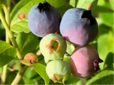
There’s nothing like the taste of a Maine blueberry just picked from the bush… the intensity of the flavor as the berry skin breaks open releasing its sweet juice, and then the slightly tart finish as the skin is chewed, is a summertime treat. (Lowbush blueberries show approximately life-size at right and in a close-up below).
|
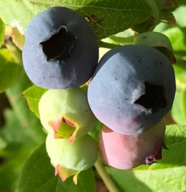
The seasonal picking of blueberries at my folk’s place is a tradition. The wild lowbush (Vaccinium angustifolium) have been producing for the last week or two. We start looking for ripened berries in July and expect a few for the 4th each year. Our highbush blueberries (Vaccinium corymbosum), growing wild along the edge of a pond, will come on later. Mid-August is generally their peak berry time.
Lowbush blueberries are a deciduous shrub that prefers acidic, well-drained soil with a surface layer of organic duff, and partial to full sunlight. The plants spread both by seed and through the growth of underground stems called rhizomes. Natural lowbush blueberry barrens (blueberries growing across a large area) form when the conditions are especially suitable for its growth.
|
Blossoms appear during springtime. Look for the small, white, bell-shaped flowers in May. In a good year, the blueberry shrubs will be so heavily laden with blossoms that they attract bees, such as the native bumble and solitary bees, and other pollinators from near and far.
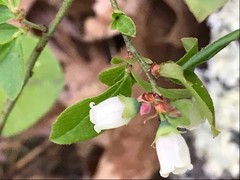
Blueberries rely solely on insects for pollination. Because its pollen is so sticky and heavy, it cannot be blown around by the wind like pine pollen. Some bees vibrate each flower with their flight muscles as they collect pollen. This buzzing activity (known as sonication) shakes pollen off the anthers so it is easy for the bee to collect. It also increases the likelihood that pollination will occur. If all goes well a bumper crop of berries will follow.
Even during a great year not all berries will mature as they should. One condition – called mummy berry – is caused by a fungus. Look for blueberries that have shriveled and turned hard as you are picking. These are mummy berries.
Blueberry picking is lots of fun. You can try raking berries with a traditional hand-held wooden or metal berry rake or use the by-hand milking-style method of lightly grasping above a blueberry bunch with thumb and forefinger and gently pulling down to release the ripened berries into a bucket held beneath the bunch with your other hand. Get out and try blueberry picking this summer and you will be joining the centuries old tradition.
|
- Black bears, foxes, deer, birds, and porcupines are among the wildlife that eat blueberries.
- Berry color can range from light, powder blue to jet black.
- Up to 16 individual flowers may develop from each bud.
- Each flower that is pollinated will become a berry.
- Lowbush blueberries are especially nutritious – they contain antioxidants, manganese, and fiber.
- Lowbush blueberries thrive in colder areas where the highbush blueberries cannot.
- Lowbush blueberries are fire-tolerant and can increase in number following a forest fire.
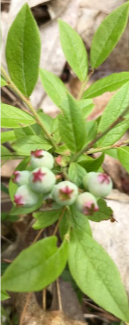
(Photo at right shows lowbush blueberries that are still ripening.)
|
|
 |
- Try blueberry picking. Eat some fresh. Try adding some to your favorite muffin recipe. Tips: Place berries in a paper sack with ¼ cup of the recipe’s flour. Shake to coat the berries, then add back into recipe. This will help distribute the berries throughout the muffins. If you want to freeze berries for later baking use, pour them onto a cookie sheet so none are touching. Place in freezer overnight. Pour into freezer bags to store until needed. Do not thaw berries – use frozen for baking. Coat with flour as with fresh berries. Freezing the berries on a cookie sheet before they are bagged keeps them from sticking together in a frozen mess.
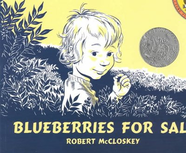
- Read Blueberries for Sal, a Maine classic picture book, by Robert McCloskey.
|
Share Nature Note with your friends, family, teachers, scouts, and anyone you think might be interested. Here is how they can sign up for a free subscription:
• Text DACF NATURE to 468311
OR
• Subscribe online
Write to me if you have a plant or animal that you'd like covered in a Nature Note. Send an email by using the link below. Be sure to put Nature Note in the subject line.
- Jocelyn Hubbell, Interpretive Specialist, Maine Bureau of Parks and Lands.
Have you missed a previous issue of Nature Note? Back issues are available online.
| 




