Invasive Pest Outreach Information
EMERALD ASH BORER AWARENESS WEEK
May 17-23, 2020
The emerald ash borer was discovered in Maine in 2018, in Aroostook county. It has since been found in York and Cumberland counties.
The middle of May has been deemed Emerald Ash Borer Awareness Week, a fine opportunity to watch out for one of the most destructive invasive insects in the U.S. Although you won't see the adult beetle in May, you may notice signs of its presence on ash trees. Help us track new infestations by looking for some of these clues. If you think you have seen any of the following, take good photos and email them to bugwatch@maine.gov.
"Blonding" is a term that refers to particular woodpecker activity on ash trees. This activity involves flecking off the raised bark ridges exposing the light-colored, new wood underneath. "Blonding" can be noticed year round, but is easier to see when leaves are off the trees.
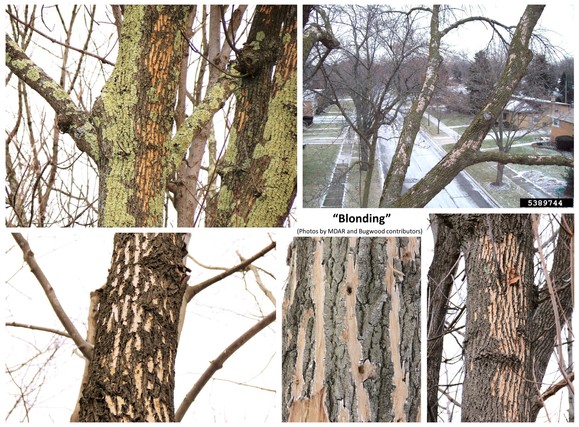 Nuthatches, Downy, and Hairy woodpeckers go after the larvae of emerald ash borer, which are feeding and tunneling just under the bark. This "blonding" on ash trees is a very good indication that emerald ash borer is in the tree.
Other things can cause the bark of ash trees to resemble "blonding", like branches of other trees rubbing against the bark. Look for beak holes in the blonded sections.
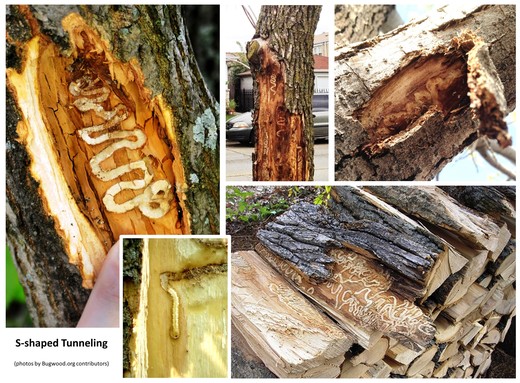
The larvae of emerald ash borer feed and tunnel in the cambium layer of ash trees. They tunnel in a serpentine manner, which is fairly distinctive.
If you see bark cracks in ash trees, peel away some of the bark. If you see galleries that have this serpentine look, it very well could be emerald ash borer.
Emerald ash borer is not the only woodborer of ash trees, so don't be surprised if you see galleries or tunneling in ash trees. Take photos and send to bugwatch@maine.gov.
Woodboring beetles are insects that spend part of their lifecycle inside wood or trees. After pupation, the adult beetle will exit the tree. EAB adult beetles exit ash trees leaving D-shaped holes behind.
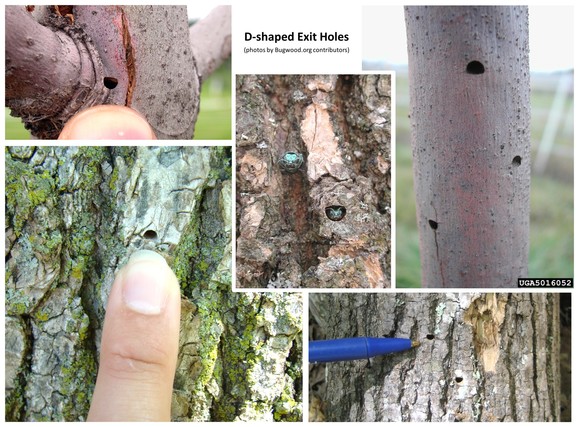 EAB adults start to exit from trees when the growing degree days reach approximately 450. In Maine, that won't occur until sometime in June. But you may notice exit holes from previous years.
EAB exit holes are small and D-shaped, and more clearly seen on younger ash trees. If you think you have EAB exit holes, take photos and email to bugwatch@maine.gov.
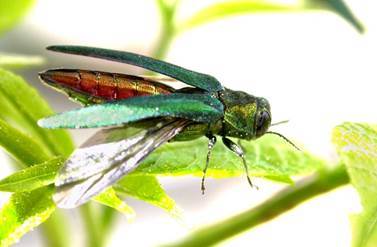
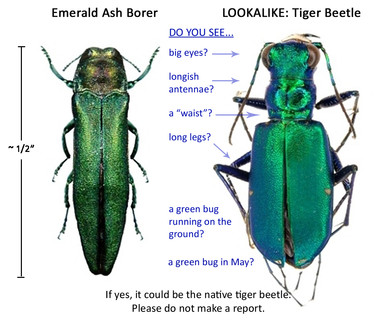
Emerald ash borer is a very small beetle, only about 1/2 of an inch. When it emerges from ash trees sometime in June, it will spend much of its time flying around ash tree canopies. Adult EAB are not easily seen.
In May, another brilliant green beetle can be seen, oftentimes scurrying along the ground. This is usually the tiger beetle, which is native and considered beneficial as it feeds on other arthropods. If you see a green beetle in May, especially one that is on the ground, it is likely the tiger beetle.
What you can do to slow the spread of emerald ash borer:
In addition to being aware and reporting signs of emerald ash borer, here are other things you can do to slow the spread of this destructive invasive insect:
Questions/Comments? Contact us!
Email: bugwatch@maine.gov
Facebook - Twitter
|