Nature Note

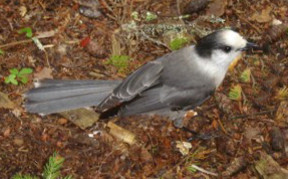
Gray Jay photo and topic idea courtesy of Paul Johnson. Taken at the Warden Camp in the Allagash Wilderness Waterway between Round Pond and Chamberlain Lake.
The Gray Jay (Perisoreus canadensis) is a highly inquisitive and resourceful bird. It lives year-round in northern forests and survives, in part, by not being a picky eater. Gray Jays eat berries, seeds, insects, fungi, small animals, carrion, and have even been known to eat blood-filled ticks off the backs of moose!
The Gray Jay stores food during the summer for feeding on during the winter. This is especially important because Gray Jays raise their young during the late winter and must have plenty of food on-hand to keep both themselves and their young warm, fed and healthy.
High-energy food, plus very thick layers of feathers help the Gray Jays stay warm throughout brutally cold northern winters. The female jay keeps the eggs and chicks warm in below-zero temperatures by sitting the nest and warming it with her body heat. The male brings food to the female so she can remain on the nest.
Look for these birds among spruce trees when hiking the boreal forests of Maine. Often, the Grey Jays will find you first - especially if you break for lunch on trail or are getting set-up at a campsite. So be sure to secure your food or you'll have a feathery "camp robber" join your mealtime. Mention Grey Jays to Mainers and north woods hikers and you'll be sure to get some great stories.
Gray Jays made an impression on Henry David Thoreau when he visited the Allagash. He included them in his description of his trip across the Mud Pond Carry from Umbazooksus Lake to Chamberlain Lake, “Three large slate-colored birds of the jay genus (Garrulus Canadensis), the Canada jay, moose-bird, meat-bird, or what not, came flitting silently and by degrees toward me, and hopped down the limbs inquisitively to within seven or eight feet. They were more clumsy and not nearly so handsome as the blue-jay.” This quote is from his book, The Maine Woods in the chapter titled “The Allegash and East Branch,” on page 220 of the 1892 Houghton, Mifflin and Co. edition.
Interesting Facts:
- Its official common name, as of 2018 by the American Ornithological Society, is the Canada Jay. Other common names include Gorbies and Camp Robber. And, some of us who grew up calling them Gray Jays continue to do so!
- Gray Jays have a special sticky saliva that acts as a glue to hold the small bits of food they store high in tree crevices, behind bark, or in globs among conifer needles.
- Gray Jays can live more than 15 years. Mated pairs stay together for life on one territory.
Activities for Children & the Young at Heart
- What common name do you like best for the Gray Jay? Why?
- If you had sticky saliva what would you use it to do?
-
Look at the Allagash Guide & Map. Can you find Umbazooksus Lake, Mud Pond, and Chamberlain Lake? Try drawing a section of this map and mark where you would like to visit. Or, make a map of your yard or town labeled with the favorite places you like to visit there.
Share Nature Note with your friends, family, teachers, scouts, and anyone you think might be interested. Here is how they can sign up for a free subscription:
Write to me if you have a plant or animal that you'd like covered in a Nature Note. Send an email by using the link below. Be sure to put Nature Note in the subject line.
- Jocelyn Hubbell, Interpretive Specialist, Maine Bureau of Parks and Lands.
|